



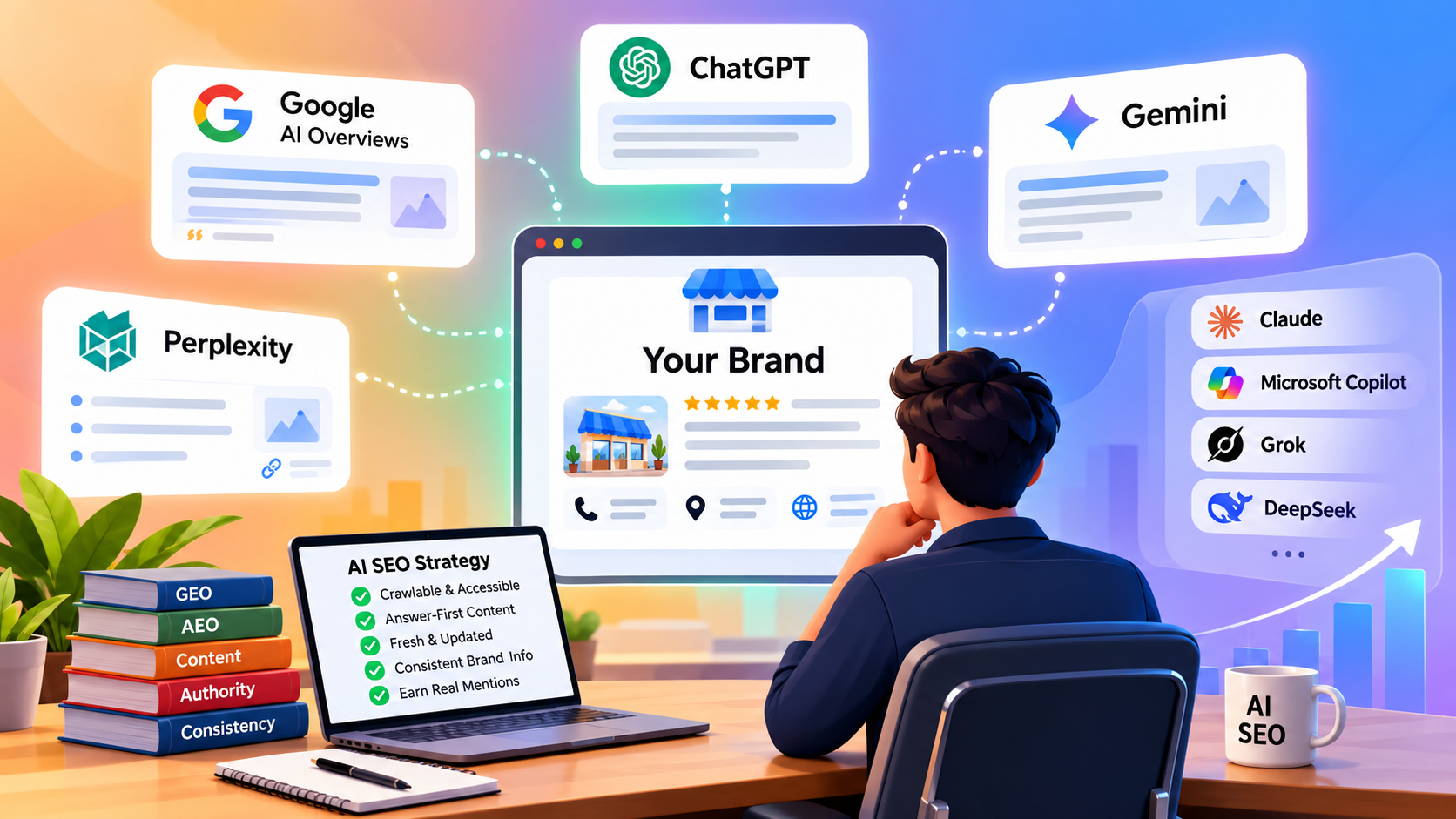
A few years ago, “search” mostly meant one box on one website. Today a customer might ask ChatGPT in the morning, Perplexity at lunch and Google’s AI Mode in the evening, and each one may tell a slightly different story about your business. That is why AI SEO has become less about a single ranking and more about being consistent everywhere. In this guide, Sarkar SEO answers the questions we hear most about optimizing for more than one AI engine at a time.
How many AI search engines do I actually need to care about?
More than you might expect. One 2026 industry roundup counted eight conversational engines in regular use: ChatGPT, Gemini, Perplexity, Claude, Microsoft Copilot, Grok, DeepSeek and Google’s AI Mode, with Google’s AI Overviews appearing as a separate surface on the results page.
You do not need a separate strategy for each. Most owners should watch three or four where their customers are most active, then build one solid foundation. That is the approach Sarkar SEO takes with AI SEO: a shared base, with small adjustments where a platform behaves differently.
Do all AI engines find information the same way?
No, and this is where many campaigns go wrong. Each tool combines its own model with its own sources, and those sources change over time.
- Google AI Overviews and AI Mode begin with Google’s index and ranking systems, then use a language model to write the answer. Strong classic SEO is the entry ticket here.
- ChatGPT search has been reported to draw partly on Bing’s index, which is why Bing Webmaster Tools deserves attention alongside Google Search Console.
- Perplexity shows its sources openly and tends to favor pages with current information and clear update signals.
These details can shift without notice, so treat them as a guide, not a rulebook. What stays steady is the pattern: be crawlable, be clear, be trusted.
Where do AI tools get their opinions about a brand?
Not only from your website. Reports on Google AI Overviews show citations spread across places such as Reddit, YouTube, Quora and LinkedIn, and one analysis of AI Mode noted that YouTube is pulled in often.
For a business, that means your reputation is built in many rooms at once. A helpful answer in a forum, a clear explainer video and a thoughtful LinkedIn post can all shape what an AI tool says about you. Sarkar SEO encourages clients to treat these channels as part of SEO, not as separate social media chores. The key is to be genuinely useful and never to fake participation, because real conversations are what these systems learn from.
What is the difference between GEO and AEO across these platforms?
GEO, or Generative Engine Optimization, focuses on being included in answers that AI writes. AEO, or Answer Engine Optimization, focuses on being the precise reply to a specific question. Both belong in any serious AI SEO plan, and both apply to every platform.
A useful way to think about it: GEO decides whether the engine knows you, and AEO decides whether it can quote you. A brand with strong GEO but muddy pages gets mentioned vaguely. A brand with crisp answers but no outside reputation rarely gets chosen. Sarkar SEO builds both together, since each one makes the other work harder.
Is there one plan that works on every engine?
Yes, and good AI SEO is simpler than the hype suggests. Practitioners across the industry say the overlap with classic SEO is around 80%, and reviews of what correlates with citations keep returning to the same inputs: content that can be retrieved, clear answers, authority and freshness.
Here is the shared plan we use at Sarkar SEO:
- Make pages reachable. Check indexing, plain HTML text and your robots.txt file for the crawlers you want.
- Answer first. Place a short, direct reply under each question heading, then add depth.
- Keep facts fresh. Update numbers, dates and offers, and show when a page was last reviewed.
- Stay consistent. Use the same business name, services and details across the web.
- Earn real mentions. Contribute expertise in reputable places your customers read and watch.
Why do the answers differ from one tool to the next?
Because each engine uses different sources, different wording and different moments in time. Ask the same question on two platforms, or twice on the same one, and you may see different brands. That is normal, and it is why one screenshot proves very little.
The better habit is to look for patterns. Run the same set of customer questions each month, write down which brands appear and which pages are cited, and watch whether your presence is rising or falling. The team at Sarkar SEO keeps this as a simple running log for clients, because trends tell the truth that single answers cannot.
Should I change my content for each platform?
Usually not. Splitting your content into five versions creates more work and often more confusion. It is better to make one excellent page per question and make sure it is easy to read, easy to quote and easy to trust.
There are two small exceptions. If a platform keeps citing a competitor’s video, consider making your own. And if a platform seems to rely on a specific source, such as a review site, make sure your profile there is complete and accurate. Sarkar SEO makes these tweaks only after the shared foundation is solid.
Can I guarantee a spot on every engine?
No, and anyone promising that is overselling. Models, sources and results change often. What you can control is the quality of your pages, the accessibility of your site, the consistency of your brand and the patience of your process.
Where should I start this week?
Choose ten questions your customers ask before they buy. Test them on three AI tools and note who appears. Then improve your single best page for each question, answer-first and up to date, and test again in a month.
