



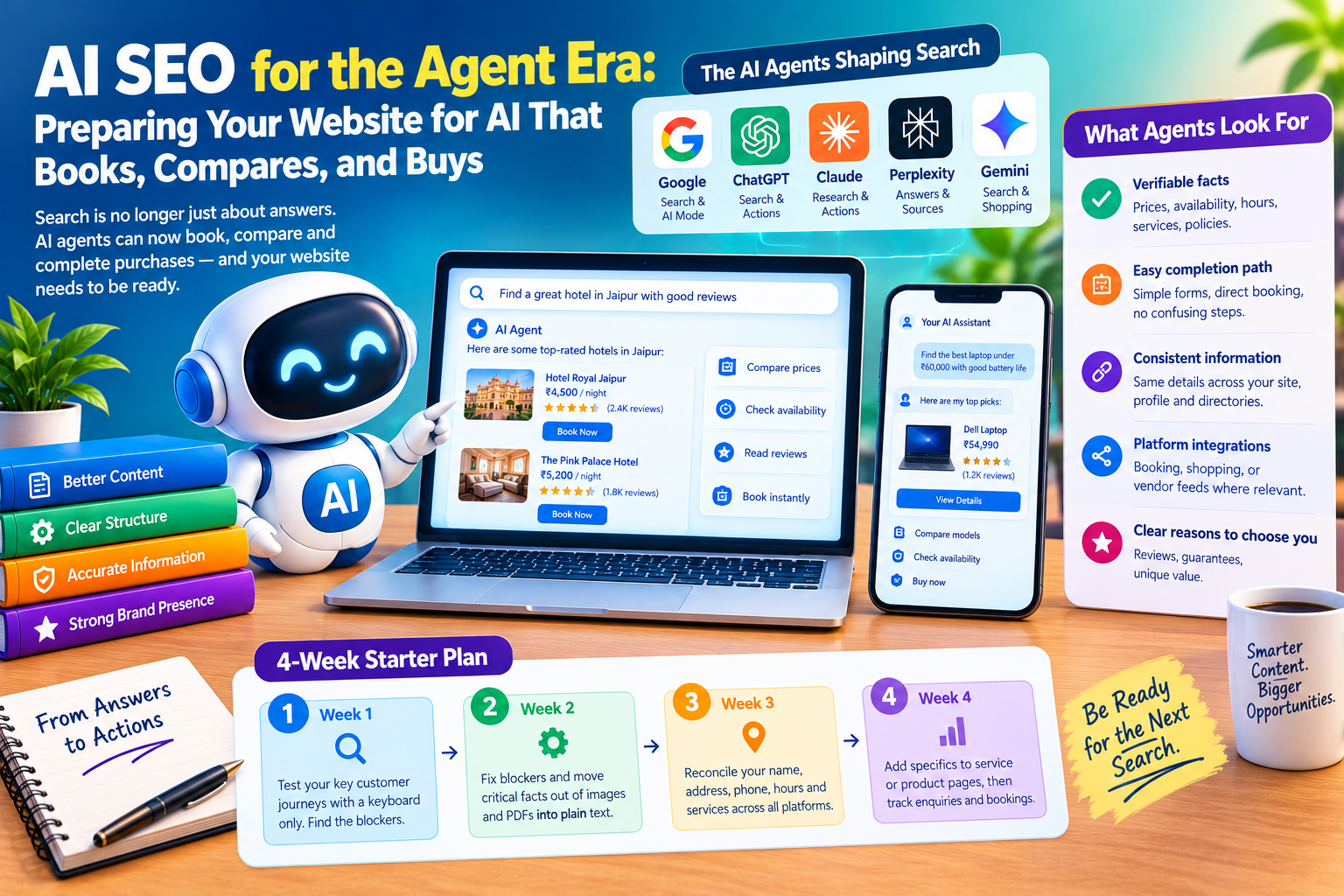
Most AI SEO talk is about getting quoted in an answer. A newer question is arriving: what happens when software does more than answer, and instead completes a task on a customer’s behalf, such as booking a plumber, comparing three suppliers, or filling a basket?
That is agentic search, and it changes what “being found” means. This guide explains what is happening, what is still uncertain, and what to fix on your site now.
From Answers to Actions
An AI answer ends with a paragraph. An agent ends with a result. At Google I/O in May 2026, the company outlined search agents that gather information in the background and expanded booking features. According to one local search publication, Google said it would expand agentic booking for local experiences and services, letting users complete a booking directly with a provider through a Google Search agent, with rollout planned for summer 2026.
Availability depends on region and subscription tier, so check what is live in your market before building plans around it. The direction of travel is clearer than the timetable.
Google’s executives describe a convergence rather than a separate channel. A summary in Search Engine Journal reports that Nick Fox, who oversees Search, Ads, and Commerce, said optimizing for AI search works the same way as optimizing for search. The same article describes the product direction as queries becoming agentic, with tasks completed inside Search and agents browsing on behalf of users. searchenginejournalsearchenginejournal
What an Agent Actually Sees
A human visitor judges a page by layout, images, and tone. An agent reads structure. The same Search Engine Journal piece links Google’s agent-friendly checklist to what agents read when they visit: the accessibility tree, semantic structure, and extractable content. searchenginejournal
This is the useful reframe. Agent readiness is less about a new tactic and more about whether your site is cleanly built. Consider what breaks an agent:
- A booking form made only of unlabeled fields.
- Prices that appear only inside an image.
- Menus that need hover actions to reveal links.
- Pop-ups that block the page before the content loads.
- Key facts such as hours, service areas, or stock status buried in a PDF.
If a person with a screen reader would struggle, an agent probably will too.
The Three Levels of Readiness
A guide from Mastercard’s developer documentation on AI shopping sorts readiness into stages. Its first stage notes that agents access your website the same way humans do, so your existing site is the starting point. A later stage covers adding structured product information and simplifying checkout so assistants work better.
Borrowing that logic, here is a practical version for any business:
Level one: make the current site work. Test your key journeys, such as enquiry, booking, and checkout, using only a keyboard and a screen reader. Fix every dead end.
Level two: make facts explicit. Put prices, availability, opening hours, policies, and service areas in plain on-page text. Where you use markup, make sure it matches what visitors can see.
Level three: connect to platform feeds. Retailers and local businesses have specific channels. One summary of Google’s guide points to Merchant Center structured feeds, an up-to-date Business Profile, and a new Business Agent that lets customers chat with an AI agent on behalf of a store. The same summary notes that a dedicated protocol, the Universal Commerce Protocol, is emerging. Treat these as developing standards and review the official documentation before investing development time.
Local Businesses: Your Profile May Matter More Than Your Homepage
For a restaurant, clinic, or trades business, an agent will often lean on what it can verify quickly. That includes your Business Profile, reviews, and the facts on your site. Make sure these three agree on name, address, phone number, hours, and services. An agent that finds conflicting hours is more likely to skip you than to guess.
Reply to reviews, keep service descriptions specific, and add a simple page for each service you want to be booked for. Vague pages like “our solutions” give an agent nothing to match against a request like “emergency boiler repair tonight.”
E-commerce: Catalog Quality Is the Strategy
For online stores, product data is the foundation. A shopping-focused guide from a review platform argues that agents do not browse visually, and that products need to be made understandable, credible, and visible through catalog structure, reviews, and off-site presence. That source is a vendor selling related software, so treat its framing as one perspective.
The basics are still reliable: complete attributes such as size, material, and compatibility, consistent naming, clear shipping and returns terms, and honest review volume. Gaps in the catalog are the agent-era version of thin content.
Separating Signal From Hype
Be careful with adoption claims. One survey cited by a WordPress publisher says 70% of surveyed brands, retailers, and agencies are testing or running an agentic storefront in 2026. Those respondents come from a vendor’s audience and may not represent small businesses, so do not read it as proof that most customers already use agents.
Likewise, some agencies sell “agentic SEO” as a distinct service. Google’s guide, as summarized by one analyst, says dedicated AI markup and Markdown copies of pages are unnecessary, because AI Mode reads the site through the same index as classic search, with no parallel channels to feed. Ask any vendor which specific change they will make and why it helps a real customer task.
A Four-Week Starter Plan
Week one: Walk through your three most valuable customer journeys with a keyboard only. List every blocker.
Week two: Fix those blockers and move critical facts out of images and PDFs into plain text.
Week three: Reconcile your name, address, phone, hours, and service details across your site, profile, and directories.
Week four: Add specifics to service or product pages, then record a baseline of enquiries and bookings so you can see change later.
Sarkar SEO treats this kind of journey audit as the foundation for AI SEO, because a site an agent cannot operate is a site that loses the sale before a human is even involved. When Sarkar SEO reviews a site, the question is simple: could a stranger, or a machine acting for one, complete the task without help?
