



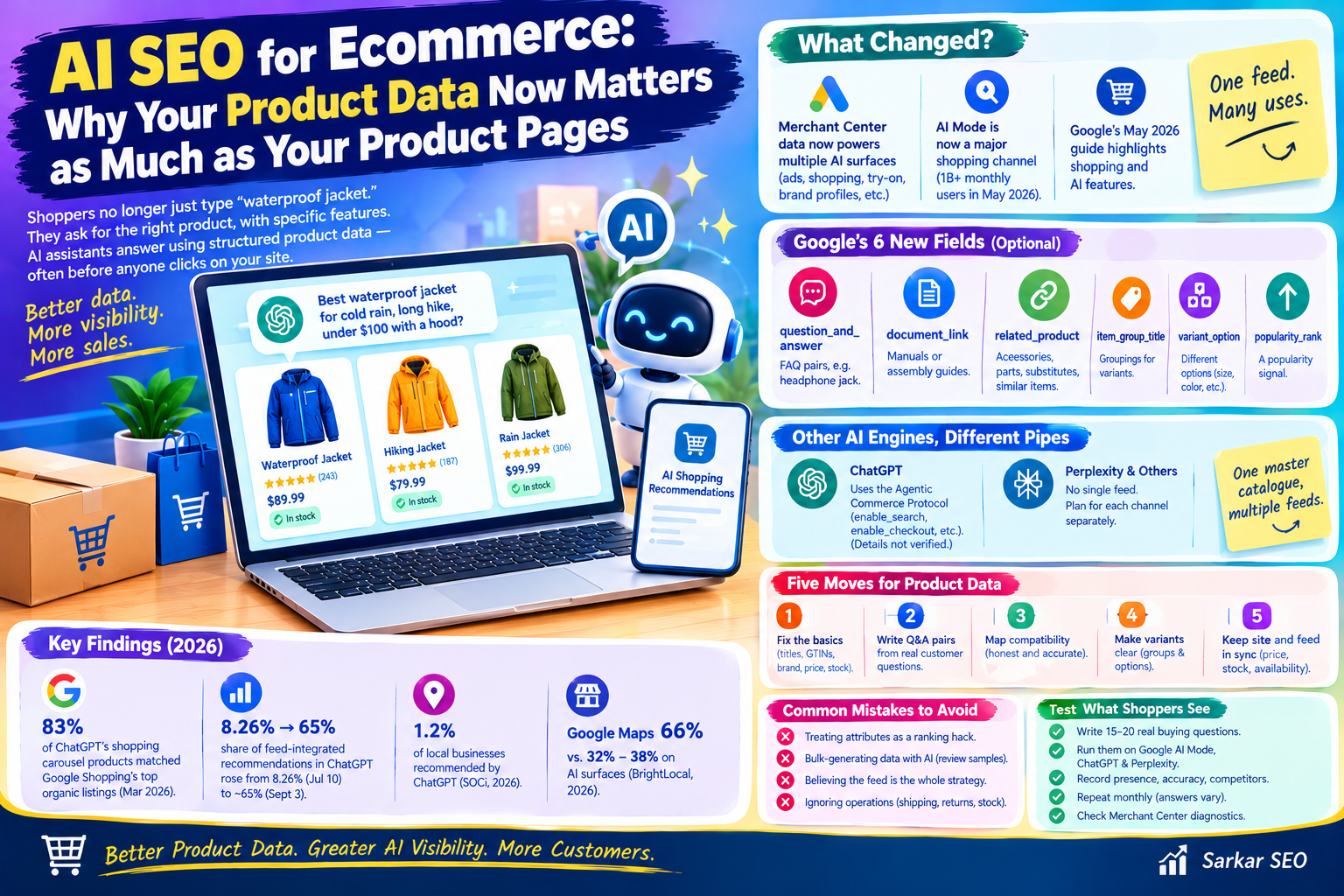
A shopper no longer types “waterproof jacket.” They ask for a jacket that handles cold rain on a long hike, fits a budget, and has a matching hood that won’t blow off. An AI SEO assistant then answers, often from structured product data, before any product page is opened.
For online stores, that makes the product feed a ranking surface in its own right. This article covers what changed, what the evidence supports, and a practical way to prepare.
Your Feed Now Feeds More Than Ads
According to reporting on a Google “Ads Decoded” briefing, Merchant Center product data now supplies AI Mode, Gemini shopping, virtual try-on, Business Agent, brand profiles, and free listings. Sources disagree on whether that makes six or seven surfaces, so I won’t give a number. The direction is consistent: one feed, many uses.
Google’s May 2026 guide to generative AI features also includes shopping guidance, according to summaries of it. And AI Mode itself passed one billion monthly users that month, according to Google’s I/O announcement as relayed by Lengow, a feed-management vendor.
Google’s Six New Fields
At Google Marketing Live in May 2026, Google introduced six optional “conversational attributes” for Merchant Center, per several feed-tool documentation pages:
- question_and_answer: FAQ pairs, such as whether a device has a headphone jack.
- document_link: links to manuals or assembly guides.
- related_product: structured links to accessories, required parts, substitutes, and similar items.
- item_group_title and variant_option: clearer grouping and differences between variants.
- popularity_rank: a popularity signal.
Three details matter. These fields are optional, and their absence does not affect product approval. Google recommends sending them through a supplemental feed. And Google advises against repeating information already in your description, highlights, or product details.
One vendor, dataiads, adds a useful warning: these fields do not make up for an empty title or a wrong GTIN. That is a vendor’s statement, but it matches common sense.
ChatGPT and Others Use Different Pipes
Here the evidence gets thinner. OpenAI has a product feed specification tied to its Agentic Commerce Protocol. Two secondary sources describe controls such as enable_search and enable_checkout, plus refreshes as often as every 15 minutes. I couldn’t verify these against OpenAI’s own documentation.
The sensible takeaway comes from LSEO’s analysis: no single feed is consumed by every AI assistant. Sarkar SEO plans store data for each channel separately, with one clean master catalogue behind them.
Five Moves for Product Data
This is my own checklist, built from the sources above.
- Fix the basics before adding extras.
Accurate titles, GTINs, brands, prices, and stock status come first. Everything else sits on top of them. - Write Q&A pairs from real customer questions.
Mine support tickets, pre-sale chats, return reasons, and reviews. Real questions beat invented ones, and answers must match the product exactly. - Map compatibility honestly.
Declare accessories, required parts, and substitutes only where true. A wrong “required part” link creates bad answers, returns, and distrust. - Make variants unambiguous.
Use consistent group titles and variant options so an assistant doesn’t have to guess differences from titles. - Keep site and feed in lockstep.
Dataiads reports that price and stock mismatches between site and feed can block AI checkout. Treat that as a vendor claim, but mismatches harm trust and conversion anyway.
Product pages still matter. Original photos, honest descriptions, and genuine reviews give assistants and shoppers something to verify. I found no hard evidence ranking these as AI factors, so treat them as sound practice, not proven levers.
Where Stores Go Wrong
Treating attributes as a ranking hack. Nothing I found shows that filling these fields raises visibility on its own. I excluded a vendor’s claim of a 23% revenue lift because I couldn’t verify its method.
Bulk-generating data with AI. Tools can extract missing attributes or draft answers across thousands of SKUs. That’s efficient, but errors scale just as fast. Review samples by hand, and if AI generates titles or descriptions, label them as Google requires for Merchant Center.
Believing the feed is the whole strategy. One analysis argues feed optimization only gets products into the selection pool. Reputation, reviews, and page quality still decide who is recommended once there.
Ignoring operations. An assistant that promises next-day delivery or a compatible part creates real obligations. Keep shipping, returns, and stock data accurate.
A Hypothetical Example
Imagine a store selling coffee equipment. Its grinder listing lacks a compatibility link, so an assistant asked for “a grinder that fits my espresso machine” can’t confirm a match. Adding structured compatibility and two true Q&A pairs gives it something to use. (This is an invented example, not a client result.)
Testing What Shoppers See
Write 15 to 20 real buying questions, with budgets, sizes, and use cases. Run them across Google AI Mode, ChatGPT, and Perplexity, and record whether your products appear, whether details are correct, and which competitors are named. Repeat monthly, because answers vary between runs. Check Merchant Center diagnostics alongside. Vendors report that Google is rolling out a report benchmarking AI-surface performance during 2026, so check whether your account has it.
