



Most AI SEO advice starts on your own pages. Fix the headings, tighten the answers, add the markup. That work matters, but it addresses only half the story. When an assistant describes your brand or recommends a product in your category, it leans heavily on what other people have written about you.
This article looks at the off-site side of AI SEO: which outside sources AI tends to trust, what the evidence says, and how to earn a presence there honestly.
The Evidence, and Its Limits
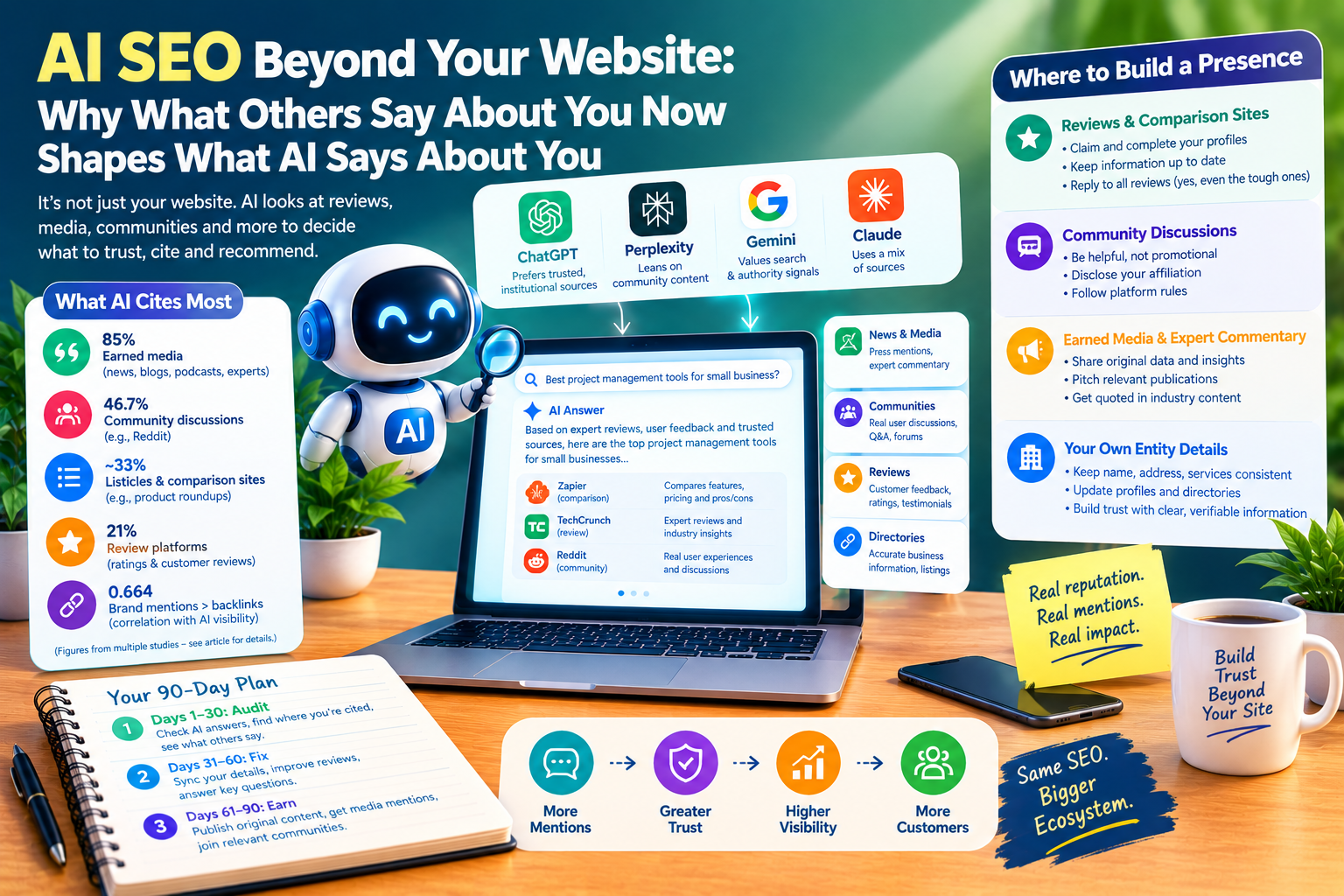
Several large studies point the same way. A Moz analysis of 40,000 AI Mode queries found that eight of the ten most-cited domains were third-party sites. A Muck Rack review of non-paid AI citations reported that roughly 85% originate from earned media sources such as named publications, analyst reports, podcasts and third-party reviews. greenlanemarketingaveri
Another widely quoted figure comes from an Ahrefs study of 75,000 brands. It found that the correlation between branded web mentions and AI visibility is 0.664, while the backlink correlation is just 0.218. In plain terms, brands talked about more often tended to appear in AI answers more often, and mentions tracked visibility better than links did.
Read these with care. Correlation is not proof that mentions cause citations. Many studies come from companies selling AI visibility tools, and methods differ. Percentages vary by dataset and month. The consistent finding, not any single number, is what deserves your trust: third-party presence matters a lot.
Each Assistant Leans on Different Places
Don’t plan as if all AI tools behave alike. Reported patterns differ:
- ChatGPT leans toward encyclopedic and institutional sources. One analysis of 9.6 million queries found Reddit captured nearly one-third of total citations in the dataset, with Wikipedia around 15%. A different audit reported a smaller split, which shows how sensitive these figures are to the method used.
- Perplexity favors community discussion. One compilation says Reddit reaches 46.7% of Perplexity’s top-source citations, against 21.0% on AI Overviews and 8.1% on ChatGPT.
- Google AI Overviews still reward traditional search strength more. One guide notes they weigh classic SEO authority signals more heavily than ChatGPT or Perplexity.
Overlap is limited. The same compilation says only about 11% of domains are cited by both ChatGPT and Perplexity. Being strong on one platform guarantees little on another.
The Part Your Website Still Controls
Before investing off-site, keep proportion. As one analysis cautions, if your site is slow, thin, badly structured or blocked to crawlers, you will not get cited, and no amount of PR fixes that. Think of your website as the entry ticket and third-party presence as the thing that gets you chosen. greenlanemarketing
Where to Build a Presence
Reviews and comparison sites
For commercial queries, listicles and review platforms feature repeatedly in citation studies. Researchers examining more than 1,400 ChatGPT and Perplexity citations for B2B software found that models pulled from third-party listicles, Reddit threads and review platforms.
Claim your profile on the two or three review sites your buyers actually use. Fill every field, keep descriptions current and reply to reviews, including critical ones. A thoughtful reply to a complaint is evidence of how you operate.
Community discussions
Questions like “has anyone tried this?” attract answers that AI systems treat as real-world validation. The honest way in is to be useful: answer questions in your area of expertise, disclose your affiliation and don’t pitch. Never create fake accounts or coordinated praise. It violates platform rules, damages trust when exposed, and Google’s own guidance lists manufactured mentions among tactics to skip.
Earned media and expert commentary
Journalists, podcasters and industry newsletters look for specific, quotable material. One agency article argues that a single original data study can earn mentions across ten or twenty independent publications. That is a claim, not a guarantee, but the logic holds: original findings give others a reason to cite you.
Your own entity details
Check that your company description, founding details, location, leadership and service list read the same everywhere. One source warns that content with inconsistent or unverified entity signals will be retrieved but not cited, because the system can’t confidently attribute the information. Auditing these details is cheap, and Sarkar SEO often starts here because inconsistencies are easy to find and fix.
A Lesson From Contradictions
One study-based guide notes that AI models can flag contradictions between what a brand says and what third parties say. If your homepage claims “industry-leading support” but reviews describe slow replies, the outside view usually wins. Off-site work therefore starts with the product, service and customer experience, not with promotion.
A Realistic 90-Day Plan
Days 1 to 30: Audit. Run 20 questions your buyers ask in several assistants. Record which outside domains get cited, which competitors appear, and how your brand is described. A spreadsheet is enough.
Days 31 to 60: Fix the basics. Correct inconsistent details, complete review profiles, and answer outstanding reviews. Identify the three outside pages cited most often in your category.
Days 61 to 90: Earn, don’t buy. Publish one piece of original research, offer an expert comment to relevant publications, and contribute helpfully to one community where your customers already ask questions. Sarkar SEO recommends picking only two or three channels at first, since scattered effort rarely builds a recognizable reputation.
Then re-run the same 20 questions and compare.
Common Mistakes
- Treating mentions as a link-building clone. The aim is accurate, positive, relevant context, not volume.
- Ignoring negative coverage. Address root causes and respond openly.
- Measuring too soon. Reputation compounds slowly, and AI answers vary between runs.
- Chasing every platform. Follow the citations in your own category, not a generic list.
