



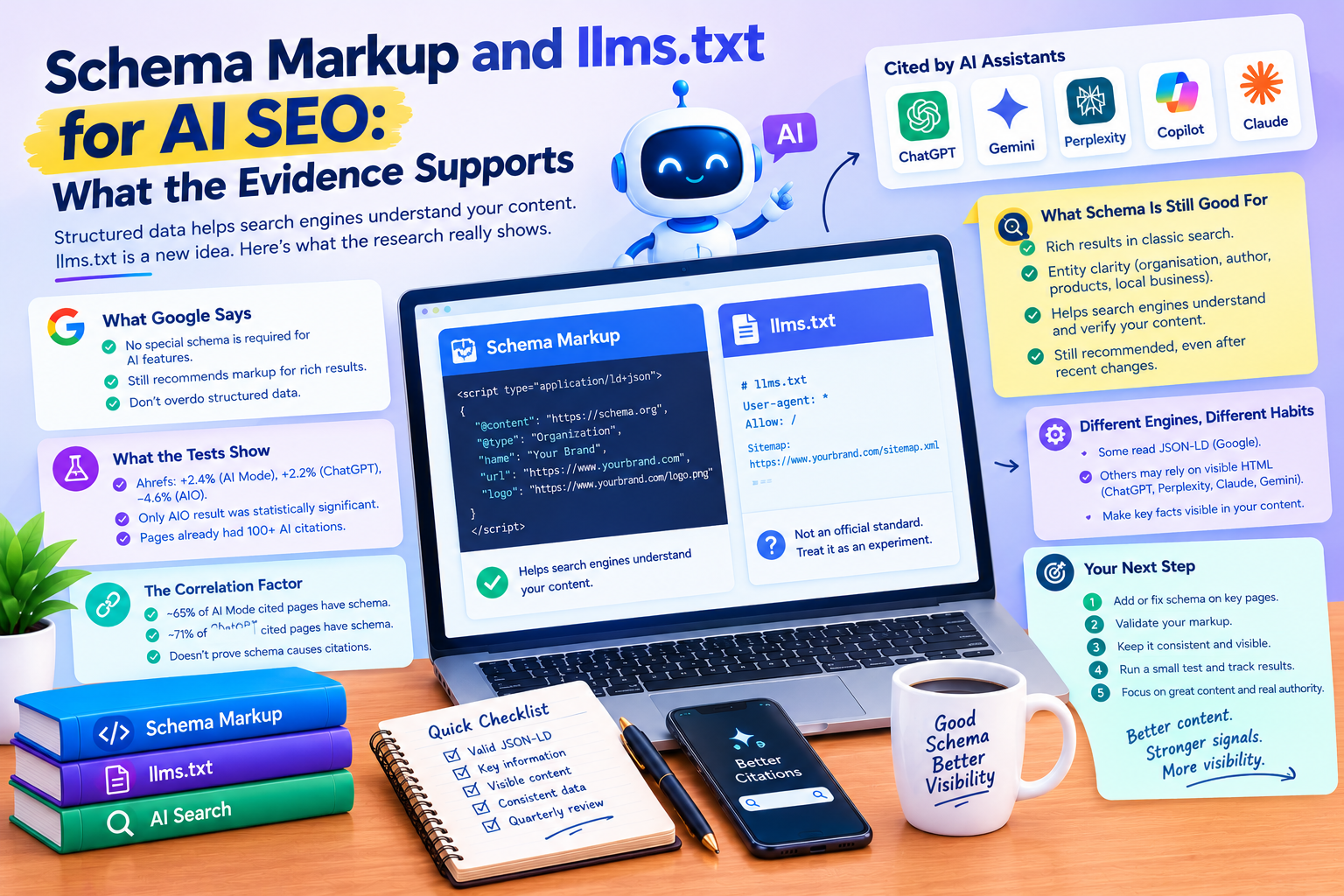
Few topics in AI SEO attract more confident claims than structured data. Some vendors imply that adding the right code makes ChatGPT and Google cite you. Others say schema is now pointless. Both camps overreach. At Sarkar SEO, we prefer to separate what is documented from what is merely repeated, so here is where the evidence stands.
What Google Has Actually Said
Google’s guidance on its generative AI features says structured data is not required for them and that no special schema.org markup needs to be added. A review of the guidance adds that it warns publishers about overfocusing on structured data. Google still recommends markup as part of overall SEO because supported markup can make a page eligible for rich results. strategicrevenuepixis
So the official position is neither “schema is a hack” nor “schema is useless”. It is “keep doing it for its normal purposes, but do not expect a separate AI switch”.
The Controlled Test
The strongest evidence so far is an Ahrefs experiment, as summarised by others. After adding JSON-LD, citation changes were +2.4% in Google AI Mode, +2.2% in ChatGPT and −4.6% in Google AI Overviews. The same summary states that only the AI Overviews result was statistically significant, and it ran against the schema pitch. thrivestackthrivestack
There is an important limit. Every page in that dataset already had 100+ AI Overview citations before schema was added, so the test shows schema did not push already-visible pages higher. It did not test whether schema helps a page that AI systems have never surfaced. Treat it as one study, not a final verdict.
Why Cited Pages Often Have Schema Anyway
You will also see statistics like approximately 65% of pages cited by Google’s AI Mode and 71% of pages cited by ChatGPT include structured data. That sounds persuasive, but it is a correlation. As one critic of this reasoning notes, there is certainly evidence that schema and AI citations are correlated, but that does not mean schema is causing the citations. Strong, well-run sites tend to have good markup and the authority that earns citations, so the two travel together. embarquestrategicrevenue
The same applies to popular statistics promising enormous gains from FAQ markup. One technical reference calls a claimed 112% increase in AI citations from FAQ schema the most repeated number in this market, and says it is unsupported. Ask any vendor quoting such a figure for the method behind it. it
What Schema Is Still Good For
Markup remains worth doing, for reasons that are real and modest.
- Rich results. Eligible pages can gain enhanced listings in classic search.
- Understanding. One review lists Google and Bing as confirmed to use structured data to understand content, with Bing’s Fabrice Canel cited as stating so on stage.
- Entity clarity. Marking up your organisation, authors and products reduces guesswork about who you are.
- Reliability. Google said it was not abandoning schema even after retiring several types. One article reports that Google retired seven structured-data types in January 2026, so review which of your types are still supported.
A fair summary from one source: structured data is not an AI-visibility lever, and it is not obsolete.
What Other AI Platforms Do
This is where evidence thins. One source reports that OpenAI’s documentation of its crawlers says nothing about structured data, and neither do Anthropic’s or Perplexity’s. Another article asserts that ChatGPT, Perplexity, Claude and Gemini read visible HTML but ignore JSON-LD, while Google’s own AI surfaces do read it. I could not verify that claim independently, so consider it a hypothesis. It does support a safe habit: make sure your key facts appear in visible text, not only in markup.
A related caution: an implementation detail as small as how you inject the markup decides which AI crawlers ever see it. If your schema is added by JavaScript after the page loads, some bots may miss it.
The llms.txt Question
llms.txt is a proposed file meant to point AI systems to a site’s most useful pages. It is not an official requirement. Google’s guidance, as summarised above, says no AI-specific files or markup exist for its features. Opinions differ beyond that. One analyst calls it worth experimenting with despite its effectiveness remaining unproven. Another says AI search bots do not actually use it as a ranking signal.
A sensible stance: if you create one, treat it as a cheap experiment, spend an hour and not a week, and do not report it to your board as a strategy.
A Practical Schema Checklist
This list is our own working suggestion, not an official standard.
- Mark up what is true and visible. Hidden or schema-only FAQs violate Google’s guidelines and risk having the data ignored.
- Cover the basics. Organisation, author and article details, products, local business details and breadcrumbs, where they apply to your site.
- Validate. Invalid JSON-LD is silently ignored by both search engines and AI crawlers.
- Keep it consistent. Names, addresses and descriptions in markup should match your site and your profiles.
- Render it in the initial HTML when you can.
- Review quarterly, as supported types change.
Run Your Own Test
Since public evidence is thin, a small experiment of your own is more valuable than another opinion. Choose a set of similar pages, such as 20 service or product pages. Add or fix markup on half of them and leave the rest unchanged. Run the same prompts monthly across the AI tools your customers use, and record citations and traffic for both groups. Expect noise, as answers vary between sessions, and do not draw conclusions from one month. Be honest with yourself if the groups look alike.
What to Prioritise Instead
The same sources that doubt schema point toward things with better support: clear visible text, strong entity signals, topical depth and third-party mentions. One reference argues that entity-focused work does more for citations than any single markup block. Fix content quality and clarity first, then add schema as infrastructure.
