



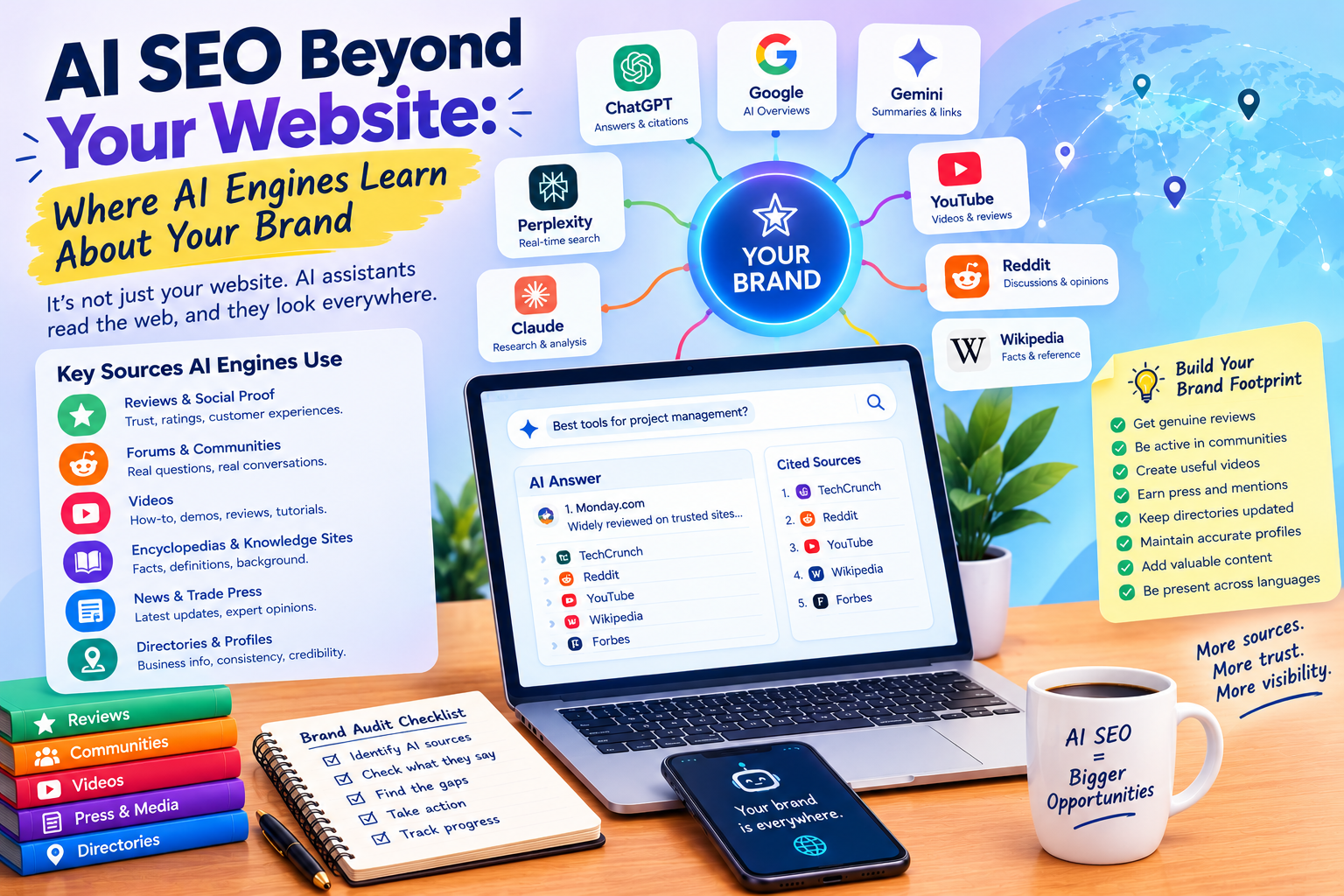
Most AI SEO advice focuses on your own pages. But ask an AI tool to compare vendors in your industry and watch the citations. Many will point to review sites, forums, videos and encyclopedias, not company websites. If those sources describe you poorly, or not at all, no amount of on-page polish fully repairs the gap.
What the Studies Suggest
Several research groups have tried to measure where citations come from. The numbers differ, and that is part of the story, but the direction is consistent.
- Third-party sources dominate branded answers. Omniscient Digital, in a study of 23,387 citations across five engines (as summarized by QuickSEO), reported that most branded citations came from reviews and social proof, while only a small share came from a brand’s own About, FAQ or home pages.
- Reddit is prominent, but its share varies wildly. One analysis puts Reddit near 6.6% of Perplexity citations, while other write-ups put it at roughly 20% to 47% for the same engine. The gap likely reflects different prompt sets and methods, so don’t treat any single percentage as fact.
- Wikipedia leans toward ChatGPT. Multiple sources identify it as one of ChatGPT’s most-cited domains. Conductor’s seven-month analysis found ChatGPT and ChatGPT Search the only Wikipedia-anchored engines in its dataset.
- YouTube matters more than many marketers assume. Conductor found that Google AI Overviews, Perplexity and Gemini frequently led with YouTube. An Ahrefs brand-mention study, reported by Contently, found YouTube mentions correlated strongly with AI appearances. Correlation, not proof of cause.
Almost all of this research comes from vendors with something to sell, so read it as a map of tendencies, not a rulebook.
Why Engines Disagree With Each Other
Qwairy’s study of 118,101 AI answers, summarized by WhiteHat SEO, reported that only about 11% of cited domains overlapped between platforms. A BrightEdge analysis found pairwise source overlap between engines ranging from 16% to 59%. SparkToro and Gumshoe.ai, testing nearly 3,000 identical prompts in January 2026, found that ChatGPT, Google AI and Claude almost never returned the same brand list.
The practical meaning is uncomfortable but useful. Being visible in one engine does not predict visibility in another, and a single “AI ranking” doesn’t exist. Your footprint needs to work across several kinds of sources.
Run a Brand Footprint Audit
You can map your own situation in an afternoon. At Sarkar SEO, we begin from the question “what would an AI system read about this company?” and work backward.
Step 1: Ask the engines. Enter 10 to 15 neutral questions about your category, such as “best [service] for [audience]” or “[your brand] vs [competitor].” Record every source cited, not just whether you appeared.
Step 2: Sort the sources. Group them: review platforms, forums, video, encyclopedias, news and trade press, directories, competitor sites and your own pages.
Step 3: Find the pattern. If your category’s answers lean on one or two source types, that is where influence sits. If review sites dominate and you have 12 reviews against a competitor’s 400, you have found your biggest gap.
Step 4: Check accuracy. Compare what the engines say about you with the truth. Wrong pricing, discontinued services and outdated descriptions often trace back to stale third-party pages.
Step 5: Record a baseline. Without it, you can’t tell later whether anything improved.
Strengthen the Footprint Honestly
Once you know the gaps, work on the ones that fit your business.
- Reviews. Ask satisfied customers to describe the problem, the service and the outcome in their own words. Detailed reviews give engines more to quote than star ratings alone. Never buy or fabricate them.
- Communities. If your audience asks questions on forums, answer them helpfully, disclose your affiliation and don’t promote. Genuine, useful participation earns credit. Drive-by promotion gets removed, and sometimes banned.
- Video. A short, clear walkthrough of a common problem can reach engines that favor YouTube. Give it a descriptive title, a transcript and a link back to a fuller written guide.
- Press and expert commentary. Offer data, original findings or informed comment to journalists and trade publications. Independent coverage carries weight that self-published claims don’t.
- Directories and profiles. Keep business listings, LinkedIn pages and industry directories accurate and consistent. They are low glamour but frequently cited.
- Your own site, as a source of truth. Publish clear, specific pages about what you do, who it’s for and how you differ. That gives other sources accurate material to draw on, and gives engines a reliable page to verify against.
- Wikipedia, carefully. Don’t try to write your own entry. Wikipedia requires independent, reliable sources, so the sensible path is earning real coverage first, then letting editors decide.
The Line You Shouldn’t Cross
The temptation is to manufacture mentions: paid fake reviews, sock-puppet forum accounts, planted listicles. Google’s published guidance on generative AI features warns that seeking inauthentic mentions may be treated as spam, and notes that AI systems can distinguish real mentions from fake ones. Beyond the risk of penalty, a hollow footprint falls apart the moment a real customer compares notes. Build the kind of presence you would be comfortable having audited.
Setting Realistic Expectations
Off-site work moves slowly. Reviews accumulate over months, press coverage depends on having something worth covering and community trust can’t be rushed. The payoff is also harder to attribute. Expect to see progress first in your prompt tests and branded search, and only later in leads.
Keep your measurements simple: how many engines mention you, which sources they cite, whether the descriptions are accurate and whether the gap against named competitors is narrowing.
