



Almost every marketing team now uses AI to draft, outline or edit. At the same time, the goal of AI SEO is to appear in answers produced by AI. That creates an awkward question: if you use AI to create the content that AI then evaluates, are you helping yourself or setting a trap?
The honest answer is that the tool matters far less than the way you use it. This guide covers what Google actually says, where the real risks sit, and a workflow that uses AI without producing the kind of pages that damage a site.
What Google Says About AI-Written Content
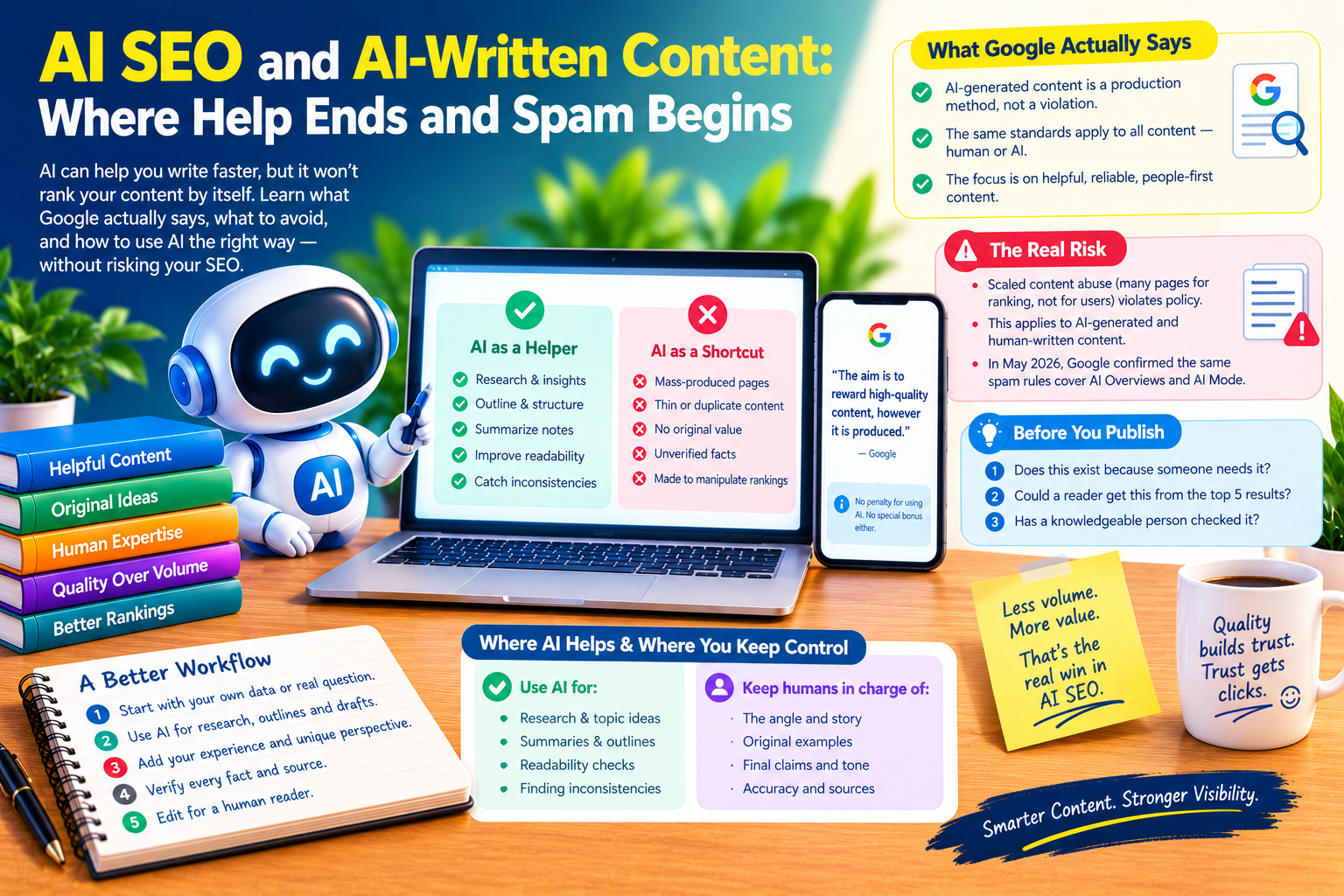
The position has been steady and is often misreported. Google’s guidance holds that how a page is produced matters less than whether it is helpful. One summary quotes it as saying the aim is rewarding high-quality content, however it is produced, and that using AI gives content no special gains.
Two practical points follow. There is no penalty for using AI as such, and there is no bonus either. A page written by a model is judged by the same standard as any other. As one small-business guide puts it, AI can absolutely rank; it just gets no head start for being AI.
The Real Risk: Scaled Content Abuse
The danger lies in volume without value. Google’s spam policy targets many pages generated for the primary purpose of manipulating search rankings and not helping users. The same source notes that this applies no matter how it’s created, so human-written content farms are covered too. Among the examples Google lists is using generative AI tools to generate many pages without adding value for users. Big content guides without breaking Google’s scaled content policy +2
The policy is not new. It was announced in March 2024 alongside a core update. What has changed is its reach. One report says Google confirmed in May 2026 that these spam rules now cover AI Overviews and AI Mode as well.
A trap specific to AI SEO
Here is a risk many AI SEO guides miss. Google’s AI features use a technique that breaks a question into related sub-questions. It is tempting to build a separate page for every variation. One analysis of Google’s May 2026 guidance warns that building pages for every fan-out query variation primarily to manipulate rankings or AI answers violates the scaled content abuse policy. eseospace
The fix is the opposite of volume. Cover related questions inside one strong page, and create a new page only when it deserves to exist on its own.
Three Questions to Ask Before Publishing Anything
I suggest a short test. If a draft fails any of these, don’t publish it.
- Does this exist because someone needs it, or because a keyword list said so? One guide describes scaled abuse as many pages existing because a keyword list said to create them. A page with a real reader in mind is different.
- Could a reader get this identical text from the first five results? Content that merely restates what’s already available adds nothing. Google’s recent guidance reportedly stresses valuable, unique, non-commodity content.
- Has a knowledgeable person checked every claim? Unreviewed output with factual errors is among the highest-risk categories, according to one compliance guide. Models state invented details with confidence. Responsibility for accuracy sits with you.
A Workflow That Keeps the Benefits
Used well, AI saves hours without lowering quality. A workable division of labor:
Use AI for: gathering questions people ask, clustering topics, suggesting outlines, summarizing your own interview notes, checking readability, and catching inconsistencies.
Keep humans in charge of: the angle, the evidence, original examples, the final claims, and the voice.
A practical sequence:
- Start with something only you have. A customer’s question, a test result, internal data or a real project. Without this, the article is generic before it begins.
- Draft with AI if it helps, but feed it your material, not just a keyword.
- Rewrite for experience. Add what you saw, tried or got wrong. Google’s quality guidance emphasizes experience, expertise, authority and trust, though these are quality concepts, not a single ranking switch.
- Verify. Trace each number and name to a source you’ve opened yourself.
- Edit for a person. Cut padding, repeated phrases and filler transitions.
Sarkar SEO uses this approach when reviewing client content, because the failure point is rarely the writing tool. It’s the missing first step: nobody supplied anything original.
What About Disclosure and Detection?
Many people worry about being “caught.” Two clarifications help.
First, detection tools are unreliable as a standard of quality. Google’s own focus is on spam patterns and low value, not the writing tool. One summary of its guidance notes that it says disclosure can be useful where readers would reasonably ask how content was created, particularly when automation substantially generated the material. That is a reader-trust consideration, not a legal requirement in every case. Rules on labeling AI images, audio or video may differ by platform and country, so check the ones that apply to you.
Second, other search engines are watching the same issue. One source says Bing has flagged scaled, low-quality AI content as a concern while staying neutral on AI as a writing aid, and added AI performance reporting to its webmaster tools in February 2026.
Signs Your AI Content Program Needs a Reset
- Dozens of near-identical pages that differ only by a city or product name
- Articles that nobody inside the company could answer questions about
- Declining impressions after a burst of new publishing
- No named author, source or date on informational pages
- Teams measuring output in pages per week, not outcomes
Fixing this usually means merging, rewriting or removing pages. Fewer, stronger pages almost always beat a large pile of thin ones. Sarkar SEO often recommends consolidating before adding anything new.
