



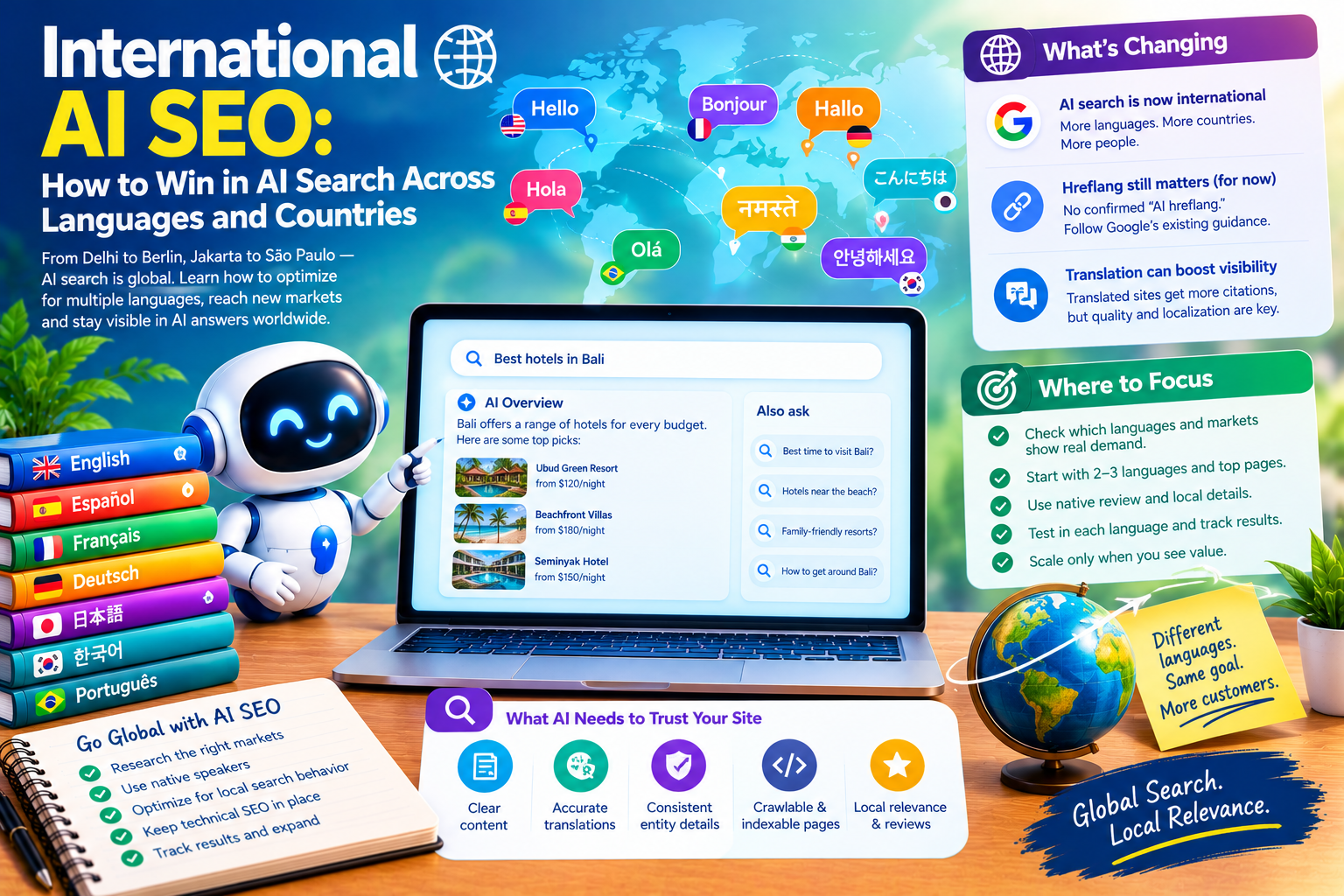
Most AI SEO advice quietly assumes an English-speaking reader in the United States. But if your business serves customers in Delhi, Jakarta, São Paulo, or Berlin, the questions are different. Which language version will an AI answer use? Does your translation help or hurt? And do the usual international SEO tools still apply?
This guide looks at AI SEO through a global lens, separating what is documented from what is still guesswork.
AI Search Is Already International
AI features are no longer limited to English. Google first brought AI Mode to non-English users with Hindi, Japanese, Indonesian, Korean, and Brazilian Portuguese. A later report said Google announced more than 35 new languages and over 40 new countries and territories, bringing AI Mode to more than 200 countries and territories in total. neowintechwyse
The commentary around that expansion is worth noting. One analysis argues that teams that treated non-English SEO as a secondary localization project may face pressure to align content quality and regional relevance sooner. In plain terms, the gap between an interface change and its effect on your overseas visibility is getting shorter.
The Hreflang Question
For years, hreflang annotations told search engines which page version suits which language or region. Does that still matter for AI answers? The honest answer is that nobody outside the vendors knows for certain.
A review of vendor documentation found no documented “AI hreflang,” and no vendor documentation showing that hreflang, the lang attribute, or any other tag controls which language version an AI answer uses. The practical recommendation from that review is to follow Google’s existing international guidance.
Early testing is encouraging but narrow. International SEO consultant Glenn Gabe ran checks across engines and reported that, in the examples he shared, AI Mode returned the correct French URL. That is a small test and not a guarantee. Keep hreflang because it still supports classic search, and do not rely on it as an AI switch.
Another source claims hreflang is less relevant for generative engines because these systems synthesize answers across languages rather than routing users to specific URLs. That is a plausible reading, but it comes from a software vendor and is not confirmed by the engines.
The English-Source Effect
One finding deserves attention if you publish in more than one language. The same vendor article states that a significant percentage of citations in non-English AI Overviews come directly from English-language sources. It gives no figure, so treat it as a hypothesis worth testing on your own queries.
If true for your market, it cuts two ways. A strong English page might be cited to a Spanish speaker, which helps you without extra work. But a local competitor with excellent native content may still beat you where it matters, since your translated page offers nothing the English one does not.
Does Translating Pay Off?
Translation vendors have started publishing data. Weglot, a translation company, analyzed 1.3 million AI citations. A summary on DeepL’s blog reports that translated sites typically earned 24% more total citations per query, including a 16% increase for their original content. The same source also reports a 431% gap in citations between translated and untranslated e-commerce sites. deepldeepl
Both companies sell translation tools, so read these figures as promising but not neutral. They also do not prove that translating causes more citations, since larger sites may translate more often.
Thin Translation Is the Real Risk
Machine translation makes it cheap to launch fifty language versions overnight. That is also the fastest way to create pages no one needs. Google’s guidance on AI-generated material still says to fact-check and review content before publishing, and a translation produced by an AI tool is AI output.
Before you launch a language, ask whether a native speaker would find the page useful rather than merely correct. Localization goes beyond words:
- Examples and references should match local culture, not just local vocabulary.
- Currency, units, and dates should follow local convention.
- Legal and policy details, such as shipping rules, taxes, and returns, must reflect the market you serve.
- Search behavior differs by language, so keyword research should be done in the target language, not translated from English.
Technical Basics That Still Apply
AI visibility rests on the same foundation as traditional search. One guide explains that Google’s crawler usually presents as US-English, so an aggressive automatic redirect can hide your other languages from it entirely. Let people choose their language rather than forcing a redirect by location.
Also confirm that every language version is crawlable and indexable, appears in your sitemap, and links to its counterparts. Hreflang is also easy to break during a site rebuild, so audit it after major changes. If you use structured data, one suggestion is to use Organization markup with the sameAs property to link international profiles. Check that approach against Google’s documentation rather than treating it as required.
A Staged Plan for Going Global
- Pick markets by evidence. Use your analytics and enquiry data to find where demand already exists, rather than translating everything.
- Start with two or three languages and your best-performing pages.
- Use native review. Pay a fluent speaker to edit and add local detail.
- Test in the language. Run a fixed set of target questions in each market’s language and record who is cited. Repeat monthly.
- Expand only where results justify it.
Sarkar SEO takes this evidence-first approach with international projects, because launching in many languages at once usually spreads effort thin. Sarkar SEO also recommends keeping a simple test log per market, since AI answers differ by language and location and one screenshot proves little.
