



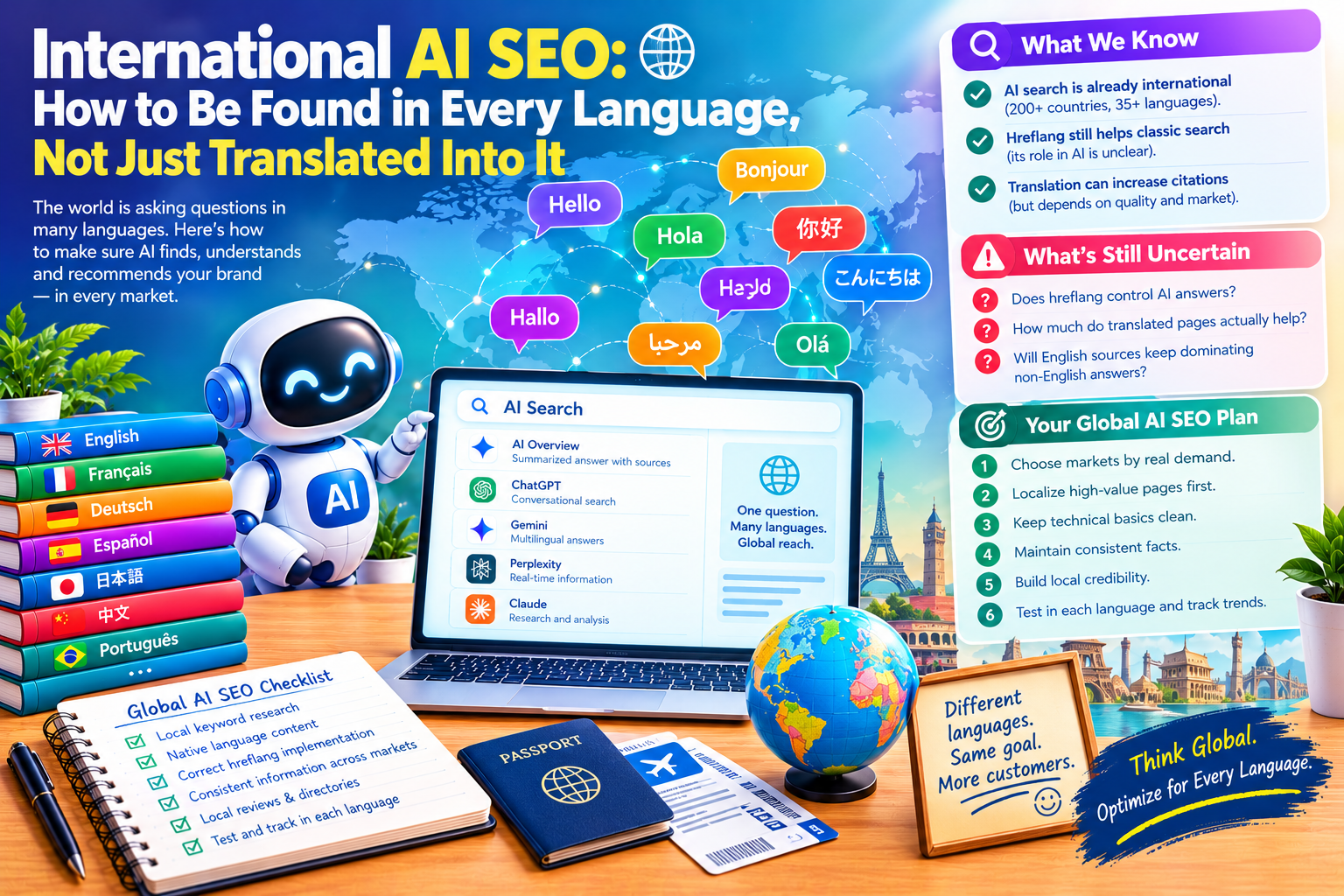
If your audience is worldwide, AI search raises a question that classic international AI SEO never fully had to answer. Traditional search sent each searcher to one URL, chosen by language and country. AI answers blend sources, summarize them and sometimes cross language borders to do it.
So what should a global website actually do? This guide separates what’s established from what’s still argued over, and sets out a practical approach.
Why Language Is Now an AI SEO Issue
AI search is spreading across languages quickly. In a report on Google’s AI Mode, an executive said it reached “many, many countries, in many, many languages” within a few months, because the underlying models are more multilingual by design. Google also said its redesigned Search box would begin rolling out in all countries and languages where AI Mode is available. techwysetechwyse
The practical meaning: markets that once lagged behind English-language search features may no longer lag for long. A brand that treats non-English content as an afterthought risks being compared against competitors who didn’t.
The Debate Over Hreflang
Hreflang is the tag that tells search engines which language or regional version of a page belongs to which audience. Does it still matter? Sources disagree, and the disagreement is instructive.
One camp argues that AI engines synthesize answers across languages rather than routing users to specific URLs, so hreflang matters less for generative results while still keeping classic search organized. The other camp, mostly vendors of multilingual tools, argues that hreflang gives AI systems “semantic confidence” about which regional version is which, and warns that US and UK English pages without it look like near-duplicates. neuronwritermultilipi
Neither claim comes from the search engines’ own documentation, so treat both as hypotheses. One practitioner tested translated pages across Google, Bing, AI Mode and several AI platforms and reported that in the examples he showed, AI Mode returned the correct language URL. That is a small sample, not a rule.
My recommendation is conservative. Keep hreflang implemented correctly because it is low-cost and still supports traditional results. Don’t expect it alone to win AI citations.
What the Language Data Suggests
Some vendor research points to a business case for translation. Weglot reported, based on 1.3 million citations, that translated sites typically earned 24% more total citations per query, including a 16% increase for the original content. The same source cites a 431% citation gap between translated and untranslated e-commerce sites.
Be careful here. Weglot sells translation services, the sample is unclear, and a larger gap may reflect which sites chose to translate rather than translation itself. Still, a direction emerges: having content in a user’s language appears to help, and it may lift visibility of your original pages as well.
A counterpoint comes from an AI-writing tool vendor, which notes that a significant percentage of citations in non-English AI Overviews now come directly from English-language sources. That means English pages can serve non-English queries, but it also means you may be quoted in a language you didn’t write, with less control over the framing.
Translation Is Not Localization
The sharpest warning in the research is about quality. One commentary says that shallow translation can be worse than none, because a poorly localized page signals low expertise. Coverage of Google’s AI Mode likewise draws a sharp distinction between multilingual content and translated content.
What separates them?
- Terminology: Customers in different markets use different words for the same thing. A literal translation of your English keyword may never be searched.
- Examples and proof: Local currencies, regulations, units, case studies and testimonials make a page relevant instead of merely readable.
- Questions asked: People in different regions ask different follow-up questions, which matters because AI answers cover related sub-questions.
- Tone and formality: Business writing norms vary more than most teams expect.
Sarkar SEO regards native review as non-negotiable for any page you expect AI to quote, since a mistranslated claim will be repeated at scale if it gets cited.
A Practical Plan for Global Sites
- Choose markets by evidence, not ambition
Check where your impressions, leads and branded searches already come from. Pick one or two languages with real demand and a team that can review them. Doing three languages well beats ten badly.
- Localize the pages that earn money first
Start with product, service, pricing and support pages. Informational blog content can follow. If a page can’t be properly localized, it may be better left in the source language than published poorly.
- Keep the technical basics clean
Use stable URLs per language, consistent hreflang pairs including return links, correct language attributes, and crawlable content. Avoid auto-redirecting visitors by IP address, which can block crawlers and frustrate people traveling or using VPNs.
- Keep facts identical across versions
If prices, policies or specifications differ between languages without a good reason, AI systems may report conflicting answers. Maintain one source of truth and update every version together.
- Build local credibility
Local reviews, regional directories, local press and community mentions carry weight in each market. A strong English reputation doesn’t automatically transfer. Sarkar SEO suggests auditing each target language separately, because the sources AI trusts in one region may be unknown in another.
- Test in the user’s language
Run your real customer questions in each target language, from that country if possible, across several assistants. Record whether you’re cited, which language the cited page is in, and how the answer describes you. Results vary by run, so repeat monthly and look at trends.
Mistakes to Avoid
- Machine-translating the entire site and publishing it unreviewed
- Assuming the same keywords translate into the same demand
- Treating hreflang as a trick for AI visibility
- Measuring only English-language prompts
- Forgetting the support and legal pages that agents and customers read
