



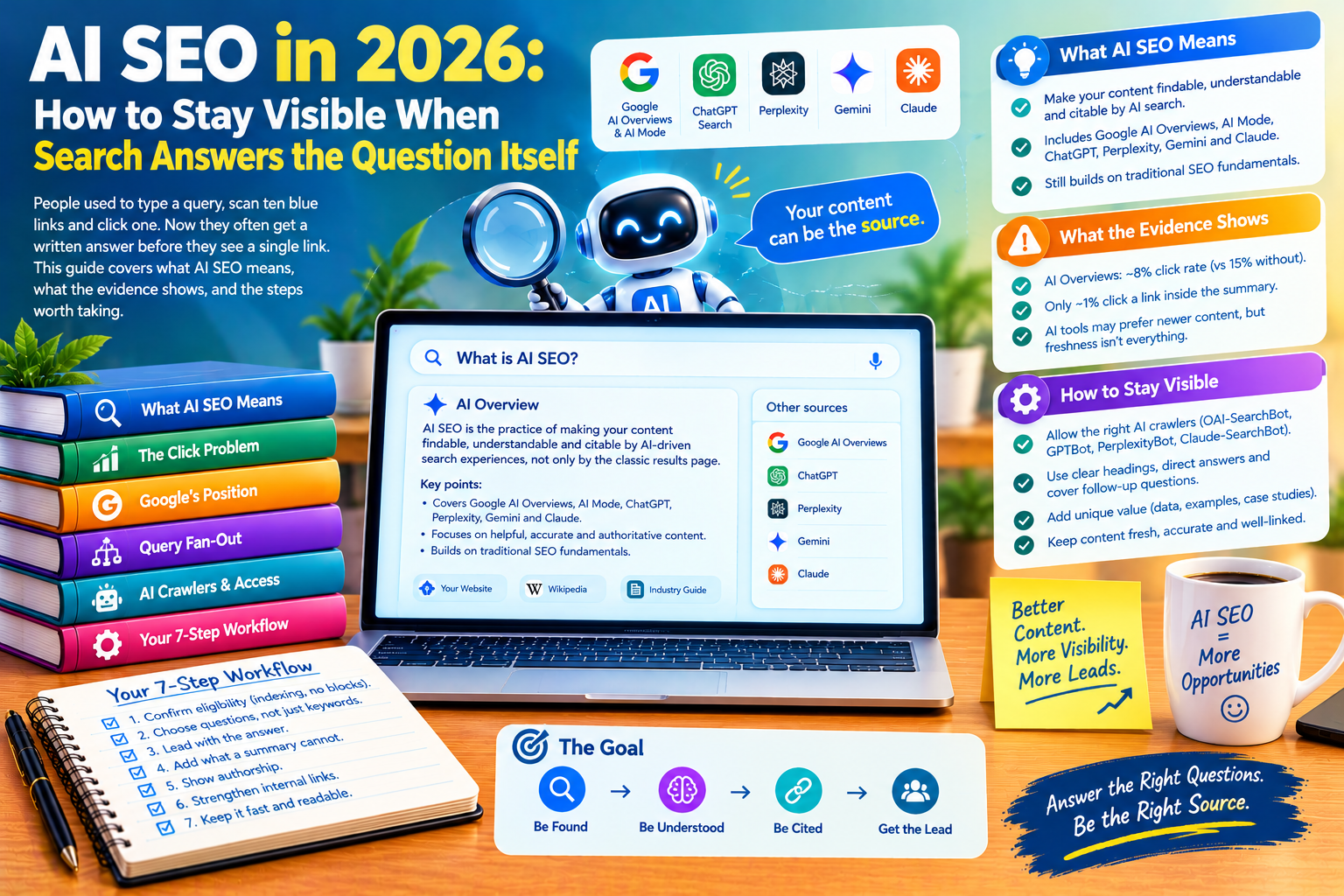
People used to type a query, scan ten blue links and click one. Now they often get a written answer before they see a single link. That shift is why AI SEO has become a serious discipline rather than a buzzword. This guide covers what it means, what the evidence shows, and the steps worth taking. It is based on Google’s own documentation, OpenAI’s crawler documentation and independent research. Sarkar SEO uses the same sources to guide its client work.
What AI SEO actually means
AI SEO is the practice of making your content findable, understandable and citable by AI-driven search experiences, not only by the classic results page. That includes Google’s AI Overviews and AI Mode, ChatGPT search, Perplexity, Gemini and Claude. You will also see it called GEO or AEO. The labels differ, but the goal is the same: when a machine assembles an answer, your page should be one of the sources it trusts.
The click problem is real, but narrower than the headlines
The evidence on clicks is mixed, so be precise about it. A Pew Research Center analysis of 900 US adults in March 2025 found users clicked a traditional result link 8% of the time when an AI Overview appeared, versus 15% when none did. The same study found that only about 1% of searches led to a click on a link inside the summary. yahooyahoo
Two cautions apply. The sample is American and the data is from 2025, so treat it as a directional signal rather than a global constant. Google also disputes the framing, saying that AI features create new opportunities for people to connect with websites. The sensible reading is that informational queries are the most exposed, and your strategy should account for that.
Google’s own position: fundamentals, not tricks
Much AI SEO advice invents secret tactics. Google’s documentation is plainer. Specific optimization isn’t required for AI Overviews and AI Mode, and existing SEO fundamentals remain worthwhile. To appear as a supporting link, a page must be indexed and eligible to show in Search with a snippet. Google also states that no special schema.org structured data is needed.
If a vendor promises a hidden markup trick for AI Overviews, that promise contradicts Google’s published guidance.
Write for the fan-out, not just the keyword
The most useful detail in Google’s guidance is a technique called query fan-out. Both AI Overviews and AI Mode may issue multiple related searches across subtopics and data sources to build a response.
A single question like “how do I do AI SEO?” can quietly become a dozen smaller searches about crawling, content structure, measurement, tools and risks. A page that answers only the headline question competes on one front. A page that covers the neighboring questions competes on all of them.
This is where most competing articles fall short. They define AI SEO, list a few tools and stop. The opportunity is depth on the follow-up questions: what to do first, what to measure, and what to avoid.
Don’t block the crawlers you want
One of the simplest wins is also the most overlooked. OpenAI runs separate crawlers for separate jobs. OAI-SearchBot surfaces sites in ChatGPT search, and a site can allow it while disallowing GPTBot, which relates to model training. The consequence is stated clearly: sites opted out of OAI-SearchBot will not be shown in ChatGPT search answers, though they may still appear as navigational links. openaiopenai
A broad robots.txt rule or firewall setting written to stop scrapers can silently remove you from AI answers. Check this before spending a rupee or dollar on new content.
A practical AI SEO workflow
- Confirm eligibility. Make sure key pages are indexed, return a clean status code and are not blocked by robots.txt or a firewall rule. Verify the site in Search Console.
- Choose questions, not only keywords. For each target topic, list the follow-up questions a curious reader would ask next. Those become your sections.
- Lead each section with the answer. Put a direct two-to-three sentence answer under every heading, then add nuance, examples and caveats. Readers and machines both reward this, since a self-contained passage is easier to quote accurately.
- Add what a summary cannot. Original data, a worked example, a screenshot of your own results or a clear opinion with reasoning gives a reader a reason to click through. Generic explanations are what AI summaries replace first.
- Make authorship visible. Show who wrote the page, their experience and when it was last updated. Do not claim experience you cannot demonstrate.
- Strengthen internal links. Google lists internal linking among the basics, noting that content should be easily findable through internal links on your website. Link related guides together so each page reinforces the topic cluster.
- Keep the page fast and readable. Clean headings, short paragraphs and descriptive link text help human readers first, and parsing second.
