



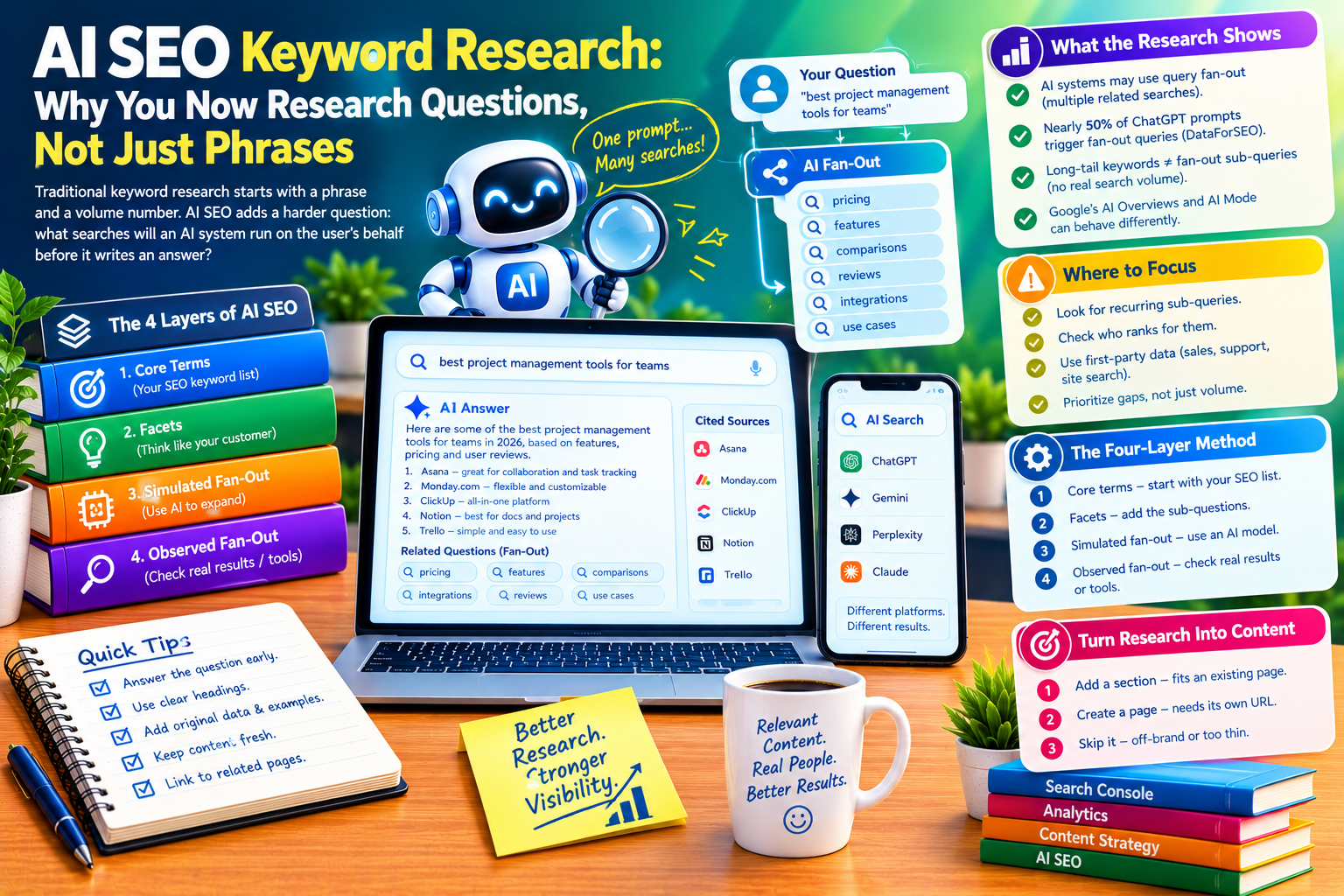
Traditional keyword research starts with a phrase and a volume number. AI SEO adds a harder question: what searches will an AI system run on the user’s behalf before it writes an answer?
Most keyword workflows were built for one person typing one query. That is no longer the only pattern, and this article shows how to adapt your research to it.
The Shift: One Prompt, Many Searches
Google’s documentation says AI Overviews and AI Mode may use “query fan-out,” issuing multiple related searches across subtopics and data sources to build a response. Other answer engines behave similarly. One industry guide defines it as a model breaking a single prompt into sub-queries and recombining the results.
The scale is not trivial. A DataForSEO study of ChatGPT prompts found that nearly half triggered fan-out queries. That is one vendor’s dataset and not a universal figure, but it explains why ranking for the typed phrase alone no longer guarantees you are retrieved.
Consider a prompt such as “I run a small bakery; how should I get more local customers online?” A person would search once or twice. An AI system may separately research local listings, review management, social posting, and paid options. Your page can be cited for any of those sub-questions, even if it never ranked for the original sentence.
Fan-Out Queries Are Not Long-Tail Keywords
A common mistake is treating sub-queries as ordinary long-tail terms. One technical guide points out an important difference: long-tail keywords are phrases real people type, with measurable volume, while fan-out sub-queries are generated by the system and usually have no volume data at all.
So your keyword tool will not show them, and “search volume” is the wrong yardstick. The useful measures are different:
- Recurrence: does the same sub-query appear across many related prompts?
- Winners: which pages currently rank for that sub-query?
- Gap: are you absent where the AI is looking?
This is where Sarkar SEO starts when we assess a topic: with the gaps, not the volumes.
A Four-Layer Method for AI-Era Keyword Research
The following framework is my own working structure, not an industry standard. Treat it as a practical checklist.
Layer 1: Core terms. Start with your normal keyword list from your SEO tools and from Search Console’s Queries report. This foundation still matters, and the Practical Ecommerce guide on fan-out research is explicit that keyword research remains essential.
Layer 2: Facets. For each core term, list the sub-questions a thoughtful buyer would need answered: cost, risks, alternatives, timing, who it suits, what can go wrong. A prompt that bundles several intents is decomposed along exactly these lines.
Layer 3: Simulated fan-out. Ask an AI model to expand your keywords. One published method uploads a keyword file to Gemini and asks for the fan-out subqueries or facets behind each topic, using the “show thinking” view to see the reasoning. The output is a hypothesis, not data. Models produce plausible-sounding questions, and some will never appear in real retrieval.
Layer 4: Observed fan-out. Where possible, check real behavior. Several AI-visibility platforms now log the internal searches that models like ChatGPT run while answering tracked prompts, and a Chrome extension has been used by at least one publisher to view them. Look for sub-queries that recur across many prompts, then check who ranks for them.
Layers 3 and 4 together beat either alone: simulation generates ideas cheaply, and observation tells you which ones are real.
Turning Research Into Content Decisions
Raw lists don’t improve rankings. Decisions do. Sort each discovered sub-query into one of three buckets:
- Add a section. The sub-query is a natural part of an existing page. Extend the page rather than creating a new one.
- Create a page. The sub-query is substantial enough to deserve its own URL, with a clear link back to the parent topic.
- Skip it. It is off-brand, too thin, or something you cannot answer better than others.
Comprehensive coverage remains the most efficient way to capture many sub-queries, according to Surfer’s analysis. But breadth without quality is wasteful. A page that touches ten sub-questions superficially loses to one that answers three of them with real specifics.
Where Your Own Data Beats Everyone’s Tools
Competitor-gap tools show what others already publish. They can’t show what customers actually ask you. Mine these first-party sources:
- Sales call notes and recurring objections
- Support tickets and live chat transcripts
- On-site search logs
- The questions prospects ask before they buy
These reveal the real sub-questions behind a purchase. Few competitors use them, which makes them a quiet source of information gain. If your team keeps sales notes, an hour of reading them will often outperform an hour in a keyword tool.
Mistakes That Waste Budget
Chasing every generated question. Fan-out output can run to dozens of items per topic. Answering all of them produces a bloated site with weak pages.
Dropping classic keywords. Conversational prompts did not replace short queries. Both exist, and most sites need both.
Treating one tool’s list as truth. Coverage differs by AI model, and platforms vary in how many fan-out queries they surface. Cross-check across at least two sources before committing resources.
Skipping intent. A sub-query asking for a comparison needs a comparison table, not an essay. Match the format to the question.
A Short Worked Example
Imagine a project management tool targeting “AI SEO for SaaS.” Layer 1 gives the head term. Layer 2 adds facets such as pricing models, integration with existing content workflows, and how to report results to executives. Layer 3 suggests sub-questions on schema and documentation sites. Layer 4 shows which of those recur. The team then extends two existing pages, writes one new comparison page, and ignores the rest. Three pages touched, not thirty created. (This is a hypothetical illustration, not a client result.)
How to Start This Week
Pick your five most valuable topics. Pull their real queries from Search Console, generate facets with an AI model, and verify the strongest candidates against actual results or an observation tool. Then make three content decisions per topic using the buckets above.
If you’d prefer expert help mapping this for your market, Sarkar SEO builds AI-era keyword and topic maps as part of its AI SEO work, so you invest only in sub-queries worth winning.
