



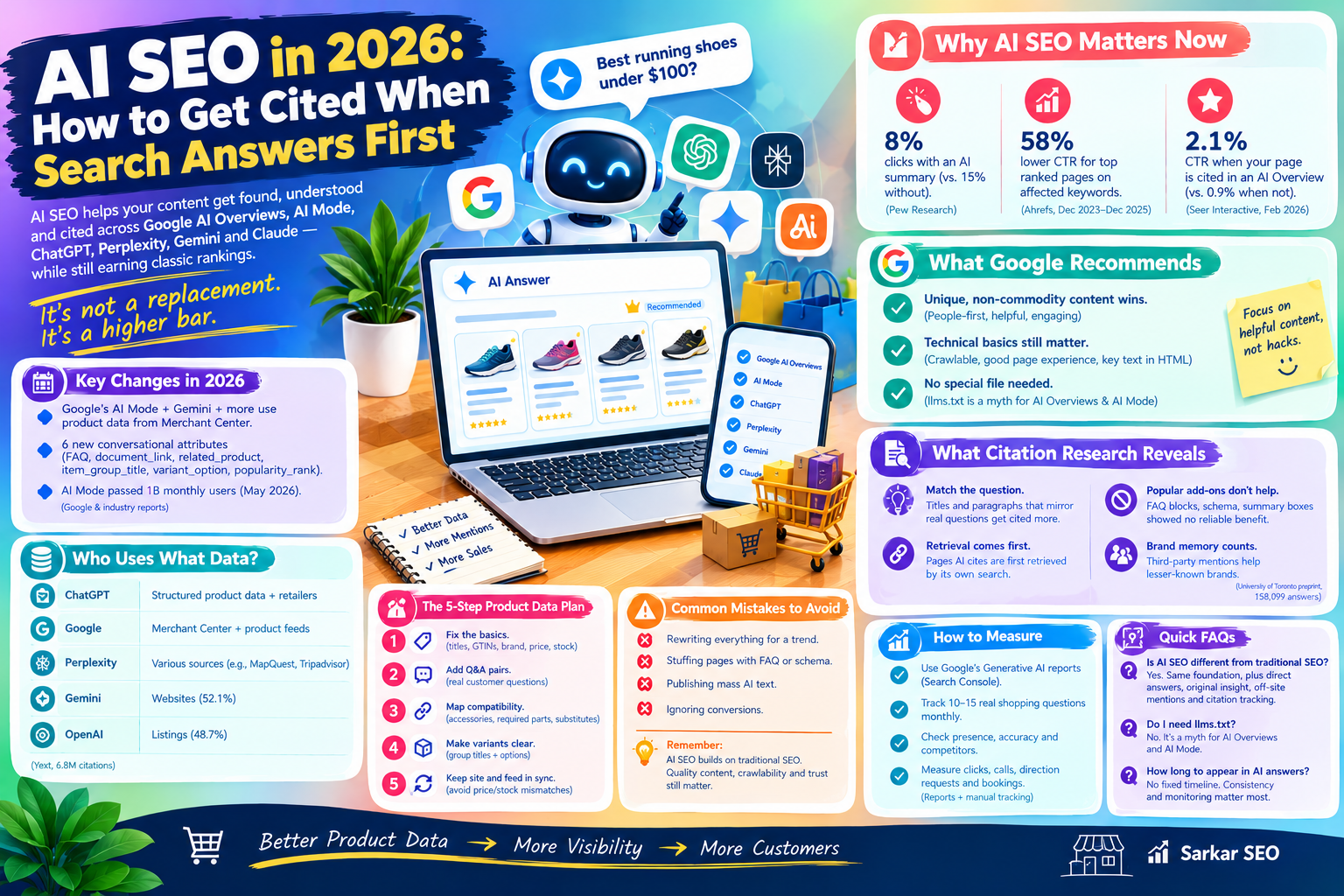
AI SEO is the practice of making your content easy to find, understand and cite across Google AI Overviews, AI Mode, ChatGPT, Perplexity, Gemini and Claude, while still earning classic rankings. It does not replace traditional AI SEO. It raises the bar: your page must be useful enough that a machine quotes it and a person still wants to click.
Why AI SEO Matters Now
Clicks are shrinking. Pew Research tracked 68,000 real searches and found people clicked a result 8% of the time when an AI summary appeared, versus 15% when it did not. Ahrefs compared December 2023 with December 2025 and measured a 58% lower click-through rate for top-ranked pages on affected keywords.
Citation changes the picture. Seer Interactive data, reported by Search Engine Land for February 2026, shows roughly 3.3% click-through with no AI Overview, about 2.1% when your page is cited inside one, and about 0.9% when it is not. Being named in the answer is worth more than double the clicks of being ignored.
Treat these as directional. Studies differ in method and sample, and the numbers keep moving.
What Google Actually Recommends
In May 2026, Google published its first official guide to optimizing for generative AI features in Search. Three messages stand out:
- Unique, non-commodity content matters most. Google says content people find unique, engaging and helpful will outweigh any other suggestion in the guide.
- Technical basics still decide eligibility: crawling allowed in robots.txt and by your CDN, strong internal links, good page experience, and important content available as text.
- Many “AEO” and “GEO” tricks are myths. Analysts reading the guide note that no special file, such as llms.txt, is needed to appear in AI Overviews or AI Mode.
The guide also offers early, openly preliminary advice on AI agents, which means this area will keep changing.
What Citation Research Reveals
Most advice about AI visibility is untested. A University of Toronto preprint studied 158,099 answers and 468,037 citations from ChatGPT, Gemini and Perplexity across two markets. Its findings are worth knowing:
- Matching the question wins. Pages whose titles and paragraphs mirrored the questions people ask were cited more often, even when compared with other pages on the same site.
- Popular add-ons did not hold up. FAQ blocks, structured data, summary boxes and author boxes looked helpful across websites, but showed no reliable benefit within a website. They mostly sat on sites that were already cited more.
- Retrieval comes first. Every page ChatGPT cited was one its own search had retrieved, using sub-queries it rewrites for every answer. Those results rarely matched Google’s top results.
- Brand memory counts. For lesser-known vendors, a third-party page naming the brand greatly raised the odds that an answer mentioned it.
Caveats: this is a preprint, it shows associations rather than proof of cause, and it covers English-language, US-focused questions. Still, it points one way: be the clearest, most relevant answer, and be discussed beyond your own site.
A Practical AI SEO Playbook
- Write for the question, not the keyword. Put the direct answer in the first lines under each heading, then add depth. Use the phrasing real people use. This helps readers and retrieval systems.
- Add information gain. Commodity summaries are what AI already produces. Publish original data, tested processes, real examples and a clear point of view. If a page could have been written by anyone, it gives a model no reason to choose it.
- Earn mentions off your site. Since engines lean on third-party pages, pursue expert commentary, partnerships, industry listings and genuine reviews. At Sarkar SEO, we view brand mentions as part of content strategy, not an afterthought.
- Keep the technical foundation clean. Make sure the crawlers you want can reach you, and keep key text in the HTML. The same study found pages whose main text needed JavaScript received fewer Gemini citations within their own sites.
- Refresh and monitor. Cited sources shift from week to week, so a single check tells you little. Review a fixed set of priority questions monthly across several AI tools, and update pages that slip.
Mistakes to Avoid
- Rewriting everything around a trend. Google’s own guidance treats AI search as an extension of search fundamentals.
- Stuffing pages with FAQ blocks or schema in the hope of a shortcut. The evidence above does not support it.
- Publishing mass-produced, generic AI text. If AI speeds up research or drafting, add human expertise and verification before anything goes live.
- Ignoring conversions. Fewer clicks can still be more valuable clicks, so measure leads and revenue, not only traffic.
How to Measure AI Visibility
Google introduced Generative AI performance reports in Search Console in June 2026, giving site owners a first official view of how pages appear in these features. Pair that with manual prompt tracking: record which questions you test, which brands and pages are cited, and how that changes over time. Segment AI-referred visits in your analytics, accepting that attribution remains imperfect.
Is AI SEO different from traditional SEO? The foundations are shared: quality content, crawlability and trust. AI SEO adds a focus on direct answers, original insight, off-site mentions and citation tracking.
Do I need llms.txt? Analysts reading Google’s guidance say no special file is required for AI Overviews or AI Mode. Other platforms may behave differently, so treat it as optional.
How long does it take to appear in AI answers? There is no fixed timeline. Retrieval changes constantly, so consistent improvement and monitoring matter more than a one-time fix.
