



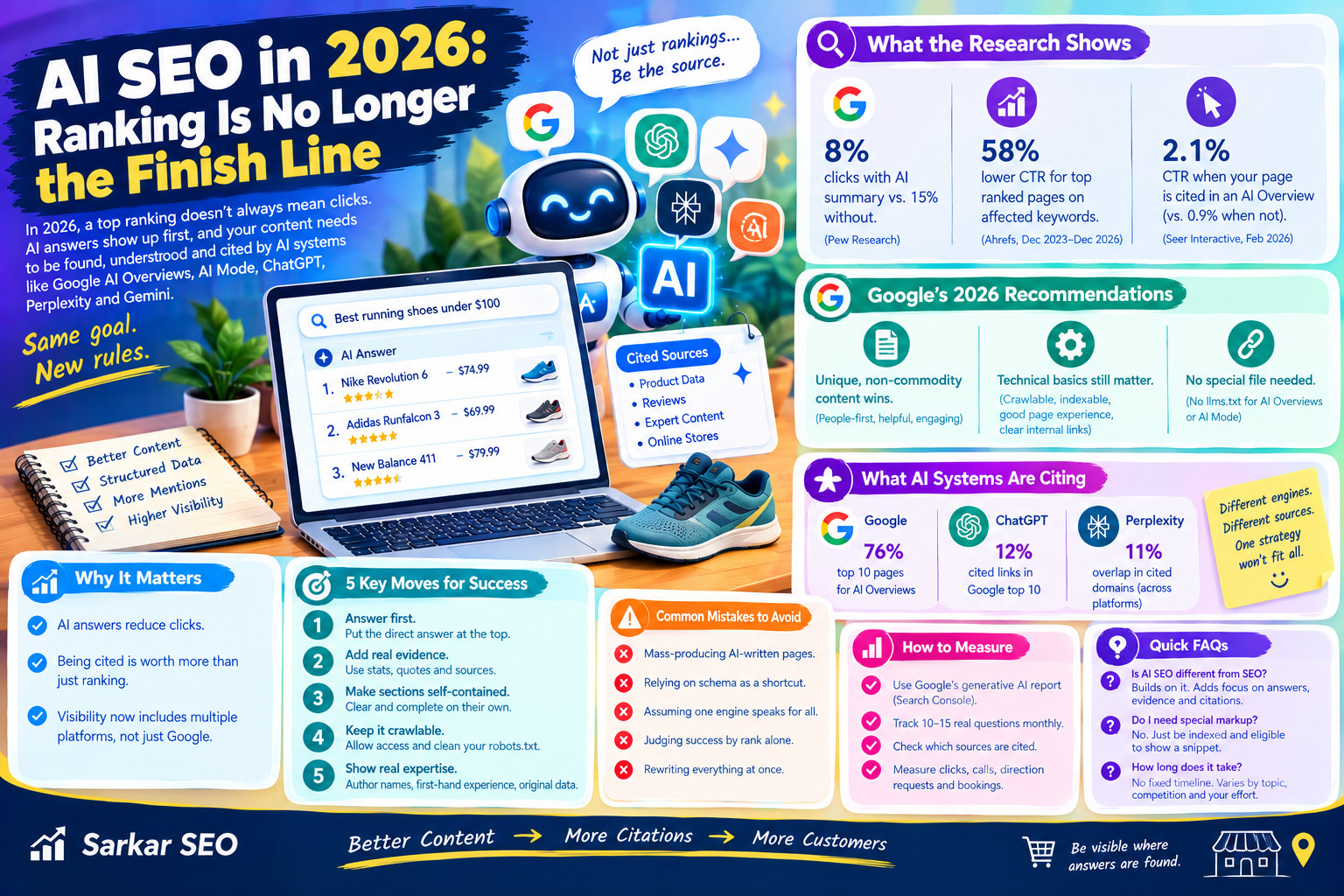
A page can hold the top Google position and still send almost no visitors. That is the uncomfortable reality of search in 2026, and it is why AI SEO has moved from a trend to a working discipline. AI SEO is the practice of making your content easy for Google AI Overviews, AI Mode, ChatGPT, Perplexity and Gemini to find, understand and cite. This guide covers what current research shows and what to do about it.
What AI SEO Actually Means
AI SEO does not replace traditional SEO. Google’s published guidance says there are no special technical requirements for appearing in AI Overviews or AI Mode beyond being indexed and eligible to show a snippet, and no new AI-specific files or markup are needed.
So the real work is quality, structure and measurement. At Sarkar SEO, we describe it simply: classic SEO earns you the right to be considered, and AI SEO decides whether you get quoted.
Why the Click Is Shrinking
Ahrefs analyzed 300,000 keywords and found that AI Overviews correlate with a 58% lower click-through rate for the top-ranking page, comparing December 2023 with December 2025. Position two lost about half its clicks, and even position ten lost nearly a fifth.
Seer Interactive’s data adds a useful detail. Searches without an AI Overview averaged about 3.3% organic CTR. When an overview appeared, cited pages averaged about 2.1%, while uncited pages sat near 0.9%.
The lesson is practical: appearing inside the answer is worth more than appearing beneath it.
Being Read Is Not the Same as Being Cited
AI systems crawl far more than they credit. AirOps studied 548,534 pages that ChatGPT retrieved across 15,000 prompts, as reported by Search Engine Land, and found only 15% were cited in the final answer. Pages ranking first on Google were cited about 3.5 times more often than pages outside the top 20, so authority still matters, but it does not guarantee a mention.
Each engine behaves differently. Ahrefs found that only about 12% of links cited by ChatGPT, Gemini and Copilot appeared in Google’s top 10 for the same prompt, while AI Overviews drew roughly 76% of citations from top-10 pages. A Qwairy analysis also reported that just 11% of cited domains overlap between platforms. Optimizing for “AI” as one thing is too vague to work.
Write for the Sub-Questions, Not Just the Keyword
AI Mode and similar tools break one question into several narrower searches, often called query fan-out. This helps explain why cited pages frequently do not rank for the original prompt. The system is answering the pieces.
A page about choosing a CRM, for example, should also answer pricing, integration, migration and team-size questions clearly. Strong internal links between related pages help the whole cluster get discovered together.
Five Practical Moves
- Put the answer first. Open each section with a direct, one or two sentence response, then add context. Machines and busy readers both extract it easily.
- Add verifiable specifics. The Princeton-led GEO study, presented at KDD 2024, found that adding statistics, quotations and source citations lifted visibility in generative answers by roughly 30 to 40%, while keyword stuffing reduced it. Name your sources and date your numbers.
- Make sections self-contained. A passage should make sense when lifted out of the page. Avoid vague references like “as mentioned above.”
- Keep access open. Pages must be crawlable, indexable and snippet-eligible. Review your robots.txt rules deliberately, and block only the bots you genuinely intend to block.
- Show real expertise. Include named authors, first-hand experience, original data and update dates. Generic summaries are easy to replace; original evidence is not.
How to Measure Progress
Google began rolling out a generative AI performance report in Search Console in June 2026, starting with a subset of site owners. It groups AI Overviews and AI Mode visibility together rather than separating them, so treat it as a directional guide.
Beyond that, track a fixed list of priority questions across ChatGPT, Perplexity, Gemini and Google on a schedule, and note which sources each one cites. Do not rely on referral sessions alone. AI-driven visits remain small, so citation presence is often the earlier signal. Sarkar SEO uses this repeatable prompt-tracking approach to compare progress month to month.
Mistakes to Avoid
- Mass-producing AI-written pages. Google warns that creating many pages without adding value may violate its spam policies.
- Treating schema as a shortcut. Structured data helps clarity, but Google says it is not required for AI features.
- Assuming one engine speaks for all. A page cited in Perplexity may never appear in ChatGPT.
- Judging success by rank alone. Rankings can hold steady while clicks fall.
- Rewriting everything at once. Update a handful of priority pages, measure what changes, then expand. Google’s own guidance cautions against sweeping rewrites during a core update, because you cannot tell what caused which result.
Is AI SEO different from SEO? It builds on SEO. The fundamentals of crawlability, relevance and trust still apply, with added focus on extractable answers, original evidence and citation tracking.
Do I need special markup to appear in AI Overviews? According to Google’s guidance, no. Your page needs to be indexed and eligible to appear with a snippet.
How long does it take to see results? There is no reliable published timeline, and results vary by topic and competition. Measure against your own baseline.
