



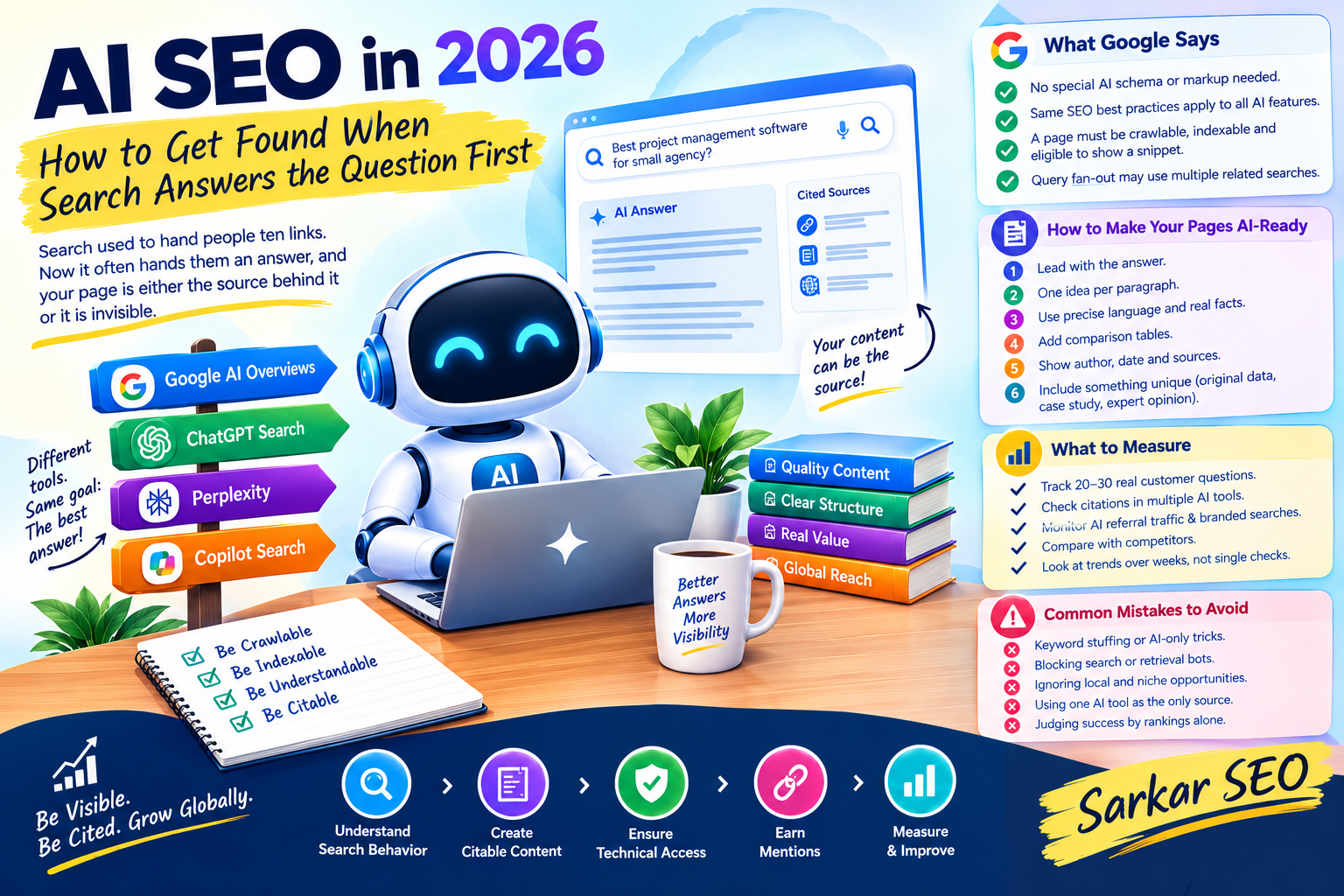
Search used to hand people ten links. Now it often hands them an answer, and your page is either the source behind it or it is invisible. That shift is what people mean by AI SEO. At Sarkar SEO, we find the confusion is usually about what the term means, not which tactics to use.
What AI SEO Actually Means
The phrase now covers two different things. One is using AI tools to speed up keyword research, audits and drafting. The other is creating pages that can be discovered, understood, extracted and cited in AI-powered search experiences such as Google AI Overviews, AI Mode, ChatGPT search and Copilot Search. This article is about the second. mangools
What Google Says
The official position is less dramatic than the industry hype. Google says the same SEO best practices apply to all AI features in Search, with no special AI schema, AI text file or custom markup required. In other words, a page that is crawlable, indexable and eligible to show a snippet is already doing the foundational work. Be wary of any service selling a secret AI-only layer on top of that.
That does not make AI SEO a rebrand with nothing new in it. Several mechanics change how you should plan content.
Query Fan-Out Rewards Coverage, Not Single Keywords
AI Mode breaks a question into sub-queries using a technique Google calls query fan-out, rather than running one search. A page built around one exact phrase competes poorly against a site that answers the questions surrounding it. llmpulse
Take someone asking for project management software for a small agency. The system may separately look into pricing, integrations, onboarding time and client-sharing features. A site with a thin comparison page covers one of those. A site with connected, specific pages on all four gives the system more to retrieve and cite.
So think in topic clusters. Each page should answer one question fully and link naturally to its neighbours.
The Traffic Reality
Third-party measurements suggest the clicks are shifting. One 2026 summary reports that AI Overviews triggered on roughly 48% of tracked queries as of February 2026. Another source cites Seer Interactive data showing organic click-through rates under AI Overviews falling from 1.76% to 0.61%. Treat these as directional, since they come from vendors with different tracking methods. Even so, the pattern is clear: some visibility will happen without a click. A citation still puts your brand in front of the reader, and that makes brand recognition a measurable goal.
Check Whether AI Crawlers Can Reach You
Many sites lose AI visibility through a forgotten robots.txt rule rather than weak content. AI companies increasingly use separate bots for separate jobs. OpenAI runs GPTBot for training, OAI-SearchBot for search indexing, and ChatGPT-User for user-initiated retrieval.
This gives you a real choice. Blocking training crawlers is a legitimate decision, but blocking the search and user agents removes your content from eligibility for AI citations. A common mistake is a blanket rule written for one bot that is assumed to cover them all. Another is an old firewall policy that blocks unknown bots and catches every bot introduced since, including OAI-SearchBot. anagramgetpassionfruit
Also check your rendering. One technical review notes that AI crawlers do not execute JavaScript, so key content that only appears after scripts run may never be seen. Open your server logs, confirm which bots visit, and test what a plain HTML fetch returns.
Write Pages That Are Easy to Extract
Models quote clear, self-contained passages. You can help without writing for robots.
- Lead with the answer. Open each section with a direct statement, then add nuance. A practitioner who tested this on their own site reported that opening a section with a single defining sentence gets quoted into AI Overviews remarkably often.
- One idea per paragraph. A paragraph that mixes three claims is hard to lift cleanly.
- Name things precisely. “Our onboarding takes nine days on average” beats “fast onboarding,” provided it is true.
- Use tables for comparisons. Structured comparisons are easy for both readers and retrieval systems to parse.
- Show who wrote it. Add author names, dates and sources, and update pages when facts change.
Avoid keyword repetition. Clear structure and plain language do more than a keyword count ever did.
Add Something the Summary Cannot
If your page only restates what ten others say, an AI summary can replace it. Information gain is what makes a source worth citing. Original data from your own clients, a documented process with real screenshots, a failed experiment and what it taught you, or a clear opinion backed by evidence all qualify. Google’s broader guidance says its systems aim to reward original, high-quality content regardless of how it was produced. AI-assisted drafting is fine, but the value has to come from something real.
Measure What Matters
Rankings alone no longer tell the full story. Build a list of 20 to 30 prompts your customers actually ask, then check monthly whether you are cited in Google, ChatGPT, Perplexity, Gemini and Claude. Record which pages get cited, and compare against branded search volume, referral traffic from AI platforms and assisted conversions. Sarkar SEO uses this kind of prompt set as a baseline, because without one you cannot tell whether a change helped or whether results simply varied.
Expect noise. AI answers change between sessions, so look at trends over weeks, not single checks.
A Practical Starting Order
- Confirm your key pages are indexable and return their content in plain HTML.
- Review robots.txt and firewall rules for search and retrieval bots.
- Pick one service or topic and map the questions around it.
- Rewrite your top pages with direct openings, specific facts and visible authorship.
- Add one piece of original evidence to each.
- Set up the prompt-tracking baseline before you publish changes.
