



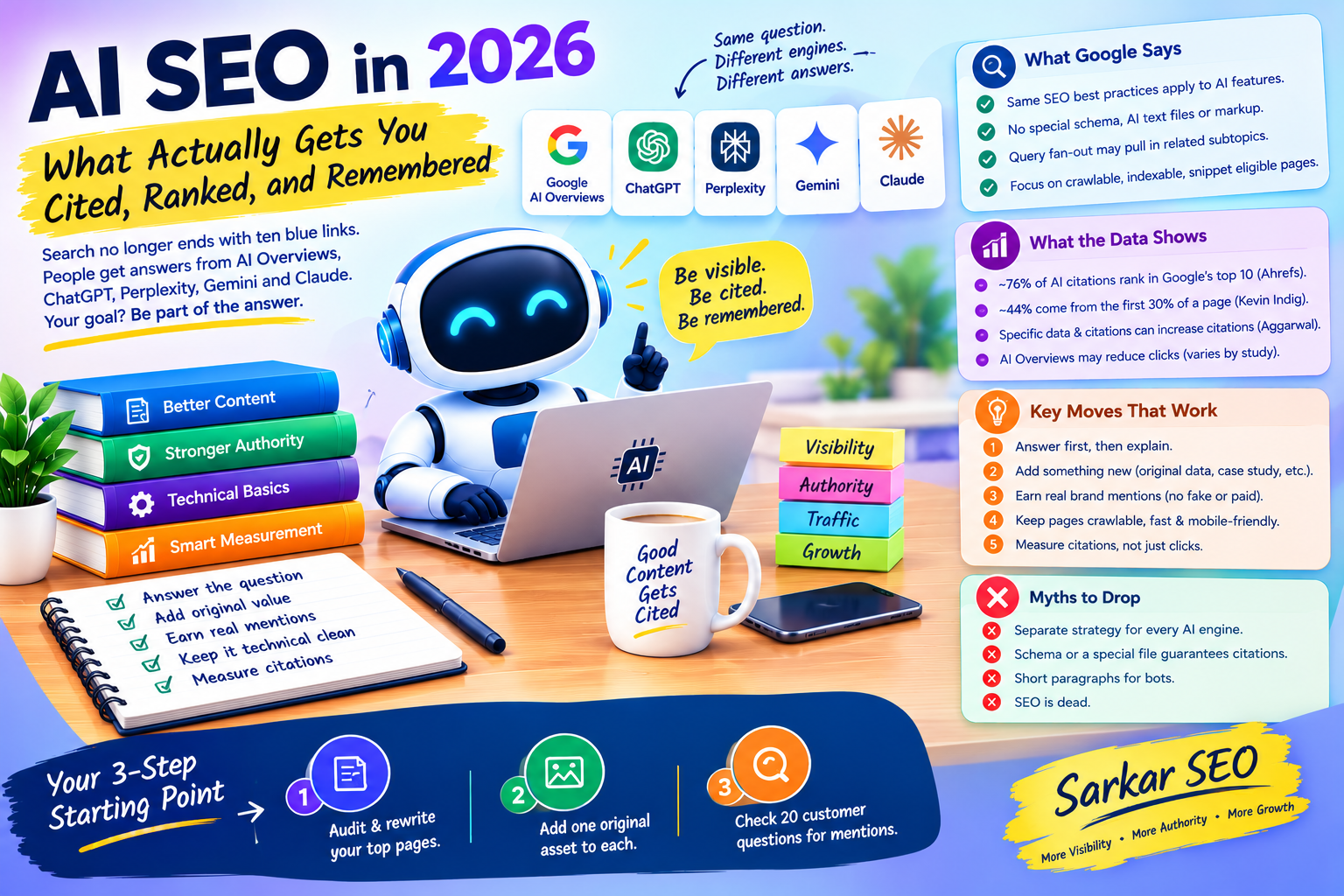
Search no longer ends with ten blue links. People now get answers from Google’s AI SEO Overviews, ChatGPT, Perplexity, Gemini and Claude, often without visiting a website. That has produced a flood of new acronyms and bold promises. Underneath the noise, the real question is simple: how do you stay visible when machines write the answer?
That is what AI SEO is about.
What AI SEO Really Means
AI SEO is the practice of making your content easy to find, trust and cite for both traditional search engines and AI answer systems. You will also see it called generative engine optimization (GEO) or answer engine optimization (AEO). The labels differ, but the goal is the same: when someone asks a question in your field, your brand should be part of the response.
At Sarkar SEO, we treat it as an extension of good search practice, not a replacement. The two disciplines share most of their foundations.
What Google Says About It
Google’s own documentation for site owners is direct. It states that normal SEO best practices still apply to AI Overviews and AI Mode, and that no extra requirements or special optimizations exist. It also explains that these features may run a “query fan-out,” meaning several related searches across subtopics, to build one answer.
Trade coverage of Google’s May guidance on generative AI features adds detail. According to Practical Ecommerce, Google says writing in an “AI-friendly” style or chopping content into tiny chunks is not required, and that chasing artificial brand mentions can be treated as spam.
The takeaway: if you rank well for the right questions, you are already in the pool Google’s AI draws from.
Where AI Search Behaves Differently
Google is only one surface. Other engines retrieve and cite in their own ways, and the studies are worth reading with a critical eye.
- Ranking still matters. An Ahrefs study of 1.9 million AI Overview citations, summarized by Crowdo, found that about 76% of cited pages already ranked in Google’s top ten.
- Position on the page matters. A Kevin Indig and Gauge analysis of 18,012 ChatGPT citations found that about 44% came from the first 30% of a page, as reported by EliteContentMarketer. Pages that bury the answer lose out.
- Evidence helps. The original 2023 GEO research paper by Aggarwal and colleagues found that adding specific statistics and credible citations can raise a page’s chance of being cited, according to LLMPulse’s summary.
Most of these studies come from vendors and agencies, and methods vary. Treat the numbers as directional, not as laws.
What It Means for Traffic
Honesty matters here. Some reports claim AI Overviews cut clicks to top-ranking pages by more than half, while others show citations lifting engagement. Gartner has predicted that traditional search volume could fall 25% by the end of 2026. The studies disagree on size, but they agree on direction: fewer clicks go to pages that merely restate common knowledge.
So the strategic shift is from chasing traffic alone to earning visibility, brand recall and qualified visits.
Five Moves That Work Across Engines
- Answer first, explain second. Open each section with a clear, self-contained answer, then add nuance. Readers get value quickly, and retrieval systems find a clean passage to lift.
- Add something new. AI systems can already summarize the average article. Publish original data, first-hand testing, a clear opinion or a framework others have not written. If your page adds nothing beyond what a model already knows, there is no reason to cite it.
- Build real brand mentions. AI answers draw heavily on what the wider web says about you. Earn coverage through useful research, expert commentary and partnerships. Skip purchased or fake mentions, since Google says it can tell the difference.
- Keep the technical basics clean. Make sure pages are crawlable, indexable, fast and mobile-friendly. Use structured data where it matches visible content, but do not expect it to work as a shortcut. One cited study even found pages with FAQ schema averaged fewer citations, while FAQ sections written into the body performed better. Another found no benefit from an llms.txt file.
- Measure citations, not just clicks. Track whether your brand appears in AI answers for your priority questions. Search Console now includes AI feature appearances in overall search traffic, and third-party tools can sample other engines. Sarkar SEO’s approach is to check a fixed list of questions monthly and note which pages get cited, then improve the pages that don’t.
Myths Worth Dropping
- “You need a separate strategy for every AI engine.” The retrieval layers overlap heavily with search indexes, so one strong foundation carries most of the load.
- “Schema or a special file guarantees citations.” The evidence does not support it.
- “Short paragraphs for bots.” Write for people. Clear structure helps readers, and that is reason enough.
- “SEO is dead.” Rankings feed the AI answers, so SEO matters more, not less.
A Practical Starting Point
If you do only three things this month:
- Audit your ten most valuable pages and rewrite their openings to answer the main question immediately.
- Add one original asset to each, such as a data point, a case insight or an expert quote you actually hold.
- Pick 20 customer questions and check which engines mention you for them.
That list will show your gaps faster than any dashboard.
