



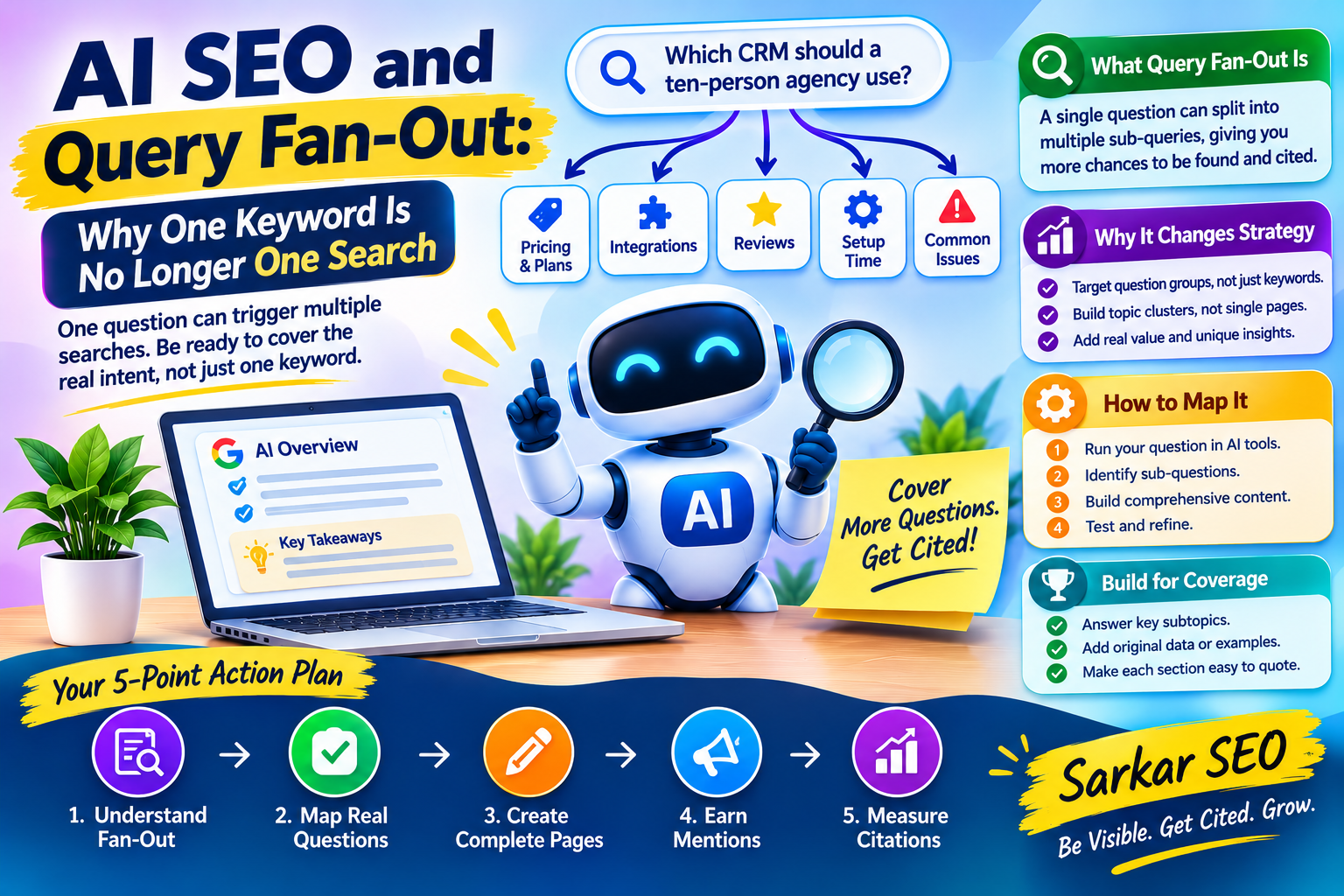
You type a question into an AI search tool and get a tidy answer in seconds. What you don’t see is that the system often ran several searches to produce it, none of which you typed yourself. That hidden step is changing how AI SEO works, and most content plans still ignore it.
What Query Fan-Out Is
Google introduced the term with AI Mode in May 2025, describing a process that breaks a question into subtopics and runs many searches at once on the user’s behalf. Google’s documentation for site owners says AI Overviews and AI Mode may use this technique. Practitioners report similar behavior in ChatGPT and Perplexity, though each company handles it differently.
Here is an illustrative example. Someone asks, “Which CRM should a ten-person agency use?” The system may quietly search for pricing tiers, onboarding effort, integrations, reviews from small teams and common complaints. Digiday’s explainer on fan-out gives a comparable case with walking sneakers, where one query splits into variants by gender, season, terrain and style.
The consequence is that your page can rank well for the visible question and still contribute nothing to the answer, because the answer was assembled from passages that matched the sub-questions.
Why This Changes Keyword Strategy
Traditional keyword work asks which phrase a page should target. Fan-out work asks which questions a buyer needs answered before they decide.
Mike King of iPullRank, quoted by Digiday, put it this way: an AI Mode response comes from synthesis, not from what ranks for a single query. That fits Google’s statement that AI features draw on its normal search systems, so ranking still matters. Ranking for one phrase is just no longer sufficient.
Two caveats are worth stating plainly:
- Google does not publish the sub-queries it generates, so any list you see is an approximation.
- Simple factual questions may barely fan out at all, while complex, comparison-style or decision-style questions fan out heavily.
One vendor glossary, Superlines, reports that roughly 31% of ChatGPT prompts trigger a web search, with about two fan-out searches on average. Treat that as a rough indicator, since the method behind it isn’t fully visible.
How to Map the Hidden Searches
You can’t see Google’s list, but you can build a useful estimate in about an hour.
- Run the question yourself. Enter your target question in AI Mode, ChatGPT and Perplexity. Note which angles each answer covers and which sources it cites.
- Sort the angles by intent. Most fall into a handful of kinds: definitions, comparisons, costs, steps, risks, alternatives and local or audience-specific variants.
- Collect real language. Sales calls, support tickets and on-site search often reveal sub-questions better than any tool.
- Test again later. Outputs vary between runs, so one sample proves little. Repeat across a few days and keep only the angles that keep appearing.
This is how we run content planning at Sarkar SEO: the sub-question map comes before the outline, never after.
Build for Coverage, Not Just Depth
Surfer’s analysis of fan-out makes a point that deserves emphasis: you don’t need to reverse-engineer every sub-query if your site covers a topic thoroughly enough that most of them find an answer. The practical shape of that is a topic cluster, built in three layers.
The anchor page. One substantial page answers the main question directly and links to the supporting pieces.
The supporting pages. Each takes a single sub-intent, such as pricing, comparison or implementation, and answers it completely. A page that tries to cover five angles shallowly gives retrieval systems nothing precise to lift.
The proof layer. This is where you earn citations rather than just coverage. Add numbers you collected yourself, named examples, screenshots of real processes or an expert’s reasoning. A page that restates what every competitor says gives an AI system no reason to choose it.
Aleyda Solis’s AI search checklist adds a useful warning here. Personalization means different users trigger different sub-queries, so cover several audiences and contexts rather than writing for one imagined reader.
Make Each Section Retrievable
Retrieval systems often pull individual passages, so each section should survive being read alone.
- Give every subheading a clear question or topic, so the section’s purpose is obvious.
- Put the direct answer in the first sentence or two, then add the reasoning.
- Name the subject explicitly instead of leaning on “it” or “this approach,” which breaks when a passage is lifted out of context.
- Keep definitions, figures and conditions inside the same section that uses them.
Google’s own guidance says you don’t need to write in an “AI-friendly” style or break content into tiny pieces for machines. So think of this as ordinary clear writing, not a special format. A section that works for a hurried human reader will usually work for a retrieval system too.
Common Fan-Out Mistakes
- Chasing the exact sub-queries. Since they change between runs, optimizing for a fixed list is a moving target. Cover the underlying intent instead.
- Publishing thin pages to fill the map. Ten shallow articles won’t beat three useful ones.
- Ignoring technical access. A page blocked from indexing, or restricted by snippet controls, cannot be used. Aleyda Solis specifically notes that a “nosnippet” rule can keep content out of AI answers.
- Measuring only rankings. Track whether your brand is cited for the sub-questions that matter to your buyers, not just where you rank for the head term.
A Simple Test for Your Next Article
Before publishing, write down the five questions a skeptical buyer would ask after reading your headline. If the article answers fewer than four of them, or answers them vaguely, you have a gap that a competitor’s page, or an AI system’s synthesis, will fill instead.
