



Most content teams treat publishing as the finish line. In AI SEO search, a published article starts aging immediately, and the evidence suggests AI assistants notice. If your best pages have not been touched in two years, the question is no longer whether to refresh them, but which ones, how deeply and how often.
What the Research Shows
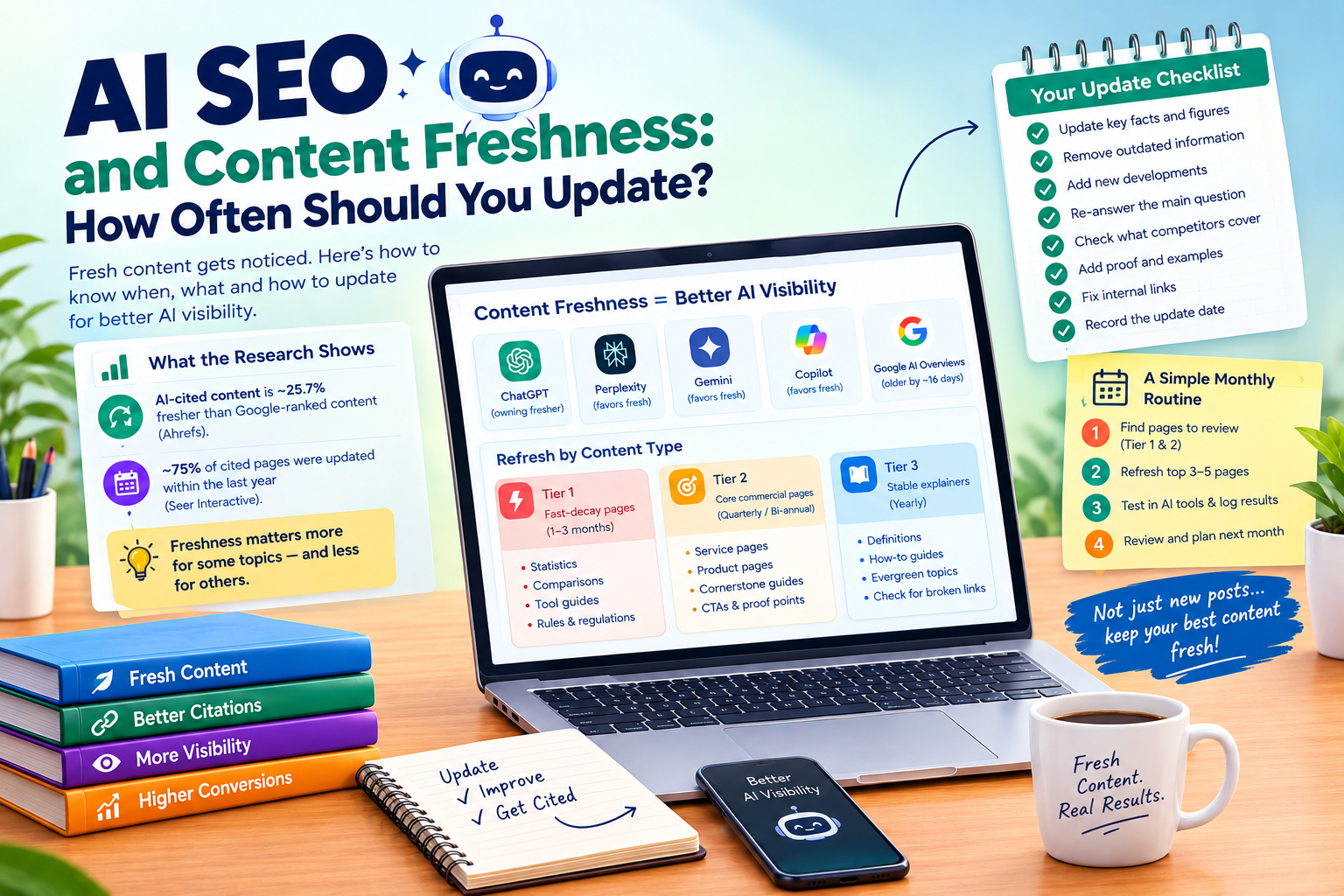
Ahrefs analyzed about 17 million citations from its Brand Radar data, covering ChatGPT, Perplexity, Gemini, Copilot, Google AI Overviews and the regular Google results. Its headline finding: content cited by AI assistants was roughly 25.7% fresher than pages ranking in organic Google results.
The pattern was not uniform:
- ChatGPT showed the strongest lean toward newer pages.
- Perplexity and Gemini also favored fresher content.
- Google AI Overviews went the other way, citing pages about 16 days older than organic results on average. Ahrefs notes that ChatGPT and Perplexity also list in-text references from newest to oldest.
A separate Seer Interactive study looked at 7,683 pages cited across ChatGPT, Gemini and Perplexity between March and June 2026. It reported that about 75% of cited pages had been updated within the previous year.
Two cautions apply. Both studies come from SEO vendors using their own datasets, and neither proves that updating a page causes more citations. Fresh pages may simply be better maintained overall. Treat the numbers as a strong hint, not a guarantee.
Why Freshness Matters More for Some Pages
The Google result is the useful clue. AI Overviews draw on Google’s ordinary ranking systems, where freshness is one input among many, so a decent older page can still be cited there. Assistants that search the live web in response to a prompt appear to weight recency more heavily.
That suggests a practical rule: the more a topic changes, the more freshness matters. Pricing, software features, regulations, statistics, “best of” lists and anything with a year in the title age fast. A definition of a stable concept ages slowly. Spending a refresh budget evenly across both is a waste.
A Triage System for Your Content
Rather than updating everything, sort pages into three tiers.
Tier 1: Fast-decay pages. These carry data, comparisons, tool recommendations or rules that change. Review them every one to three months. Examples include market statistics, platform guides and cost breakdowns.
Tier 2: Core commercial pages. Service pages, product pages and cornerstone guides that drive leads. Review them every quarter or twice a year, checking accuracy, proof points and calls to action.
Tier 3: Stable explainers. Foundational definitions and timeless how-tos. A yearly check is usually enough, mainly for broken links and outdated examples.
At Sarkar SEO, we handle this with a simple spreadsheet: URL, tier, last substantive update, next review date and one-line notes on what changed. It takes an hour to build and saves guessing every month.
What a Real Refresh Includes
A refresh is not a new date on an old page. If the content hasn’t changed, a new date misleads readers and gives machines nothing new to evaluate. The studies above measure published or updated pages, and the useful kind of update changes substance.
Work through this checklist:
- Replace stale numbers with current figures, and name the source and year beside each.
- Remove what no longer applies, such as discontinued tools or outdated steps.
- Add what has happened since: new developments, features or rule changes.
- Re-answer the main question in the opening paragraph so it reflects today’s best answer.
- Check the competition. Search the target question in AI tools and see what cited pages cover that yours does not.
- Strengthen proof. Add original examples, screenshots or expert commentary you can stand behind.
- Fix internal links, pointing older articles toward the updated page.
- Record the update visibly. A short note such as “Updated October 2026: revised pricing and added new platform steps” helps readers see what changed. Make sure the page’s dates match reality in both the visible text and the markup.
Where Freshness Backfires
- Fake updates. Changing dates without editing content erodes trust and, if discovered, your credibility. Update only when something truly improved.
- Rewriting what already works. If a page ranks and converts, change facts and gaps, not the whole structure. A full rewrite can lose the signals that earned the position.
- Chasing recency on timeless topics. Constant tinkering with evergreen pages burns time that would be better spent on new coverage.
- Treating a year in the title as a strategy. A title that says 2026 on a page that was not reviewed in 2026 is a promise your content does not keep.
- Skipping the measurement. Note which refreshed pages gain mentions, rankings or leads in the following weeks. Without before-and-after notes, you can’t learn what works for your site.
A Realistic Monthly Routine
You don’t need a content calendar full of new posts to benefit. A sustainable rhythm looks like this:
- Week one: pull your list of Tier 1 and Tier 2 pages due for review.
- Week two: refresh the top three to five, based on traffic and commercial value.
- Week three: test the main questions for those pages in two or three AI tools and log whether you appear.
- Week four: review the results, adjust the list and plan next month.
Small, steady maintenance tends to beat occasional bursts, because pages never fall far behind.
