



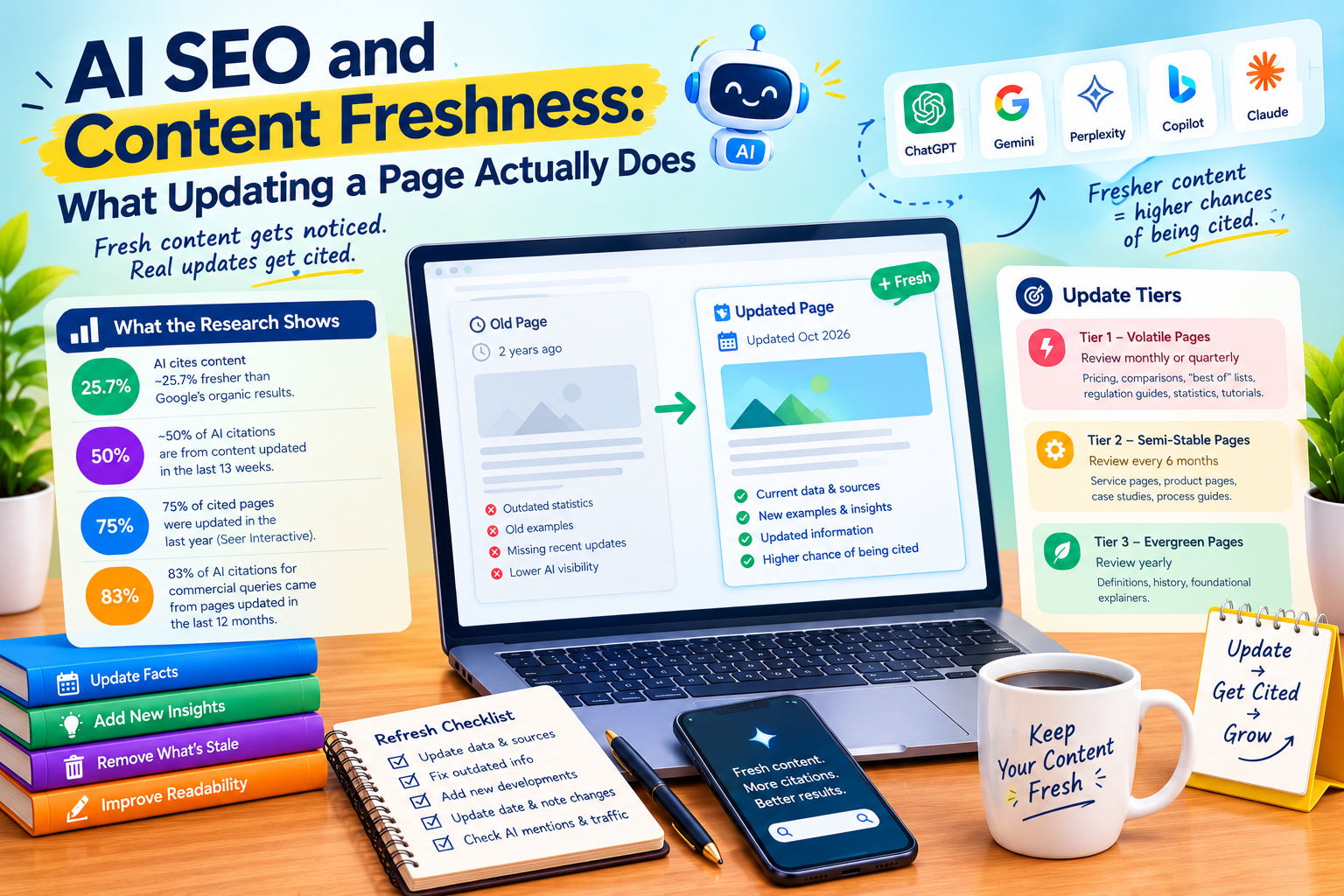
Many site owners hear that AI SEO assistants love fresh content and respond by changing dates on old posts. That is the wrong lesson. The evidence points to freshness mattering, but the type of freshness that counts is real change in substance. Sarkar SEO uses this as a planning rule: update a page when the world has moved on, not when the calendar says so.
What the Studies Found
The most quoted figure comes from an Ahrefs analysis of about 17 million citations across several AI platforms. As summarised by others, AI assistants cite content averaging 25.7% fresher than what ranks organically on Google. The same source says that roughly half of all AI citations trace back to content published or substantively updated within the last 13 weeks. nogoodnogood
Other datasets point the same way. Seer Interactive studied 7,683 cited pages across ChatGPT, Gemini and Perplexity, and a summary of that work reports that 75% were updated in the last year. A separate analysis of about 35,000 citation URLs reportedly found that 83% of AI citations for commercial queries came from pages updated in the past twelve months. somethingincsomethinginc
Those numbers are striking, but read the next section before acting on them.
Why Correlation Is Not a Recipe
The same commentary that reported the Seer study adds a sharp warning: every study here is correlational, and there is a plausible confound: the pages that get maintained are the pages someone cares about. In other words, cited pages may be fresh because they are good and actively managed, not cited because they are fresh. The same source also notes that Seer could date only about two-thirds of its sample.
So the honest reading is that freshness is a useful signal and a reasonable priority, but nobody has shown that touching a page makes AI engines cite it. A refreshed page that is still thin will stay thin.
Engines Differ
Freshness preferences are not uniform. One round-up concludes that Perplexity and Grok weight freshness most heavily, while Google’s AI surfaces are the most conservative. It also reports that Ahrefs found AI Overviews cite pages that run about 16 days older than organic results.
Another summary notes that Google AI Overviews have the strongest correlation with traditional search rankings, with 76.1% of AI Overview citations also ranking in Google’s top 10. The practical consequence: a page aimed at Google’s AI features should rely on solid ranking fundamentals, while one aimed at Perplexity or ChatGPT should be kept more actively current. The same source warns that ChatGPT’s behaviour has swung sharply across model releases and should not be treated as one stable number.
Not Every Page Needs Frequent Updates
Updating everything monthly would waste effort. A definition of a stable concept does not change weekly. A pricing comparison or a guide to a changing platform feature does. Here is a triage method we suggest. It is our own framework, not a published standard.
Tier 1: Volatile pages. Pricing, comparisons, “best of” lists, regulation guides, software tutorials and anything with statistics. Review monthly or quarterly.
Tier 2: Semi-stable pages. Process guides, service explanations and case studies. Review every six months.
Tier 3: Evergreen pages. Definitions, history and foundational explainers. Review yearly, or when a major change occurs.
Start by listing your top 20 pages by traffic, leads or AI citations, then assign each a tier.
What Counts as a Real Update
A useful test: could a reader tell the difference? Genuine updates include:
- Replacing outdated statistics with current ones, and naming the source and year.
- Removing advice that no longer works.
- Adding a section for a development that matters.
- Correcting an error you found.
- Adding original data, a new example or a tested result.
- Fixing broken links and outdated screenshots.
One commentary frames it well: the 25.7% freshness advantage is about recency of substance, not volume. Another observes that a 2023 explainer on a fast-moving topic may read fine yet miss eighteen months of meaningful development that changes the practical implications. That is the kind of gap that makes a page unreliable. nogoodmarketing
The Date Trick That Backfires
Changing the “last updated” date without changing the content is tempting, and I recommend against it. This is my judgement, not a quote from any search engine’s rules. The reasons are practical: readers notice when a “2026 update” contains 2022 advice, trust drops, and you gain nothing if systems compare content, not labels. The study evidence is also about pages that were updated, not pages that claimed to be.
Be transparent instead. Show a visible “Updated” date next to a short note of what changed. This helps readers and keeps your own editing history honest.
Build a Simple Refresh Routine
- Pick the page. Choose from your Tier 1 list, or one that has lost traffic or citations.
- Check the facts. Open every cited source again. Replace anything out of date.
- Add what is new. Include at least one improvement that adds value, such as a new example or data point.
- Cut what is stale. Removing outdated material often helps as much as adding.
- Note the change. Record the date and a one-line summary in an internal log.
- Recheck after a few weeks. Look at traffic, enquiries and whether AI answers cite the page.
Because AI answers vary between sessions, judge results over several weeks, and avoid making conclusions from one test.
Refresh Before You Publish More
Many teams chase new articles while older ones decay. One practitioner article claims that content updated within 30 days gets 3.2 times more AI citations than older content. That is a single vendor’s figure, so treat it as illustrative, not as a target. A more reliable principle is that a well-maintained library of 30 strong pages usually serves readers better than 100 pages that nobody has checked in two years.
