



There is a certain irony in AI SEO: many teams now use AI tools to produce the content meant to win visibility in AI search. Done well, that saves time. Done badly, it floods a site with pages nobody needs. The difference isn’t the tool. It’s the purpose and the process.
What Google Actually Says
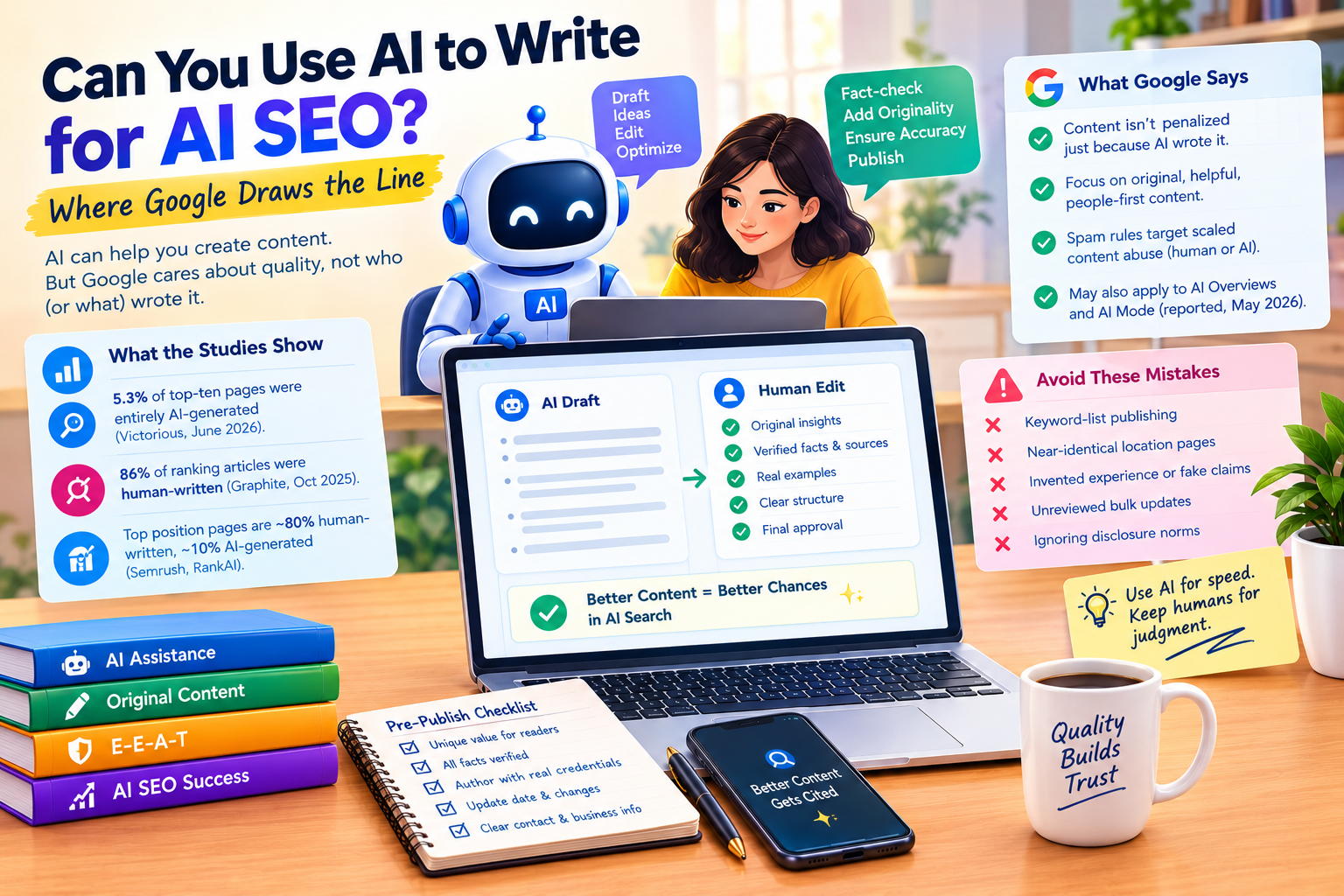
Google’s position has been stable since February 2023: content isn’t penalized simply because AI helped create it. What matters is whether the result is original, helpful and written for people. Google’s own summary, as quoted by Frase, is that however content is produced, publishers should aim for original, high-quality, people-first work.
The risk sits in a separate policy. Google’s spam rules define scaled content abuse as generating many pages mainly to manipulate rankings instead of helping users. The policy was renamed and broadened in March 2024, and its examples include using generative AI tools to create many pages without adding value. Crucially, it applies regardless of who or what produced the pages. A human content farm and a poorly supervised AI workflow can break the same rule.
Two recent developments deserve a note, with some caution:
- A secondary source citing Search Engine Land reports that in May 2026 Google confirmed its spam rules also apply to AI Overviews and AI Mode.
- Originality.ai reports that Google updated its documentation on generative AI content guidance on October 1, 2026. I couldn’t review the primary text, so read Google’s current page directly before changing your policy.
What Ranking Studies Show
Several analyses have asked how much AI-written content appears in top results. They use different detectors and samples, so the numbers vary:
- Victorious reviewed 150,000 top-ten pages from 100,000 searches in June 2026. It found 5.3% were entirely AI-generated, and pages with less than 50% AI content held 82.2% of the top-three spots.
- Graphite, in an October 2025 study of 31,493 keywords, classified 86% of sampled ranking articles as human-written, and found AI-classified articles tended to rank lower.
- Semrush’s 20,000-keyword analysis, as summarized by RankAI, put position-one pages at about an 80% likelihood of being human-written, versus about 10% for AI-generated ones.
Now the caveats. Detection tools are unreliable. The same RankAI summary cites one evaluation in which a detector caught only 26% of AI-written text while mislabeling 9% of human writing. A Pixis review also reported near-zero correlation (0.011) between estimated AI share and ranking position in one dataset. Frase makes a sharper point: the winning “human-written” pages may well have been drafted with AI and edited heavily.
The fair reading: AI content can rank, gets no special boost and tends to underperform when published raw. Nothing here proves that Google detects and demotes AI authorship.
Why Raw AI Output Struggles in AI Search
Even setting policy aside, unedited AI drafts have a structural weakness. A model trained on the web tends to restate what the web already says. In AI search, where engines synthesize many sources, a page that adds nothing beyond the consensus gives a system no reason to cite it. Earlier studies on citation behavior point toward specific statistics, credible sources and original material as the features that help.
Accuracy is the other problem. AI tools can state outdated or invented details confidently. Google’s guidance reportedly calls for manual review of AI-generated content for accuracy and trustworthiness, and that is sensible for any publisher.
A Workflow That Respects the Line
A useful rule of thumb: let AI speed up the work, and let humans own the judgment. At Sarkar SEO, we think of drafting help and publishing responsibility as two separate jobs.
Good uses of AI:
- Summarizing source material you have actually read
- Suggesting outline structures and subtopics to check
- Tightening phrasing and fixing grammar
- Generating variations for headlines and meta descriptions
- Turning your own notes, data and interviews into a first draft
Jobs that need a person:
- Choosing which topics deserve a page at all
- Supplying original data, firsthand experience and opinions
- Verifying every statistic, quote, date and claim against a real source
- Deciding what to cut, because a shorter, sharper page usually serves readers better
- Approving the final version with a named, accountable author
Add a short pre-publish checklist: Is there something here a reader can’t get from the top five results? Has every number been checked? Would the author stand behind it publicly? If the answer to any is no, the page isn’t ready.
Patterns to Avoid
- Keyword-list publishing. Creating a page for every variation of a phrase because a tool suggested it is the classic scaled-content pattern. Fewer, stronger pages win.
- Near-identical location or product pages. Swapping a city name in a template adds nothing for readers.
- Invented experience. An AI draft saying “in our years of testing” is a fabrication if no testing happened. Don’t publish claims of experience that nobody has.
- Unreviewed bulk updates. Running a whole archive through an AI rewrite changes dates and wording without improving substance.
- Ignoring disclosure norms. Some topics, platforms and clients expect transparency about AI assistance. Where in doubt, say so.
Quality Signals Worth Keeping
Whatever tools you use, build in the markers that signal real accountability: a named author with relevant credentials, sources named in the text, a visible update date tied to genuine changes, original images or data and clear contact and business information. These help readers decide whether to trust you, and they cost little.
