



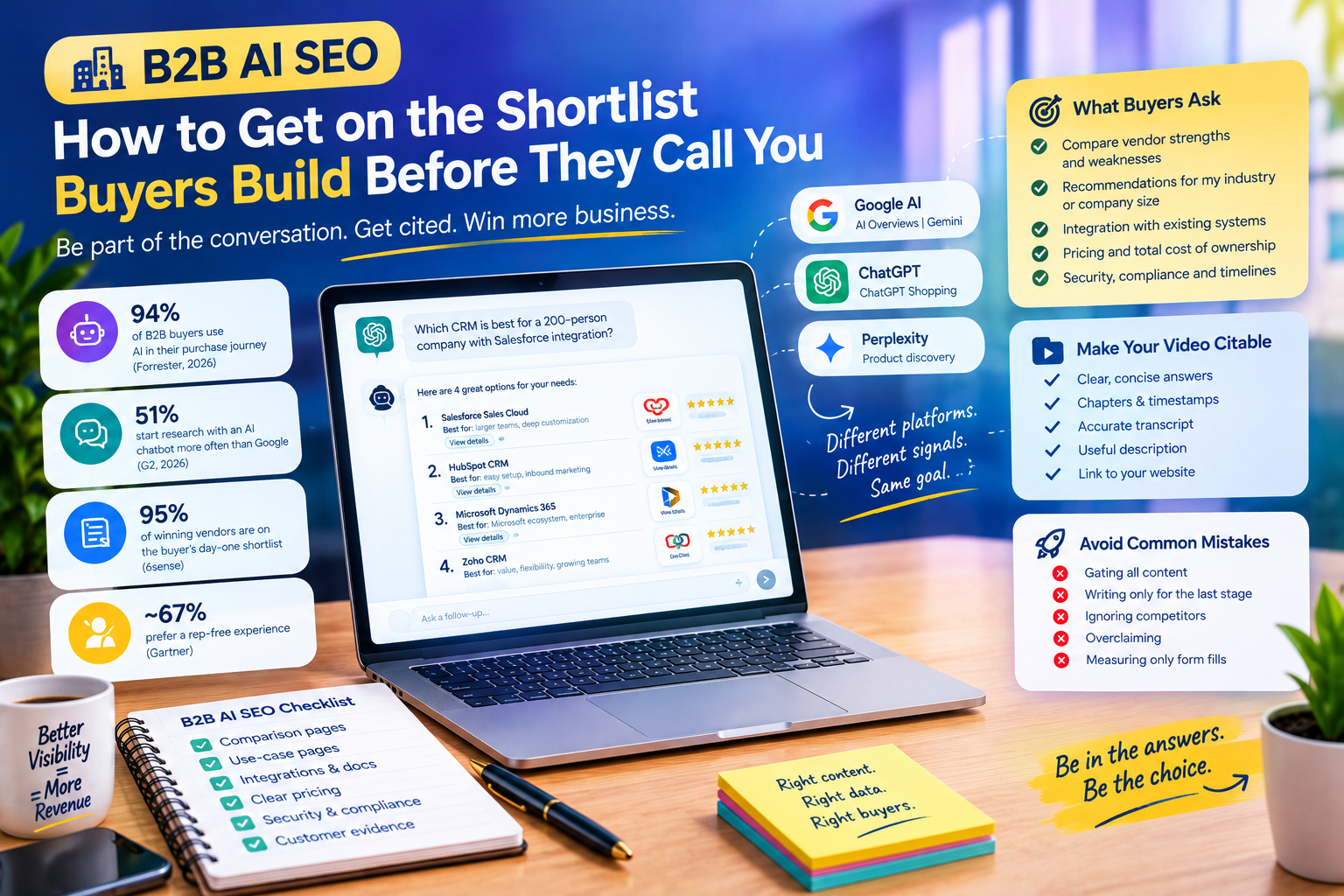
Most B2B marketers still picture the buyer journey as a funnel: search, click, read, enquire. Increasingly, the shortlist is formed earlier and elsewhere, inside a chat window. AI SEO your company isn’t named in that conversation, the buyer may never reach your website, let alone your sales team.
What the Buyer Surveys Say
Several large surveys point the same way, though they measure different things and come from vendors or research firms with their own interests.
- Adoption is near-universal. Forrester’s 2026 Buyers’ Journey Survey, covering nearly 18,000 business buyers, found 94% used generative AI in their most recent purchase, as reported by Abmatic. The same coverage says buyers used it to research product information, compare vendors and build internal business cases.
- AI is a starting point for many. G2’s March 2026 survey of 1,076 software buyers found 51% start research with an AI chatbot more often than Google, up from 29% eleven months earlier.
- AI influences the shortlist. In the same G2 research, 54% named AI chatbots as the biggest influence on which vendors make the list, and 69% chose a different vendor than originally planned after chatbot guidance. One-third bought from a vendor they hadn’t heard of before.
- Shortlists form early. 6sense’s study of 4,510 buyers, summarized by Gracker, found 95% of winning vendors were on the buyer’s day-one shortlist.
- Buyers prefer to self-serve. Gartner, cited in a June 2026 press release, finds roughly two-thirds of B2B buyers prefer a rep-free experience.
Other aggregated figures vary widely. Some roundups claim that 68% or 76% of buyers use AI, depending on the question asked. Treat exact percentages with caution, and focus on the consistent direction instead.
What Buyers Actually Ask
B2B prompts are rarely “best CRM.” They are specific, comparative and skeptical. According to G2’s findings, comparing vendor strengths and weaknesses is the top use case, at 41%. Typical patterns include:
- “Which [category] tools suit a 200-person company with [constraint]?”
- “Alternatives to [competitor] with better [feature].”
- “Does [vendor] integrate with [system], and how hard is setup?”
- “[Vendor A] versus [Vendor B] for [use case].”
- “Build a business case for switching from [old approach].”
Each question is an opening to be included or excluded. At Sarkar SEO, we treat that list as the real keyword set for B2B work, and we collect it from sales calls and support tickets before touching an outline.
Content That Earns a Place in the Answer
Honest comparison pages. A page comparing your product to named alternatives, with real trade-offs, serves buyers and gives AI systems balanced material. A page that claims you beat everyone at everything reads as marketing and rarely gets quoted.
Specific use-case pages. Organize by situation, such as industry, company size or problem solved. Generic “solutions” pages give an engine little to match.
Integration and technical documentation. Buyers ask whether a product works with their existing systems. Clear, public documentation of integrations, limits and setup requirements answers the questions that decide shortlists.
Plain pricing information. Even ranges and pricing logic help. When pricing is hidden, assistants fill the gap with guesses, often from outdated third-party pages.
Security, compliance and implementation pages. Enterprise buyers screen for these early. Publish certifications, data handling practices and typical timelines in a form that can be read without a form fill.
Evidence from customers. Case studies with named outcomes, scope and timeframes carry more weight than adjectives. Share only results you can support, and get customer approval first.
Think Beyond Your Own Site
Third-party material shapes what AI says about B2B vendors. Analyst coverage, review platforms, industry publications and partner pages all contribute. Keep review profiles current, correct outdated listings and offer genuine expertise to trade publications. This overlaps with general off-site reputation work, but B2B adds a particular twist: buyers often check review sites after an AI answer, so the two need to tell the same story.
Close the Loop With Sales
Visibility only matters if it reaches revenue, so involve the sales team early.
- Ask how buyers found you. Add an open “How did you hear about us?” field to demo forms and log AI mentions in the CRM.
- Test what AI says about you. Run your category and competitor comparison prompts monthly. Note inaccuracies, such as missing features, old pricing or wrong positioning, and fix their sources.
- Prepare for informed prospects. Buyers may arrive with a clear but flawed picture. Gartner, per the same press release, warns that self-directed AI research can create confident misunderstanding. A good first call corrects gently and verifies what the buyer believes.
- Track lower-funnel signals. AI-influenced buyers may never appear as a referral in analytics. Watch branded search, direct visits and demo-request quality alongside classic traffic.
Common Mistakes
- Gating everything. Putting all useful content behind forms keeps it away from the systems and buyers doing early research.
- Writing only for your ideal customer’s last stage. The shortlist is formed at the awareness and comparison stage, so publish there.
- Ignoring competitors’ claims. If a rival’s content frames the category and you don’t respond, the AI will inherit their framing.
- Overclaiming. Unsupported superlatives hurt credibility with both people and machines.
- Measuring only form fills. Much influence is invisible, so rely on several indicators.
