



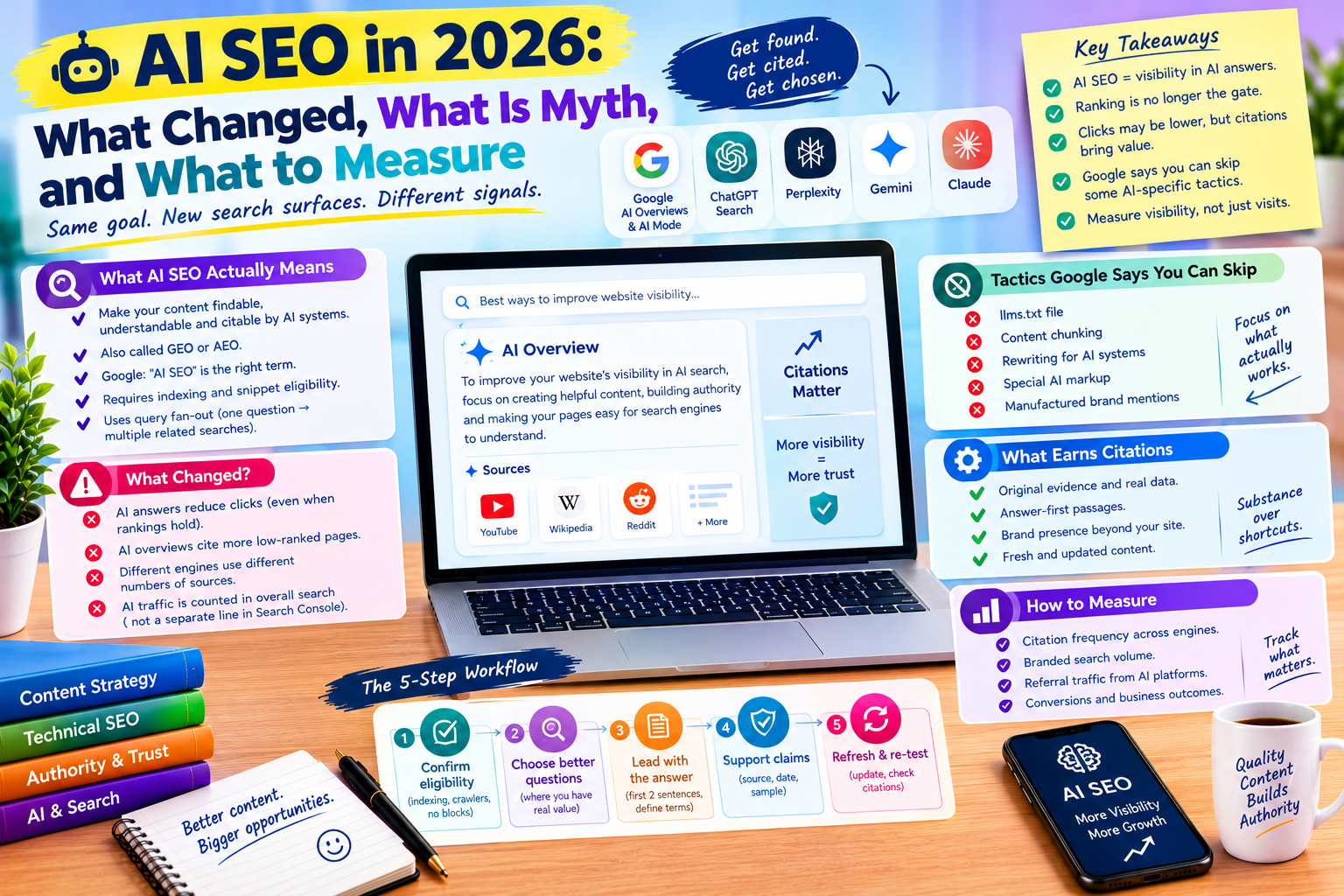
AI SEO is the work of making your content eligible to be found, understood, and cited by AI-driven search, including Google AI Overviews and AI Mode, ChatGPT, Perplexity, Gemini, and Claude. For Google, the tactics have barely changed. What has changed is how you know whether they are working.
What AI SEO Actually Means
You will see the same idea called generative engine optimization (GEO) or answer engine optimization (AEO). In its May 15, 2026 guide to generative AI features, Google acknowledges both terms and states that optimizing for generative AI search is still AI SEO.
The mechanics support that position. To appear as a supporting link in AI Overviews or AI Mode, a page must be indexed and eligible to show with a snippet. Google also says these features use query fan-out, which splits one question into several related sub-searches, so a page can be pulled in for a subtopic the searcher never typed.
Why Clicks Fall Even When Rankings Hold
Seer Interactive studied 3,119 informational queries and found organic click-through rate on queries with an AI Overview fell from 1.76% to 0.61%. Ahrefs reported that, as of December 2025, an AI Overview cut clicks to the top organic result by 58%, a sharp rise from its earlier estimate of 34.5%.
There is a counterweight. In the same Seer study, brands cited inside an AI Overview earned 35% more organic clicks and 91% more paid clicks than brands that were not cited. Being quoted now matters nearly as much as being ranked.
A caution on reading these numbers: a percentage drop in click-through rate says nothing about absolute clicks, and Ahrefs found AI Overviews skew toward low-volume, long-tail informational queries. Check your own Search Console data before assuming your whole site is exposed.
Tactics Google Says You Can Skip
A cottage industry now sells AI-specific fixes. Google’s guide says you do not need an llms.txt file, content chunked into tiny fragments, text rewritten for AI systems, special AI markup, or manufactured brand mentions to appear in its generative features.
Sarkar SEO reads this as permission to stop spending budget on theatre. Two nuances apply. First, the guidance covers Google only; other assistants may behave differently, and Google does not speak for them. Second, schema markup still earns its place for rich results, but a May 2026 study reported by Search Engine Journal found that adding JSON-LD did not measurably raise AI citations for pages already visible in AI Overviews. Use structured data where it is accurate and useful, not as a citation lever.
Ranking Is No Longer the Gate
Page one is not a guarantee of citation. According to an Ahrefs analysis of 863,000 keyword results, reported by The SEO Agent, 38% of pages cited in AI Overviews ranked in the top 10 for the same query, down from 76% a year earlier. Nearly two thirds of citations came from lower-ranked pages.
Engines also differ in how many sources they use. A Semrush study of 126 million US prompts found ChatGPT cited about 15 sources per response, while Gemini cited about 3. Broad topic coverage helps on generous engines; one strong page matters on sparing ones.
What Earns Citations
The best-documented lever comes from peer-reviewed work. The Princeton-led GEO study, presented at KDD 2024, found that adding statistics, quotations, and cited sources raised visibility in generated answers by up to 40%, while keyword stuffing did nothing.
- Original evidence. A first-party number, a documented test, or an expert observation cannot be assembled from other pages, so it gives engines a reason to cite you specifically.
- Answer-first passages. Open each section with a direct, self-contained answer, then add nuance.- Brand presence beyond your site. An Ahrefs study of 75,000 brands found brand mentions correlated with AI visibility at 0.664, versus 0.218 for backlinks. Correlation is not causation, but credible third-party discussion likely helps.
- Freshness. Several vendor studies suggest AI citations favor recently updated pages. Treat the exact multipliers as directional, since they come from commercial datasets, but review your key pages on a regular schedule.
A Five-Step Workflow
Sarkar SEO recommends this sequence for any page you want AI systems to cite:
- Confirm eligibility. Check that robots.txt, your CDN, and hosting do not block crawlers, and that the page is indexed with no restrictive snippet controls.
- Choose questions you can answer better. Prioritize topics where you hold real data, process knowledge, or direct experience.
- Lead with the answer. State the conclusion in the first two sentences, define terms, and attach limits to claims they affect.
- Support every material claim. Name the source, the date, and the sample where relevant. Cut claims you cannot verify.
- Refresh and re-test. Update figures, then query the engines your audience uses and record whether you are cited.
Measure Visibility, Not Only Visits
If AI answers absorb the click, sessions alone will understate your influence. Google notes that traffic from AI features is counted within overall search traffic in Search Console, so it will not appear as its own line. Bing Webmaster Tools added an AI Performance report in February 2026 showing citations, grounding queries, and page-level activity.
Build a simple dashboard: citation frequency across the engines you care about, branded search volume, referral traffic from AI platforms, and conversions from organic visitors. Seer Interactive’s own advice was to shift from raw traffic toward share of voice and visibility, which is a sensible reframing.
