



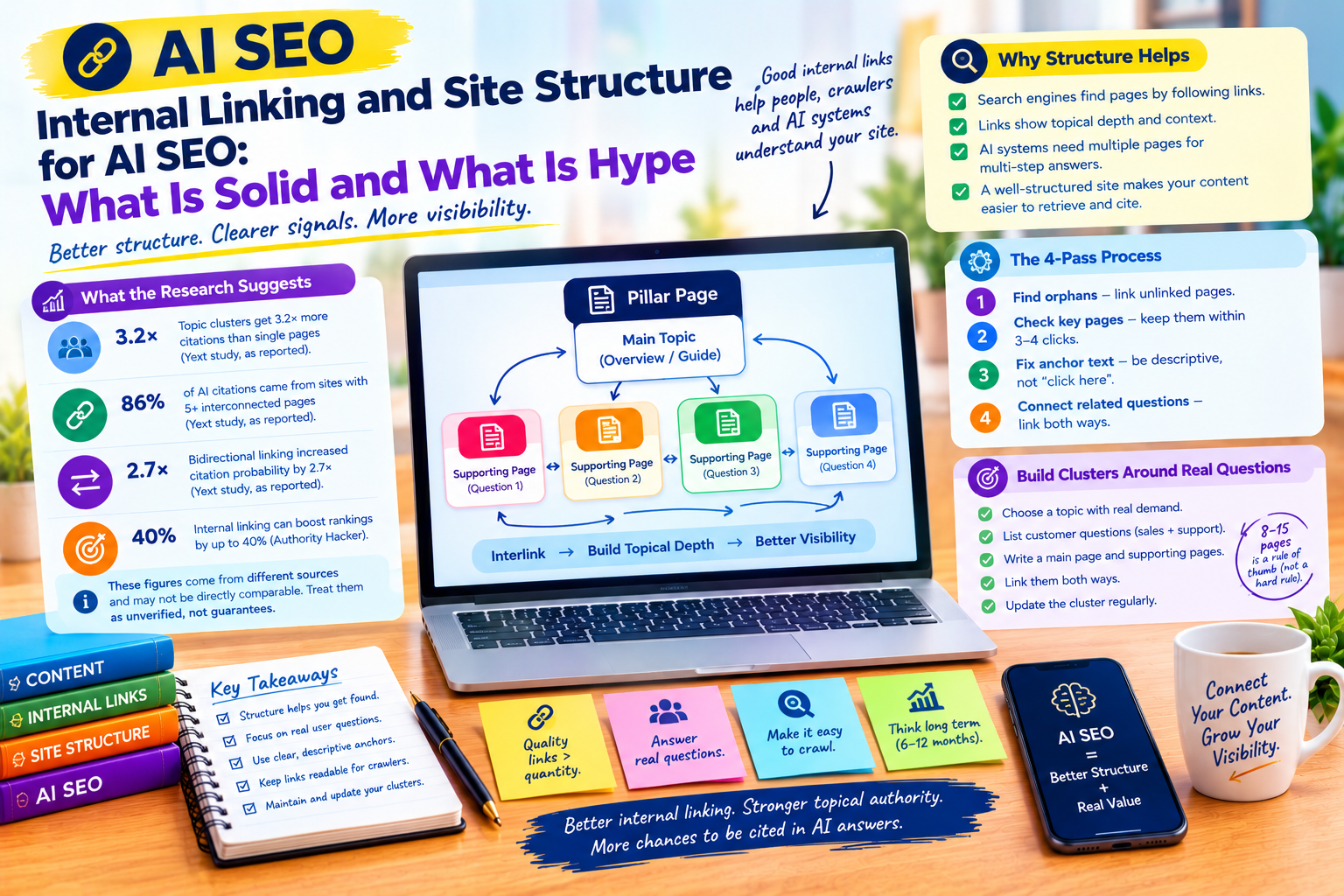
Internal links are the cheapest lever on any website, AI SEO is exactly why they attract so many exaggerated claims. Topic clusters, hubs and pillar pages are now sold as the secret to AI citations, often with precise multipliers attached. At Sarkar SEO, we think structure matters, but we also think you should know which claims have real support. Here is a plain account.
Why Structure Helps, in Plain Terms
The logic does not depend on any statistic. Search systems find pages by following links, and they judge a page partly by its surroundings. One guide notes that without internal links, pages can become invisible to Google, even if the content is strong. Another says that when a crawler finds multiple interlinked pages covering a topic from different angles, it interprets that as genuine topical depth. That second point is an interpretation, not a documented rule, but it matches how most practitioners understand topical coverage. contentgripprofiletree
AI answers add a second reason. Systems that split a question into several lookups need pages for each part. A site that covers the surrounding questions and connects them clearly gives more to retrieve.
The Statistics in Circulation
Several numbers appear on page after page. One guide says websites with topic clusters receive 3.2× more citations than single-page competitors, 86% of AI citations came from sites with five or more interconnected pages, and bidirectional internal linking increased citation probability by 2.7×, attributing this to a Yext study of 6.8 million citations. Others cite pages ranking for both main and fan-out queries being 161% more likely to be cited in AI Overviews, credited to an analysis passed on by an agency, and internal linking boosting rankings by up to 40%, credited to Authority Hacker. Topic Clusters for SEO: Build Content That Ranks (2026 Guide) +2
I could not trace any of these to an original report. The 3.2× figure in particular is repeated across agency blogs and sometimes credited to a different source each time. Several of those agencies sell content services. Treat the numbers as unverified, and do not put them in a client proposal.
Even if accurate, they would show correlation. Sites with five connected pages on a topic are probably also the sites that know the topic well, publish consistently and earn more mentions.
Rankings Are Not the Whole Story
One article claims that only 38% of pages cited in Google AI Overviews ranked in the top 10 organic results, down sharply from 76% in July 2025, attributing it to Ahrefs. Earlier in this series we saw other analyses that put the overlap much higher, so measurement clearly varies. The practical lesson is cautious: do not assume that ranking well guarantees a citation, or that ranking poorly rules one out. Pages are chosen for how well they answer a specific part of a question.
What You Can Reasonably Do
This four-pass process is our own working method.
Pass 1: Find orphans. Crawl your site and list pages with no internal links pointing to them. Link them from relevant pages, merge them into stronger ones or remove them.
Pass 2: Check your important pages. Your core service, product and guide pages should be reachable in a few clicks from the homepage through normal links. A page buried six levels down sends a weak signal about its importance.
Pass 3: Fix anchor text. Use descriptive anchors that tell readers where the link goes, such as “checklist for auditing product feeds”, not “click here”. Avoid using the identical anchor for different pages.
Pass 4: Connect related questions. Link from each page to the next question a reader is likely to ask, and link back to the overview. Two-way links between related pages help both readers and crawlers.
Build Clusters Around Real Questions
A cluster is a main page plus supporting pages, linked together. Some guides say the consensus is 8 to 15 cluster pages per pillar. Treat that as a rule of thumb from one agency, not a requirement. A smaller number of genuinely useful pages beats a long list of thin ones. One guide warns that search engines interpret sparse clusters as shallow coverage of the topic. That is plausible, but the remedy is real substance, not padding.
A practical build looks like this:
- Choose one topic where you have real expertise and customer demand.
- List the questions customers ask about it, drawing on sales and support notes, as our prompt research article explains.
- Write a main page that summarises the topic, answers the main question directly and links to each supporting page with a one-line description.
- Write supporting pages, each answering one question fully with specifics.
- Link them both ways and add a short “next steps” link where it helps the reader.
- Update the hub whenever you add or change a supporting page.
Keep the Links Readable by Machines
Use ordinary HTML links in the page content. Links created only by scripts, or hidden in menus that load after the page renders, may not be seen by every crawler, as our earlier article on crawler access explained. Place important links within the body text near relevant passages, not only in footers or sidebars. Do not exceed what is sensible on a page. One agency suggests 30 to 60 outbound links as a practical range, but this is again a rule of thumb from a tool vendor, so let readability decide.
Maintenance Matters
Clusters decay. Pages become outdated, links break and new content is added without connections. One guide says full impact, including improved domain authority and AI citations, usually takes six to twelve months. That timescale is another agency estimate, but it is a sensible reminder to plan for months, not weeks. Review each cluster quarterly: check links, update facts and consider merging pages that overlap.
Common Mistakes
- One-way links. The main page links out, but nothing links back.
- Link stuffing. Cramming links into every paragraph.
- Generic anchors. “Learn more” tells neither readers nor systems anything.
- Duplicate pages. Several near-identical pages compete with each other.
- Mass-produced variants. Hundreds of thin pages created to fill a cluster carry the risks covered in our spam policy article.
A Simple Test
Pick two topics of similar size. Restructure one with the four passes and leave the other alone. Track crawl coverage, rankings, AI citations for buyer-worded questions and enquiries over several months. Because AI answers vary, check each question many times. If both look alike, you have saved yourself from over-investing, and that is useful too.
