



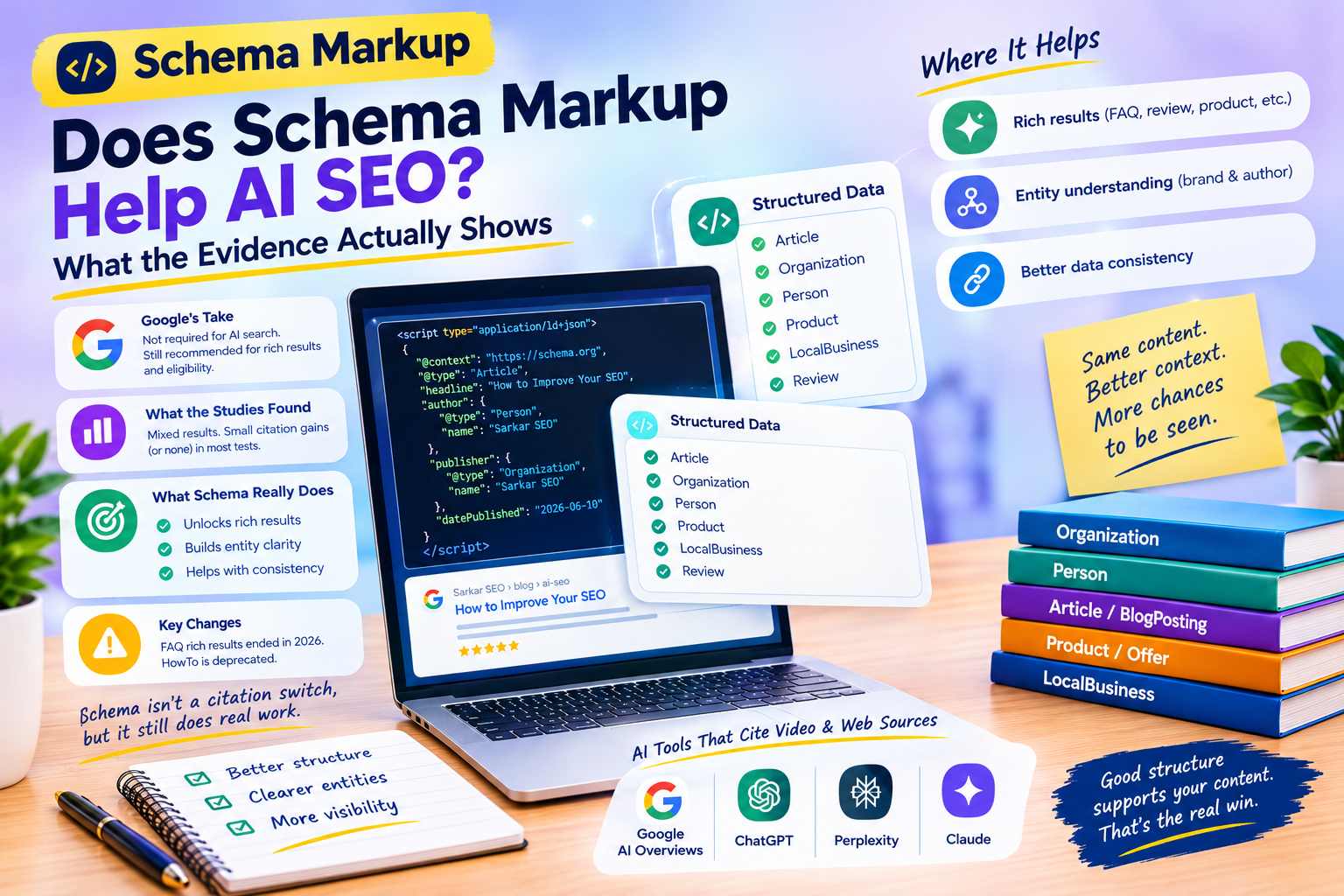
Few topics in AI SEO attract more confident claims than structured data. Add the right JSON-LD, the pitch goes, and AI systems will notice you. The reality is more modest and more useful. Schema is not a citation switch, but it still does real work when you understand what that work is.
What Google Says
Google’s guidance on generative AI features is direct, as quoted in several secondary guides: structured data isn’t required for AI search, and no special schema.org markup needs adding. It also says continuing to use structured data is a good idea, because it can make pages eligible for rich results. In the same spirit, Google reportedly describes optimizing for generative AI search as still being SEO.
So the first rule is simple: there is no “AI Overviews schema.” Anyone selling one is selling something Google says doesn’t exist.
What the Studies Found
The evidence is mixed, and the disagreement is instructive.
The controlled test. In May 2026, Ahrefs compared 1,885 pages that added JSON-LD between August 2025 and March 2026 with about 4,000 control pages that didn’t. As reported by Gist and Pixis, citations barely moved: roughly +2.4% in Google AI Mode, +2.2% in ChatGPT (statistically indistinguishable from zero) and a 4.6% relative decline in AI Overviews. A separate study by Marshal reportedly found no significant citation advantage for generic types such as Article and Organization.
The caveats. The same coverage notes the Ahrefs sample consisted of pages already receiving substantial citations, and it pooled several schema types together. A page with no AI visibility might behave differently.
The opposing evidence. Analyzify’s roundup lists other studies, including ones from Digital Applied and UC Berkeley, that found positive correlations between schema and citations, with Google AI Overviews showing the strongest response. Correlation is weak evidence here, because well-optimized sites tend to use schema and also tend to earn citations for other reasons.
One insider hint. Icoda reports that at an April 2026 Search Central event, a Google structured-data engineer said schema is used as context served to models during query fan-outs. I couldn’t confirm that from a primary source, so treat it as suggestive, not settled.
The fair summary: adding schema to a page that already deserves citation does not reliably increase them, and nobody has shown that it causes them.
What Schema Is Actually For
At Sarkar SEO, we describe structured data’s job in three parts, none of which involves guaranteeing a citation.
- Eligibility for search features. Supported markup can unlock rich results for products, reviews, events, articles and other formats. That benefit is real, measurable and independent of AI.
- Entity clarity. Organization, Person and sameAs markup tells machines which brand, author and profiles belong together. This helps disambiguate you from similarly named companies, which matters when engines build an answer about “who is this business?” Several guides call entity markup the area where careful structured data has the best return for the effort.
- Consistency checks. Pixis and others stress that structured data should describe what’s visible on the page. When markup says one price and the page says another, the mismatch undermines trust, and Google’s guidelines warn against markup for content users cannot see.
What Changed for FAQ and HowTo
Two shifts matter if your strategy leaned on these types. According to Icoda and Globerunner, Google announced on May 7, 2026 that FAQ rich results would stop appearing in Search, with support removed from Search Console and the Rich Results Test by June 2026. HowTo rich results on desktop were deprecated in 2023.
Globerunner adds that Google hasn’t confirmed any direct link between FAQ schema and AI citations. The underlying question-and-answer content still helps readers, so keep real FAQs on the page, written as prose people can read. Just don’t expect the markup alone to carry any weight.
A Practical Priority List
Start with the types that serve the three jobs above, and skip the rest until you need them.
- Organization. One consistent legal or trading name, canonical URL, logo, contact details and sameAs links to profiles you actually control. Put it on the homepage.
- Person for authors. Link each byline to a real author page with credentials, and connect articles to the publisher’s Organization entity.
- Article or BlogPosting. Include headline, author, published and modified dates. Keep dates honest and tied to real edits.
- Page-specific types. Product, Offer and Review for ecommerce, LocalBusiness for local services, and so on, only where the page genuinely shows that information.
- BreadcrumbList. Cheap to add and helps clarify site structure.
Implementation Rules That Prevent Damage
- Use JSON-LD and validate it. Superblog notes that invalid markup is silently ignored, so errors waste effort without warning.
- Match visible content. Never mark up reviews, FAQs or prices that readers cannot see.
- Keep it current. Contently warns that stale or inaccurate structured data can hurt more than having none.
- Test the rendered page. Use Google’s Rich Results Test for supported features and the URL inspection tool in Search Console to confirm Google can read the live markup.
- Don’t expect chatbots to read it. One guide suggests live-browsing tools from ChatGPT, Perplexity and Claude may ignore schema, though I couldn’t verify this. Write clear visible text regardless.
