



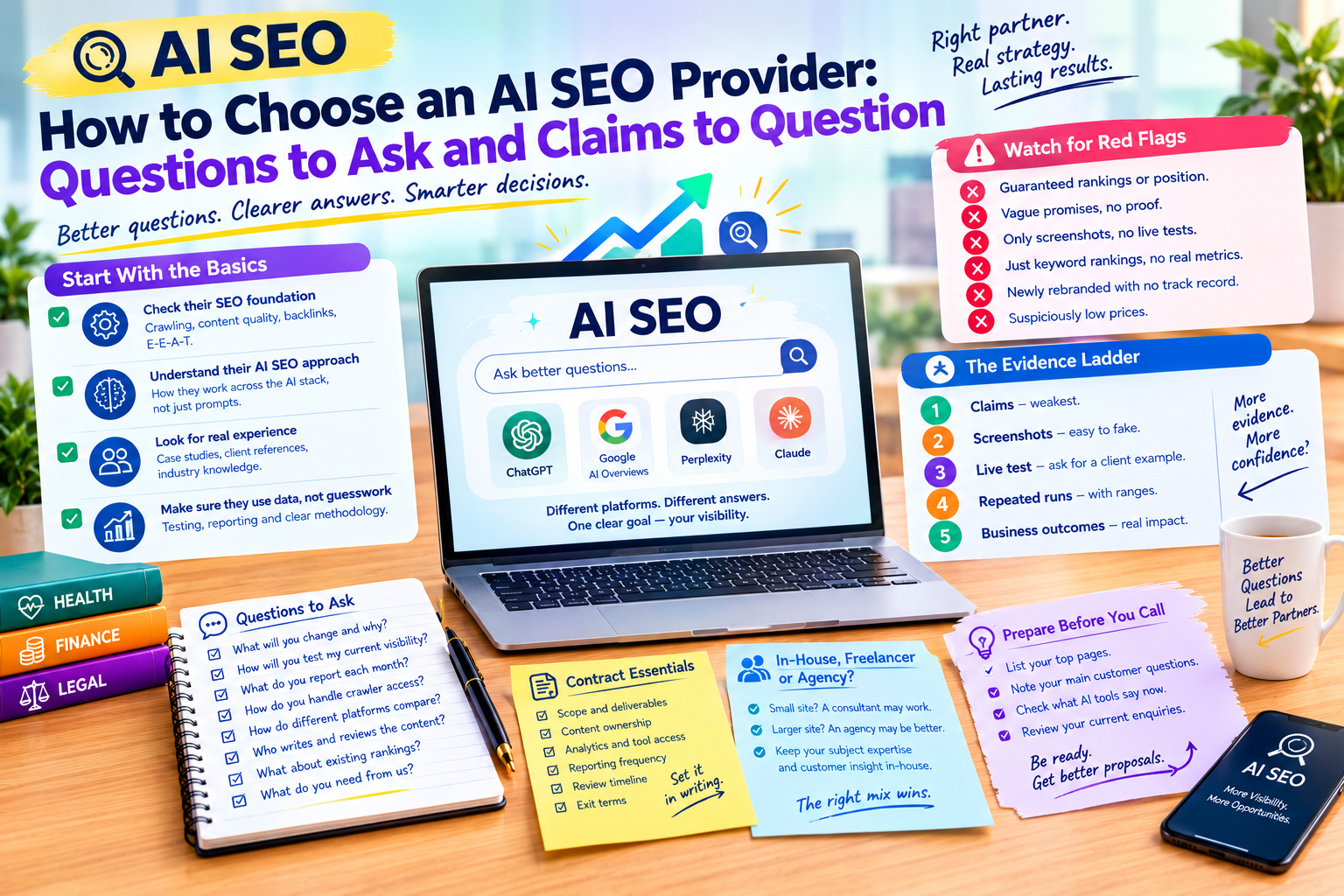
Every SEO provider now offers AI SEO. Service pages were updated, new acronyms appeared, and proposals started mentioning ChatGPT. Some of that work is real and some is old SEO with a new label. At Sarkar SEO, we would rather you hire well, even if that is not us, than sign with someone who cannot deliver. Here is a practical way to judge any provider, including us.
A Note on the Sources
The guides on this topic are mostly written by agencies, who have an obvious interest in how you choose. I have used them where they agree with each other and with independent evidence, and flagged the rest. Treat any “how to choose” advice, including this, as input to your own judgement.
The Foundations Still Matter
A recurring point among these guides is that AI visibility sits on top of ordinary SEO. One agency article puts it as “there is no GEO without SEO,” and suggests that a sound selection process starts with a baseline audit covering rankings, crawlability, backlink profile and E-E-A-T signals. That fits what Google has said about its AI features, as covered earlier in this series. revnewrevnew
So a provider who talks only about prompts and skips crawling, content quality and authority is skipping the part that most AI results depend on.
A Useful Way to Sort Providers
One guide organises GEO work into four layers: being reachable by AI systems, being understood correctly, being chosen on the strength of your evidence, and being measured. It advises choosing by how far down the stack they work, not by what they claim to specialize in. The author sells a GEO service, so note the interest, but the layered view is a good test. Ask a provider which layers they cover and how they would prove each one.
Red Flags
A guaranteed position. This is the most consistent warning across sources. One guide states it plainly: a good agency never promises a guaranteed spot in an AI answer. Another says anyone promising first position in ChatGPT doesn’t understand how AI search works. The reason is covered in our article on tracking: answers change from run to run, so no one controls the outcome. lilachbullockfigmentagency
Pitches that conflict with evidence. The same four-layer guide names guaranteed rankings, llms.txt as a centerpiece, and schema markup sold as an AI citation lever as pitches that conflict with published evidence. Our schema article explains the details. Markup and files can be useful housekeeping, but they should not be the whole plan.
Reporting that is just rankings. One guide says that if reporting focuses only on keyword rankings or organic traffic, they’re offering traditional SEO under the AI SEO label. That is a fair prompt to ask what they track beyond clicks.
Rebranded overnight. One agency notes that every SEO agency added “AI Visibility” to their service page after a major platform announcement. A recent start is not disqualifying, but it means you should ask for evidence of results, not credentials.
Bargain prices for a full service. One UK agency says anyone offering comprehensive AI search work for £500 monthly either doesn’t understand the work involved or is providing superficial services. Another US agency suggests mid-sized businesses typically pay $2,500 to $10,000 per month. Both are opinions from sellers in different markets, so use them only as a sanity check and compare several quotes. figmentagencygloberunner
Our Evidence Ladder
This framework is our own, to help you weigh the proof a provider offers. Climb as high as you can.
- Claims. “We have AI expertise.” Weakest.
- Screenshots. Easy to cherry-pick and impossible to check.
- A live test. One guide suggests asking for a client name and, with their permission, testing whether that client’s business gets cited in ChatGPT or Google’s AI Mode in front of the agency during your conversation. Remember that a single run proves little.
- Repeated runs with ranges. The provider shows many runs per prompt and reports ranges, not single scores.
- Business outcomes. Enquiries, sales or branded demand linked to the work, with the method explained.
A provider who cannot reach step 3 or 4 should say so honestly.
Questions Worth Asking
Adapted from several guides and our own view:
- What will you change on my site, and why? Expect specifics, not slogans.
- How will you test where I stand today? The answer should include buyer-worded prompts and repeated runs.
- What do you report each month? Look for AI visibility, traffic, enquiries and notes on what changed.
- How do you handle crawler access? One guide says a serious team will mention robots.txt configuration for specific AI crawlers. Also ask whether key content renders without JavaScript.
- How do platforms differ? One guide suggests asking how ChatGPT’s source selection differs from Perplexity’s.
- Who writes and reviews content? Ask about expert review and fact-checking, particularly for sensitive topics.
- How do you protect my existing rankings? Changes should not put current traffic at risk.
- What do you need from us? Good work depends on your product knowledge and access.
Contract Points
Agree these in writing: the scope and deliverables, who owns the content and accounts, whether you retain full access to analytics and tools, how reporting works, how long before you review progress, and how you can end the contract. Avoid any clause that promises outcomes you cannot verify.
In-House, Freelancer or Agency?
A small business with few pages may do well with a consultant and clear priorities. A larger site with many stakeholders may need agency capacity. Keeping part of the work in-house, such as subject expertise and customer insight, usually improves results whoever you hire, because those are hard to outsource.
What to Do Before You Call Anyone
Spend an hour gathering a baseline: your top pages, your main customer questions, what AI tools say when asked those questions, and your current enquiries. This lets you judge any proposal against something real.
