



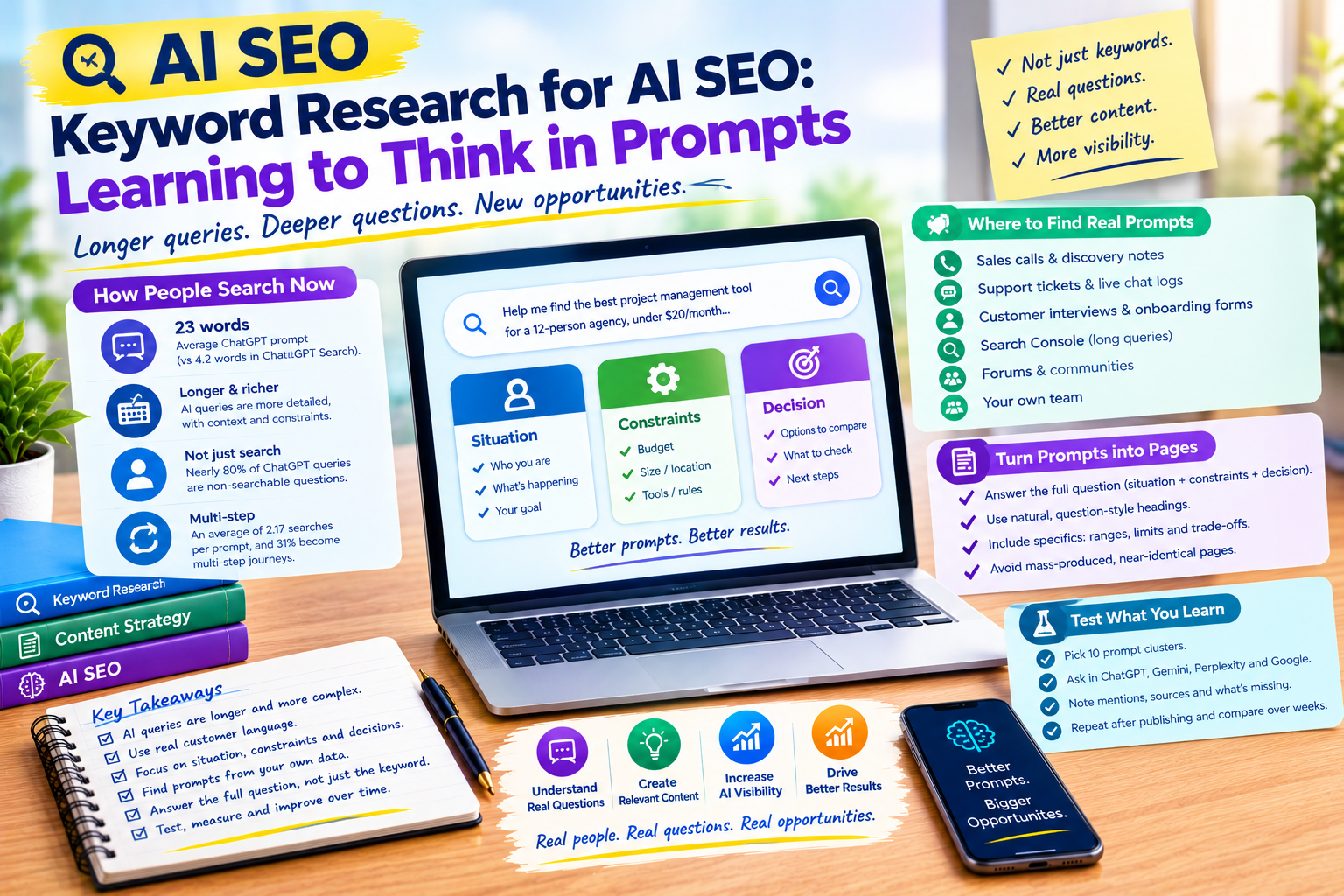
Keyword research was built for people who type two or three words. AI SEO assistants invite something different: a paragraph describing a situation, a set of constraints and a decision to make. If your content plan comes only from a keyword tool, you may be answering questions nobody asks any more and missing the ones they do. At Sarkar SEO, we think of this as an extension of keyword research, not a replacement, and this article shows how to do it.
How Much Longer Are AI Queries?
The honest answer is that it depends on which tool and which mode, and published figures conflict. A Semrush study, as summarised by Otterly, found that the average ChatGPT prompt is 23 words long, compared with just 4.2 words when ChatGPT Search is switched on. A statistics roundup instead says that Perplexity and ChatGPT Search queries average 23 words, compared with 5.2 on classic Google. Those two claims contradict each other about the same 23-word figure.
Other estimates vary again. One source says the average Google AI Mode query is 7.22 words, and Search Engine Journal, citing Google’s I/O 2026 data, reports that the average AI query is three times longer than a traditional search. A guide from AirOps adds that around 60 percent of AI prompts are 10 words or longer. AI Search Query Length Statistics (2026) | STARTUP EDITION +2
Do not pick one figure and quote it. The reliable takeaway is that conversational prompts are longer and richer than keyword searches, and that web-search modes pull them shorter again.
What the Longer Prompts Contain
The Search Engine Journal piece says AI Mode queries are marked by action-oriented commands like “explain” and “summarize” and notable use of the pronoun “I,” suggesting a personal, dialogue-style request. The same article says these queries are heavily weighted toward evergreen content (75.2%). That implies steady, reusable topics matter more than news-driven ones. searchenginejournalsearchenginejournal
AirOps makes a commercial point: the highest-value prompts are long, specific queries where someone describes their exact use case, required features and integrations. They note that keyword tools and Search Console surface only the head of the distribution and will not reveal the complex prompts people type into AI tools. AirOps sells AI tooling, so keep that in mind, but the logic holds.
People Also Use AI for Non-Search Tasks
Not every prompt is a search. A summary of Microsoft Research work on more than 200,000 ChatGPT interactions reports that almost 80% of queries were “non-searchable” questions that could not easily be answered through a traditional Google-style search. That is a secondhand claim from a newsletter, so verify it before relying on it. Still, it is a reminder that many prompts ask for advice, drafting or reasoning, and these are not content opportunities in the usual sense.
Multi-Step Conversations
One prompt may trigger several lookups. A Nectiv study reported through Ignite Visibility says ChatGPT conducts an average of 2.17 searches per user prompt, and 31% of prompts evolve into multi-step journeys. People refine, add constraints and follow up. A page that answers only the opening question may be dropped when the second one arrives.
Do Not Abandon Short Keywords
Short queries remain important. A Peec study of 500,000 prompts found that two-word queries got a Google AI Overview 64.6% of the time, rising to 89.1% at 11 to 15 words. That suggests short queries are affected too. Treat that dataset with caution, since its overall average of 87% is far above other estimates, such as 30 to 40 percent of Google queries from AirOps. Different tracked prompt sets produce different results.
The sensible position, as one commentator puts it, is that the rise of AI search does not mean businesses should abandon keyword research or traditional SEO. Keep your head terms, and add the long tail.
Our Prompt Anatomy Method
This framework is our own. Most useful long prompts contain three parts:
- Situation: who the person is and what is going on. “We are a 12-person agency running 30 client sites.”
- Constraints: budget, size, region, tools, rules. “Must work with our existing CRM and cost under a set amount.”
- Decision: what they need to choose or do. “Which option should we pick, and what should we check first?”
Your pages should help with all three. Many sites cover the generic topic, then fail on constraints, which is where recommendations are made.
Where to Find Real Prompts
No tool shows what people type into ChatGPT, so gather proxies:
- Sales calls and discovery notes. Customers describe situations and constraints in their own words.
- Support tickets and live chat logs. These show real problems in full sentences.
- Customer interviews and onboarding forms. Ask how they researched you.
- Search Console. Filter for long queries. They show the longer tail you already attract.
- Forums and communities. Look for detailed questions in your field, using the public posts only.
- Your own team. Ask frontline staff for the five questions they hear most.
Cluster what you collect by situation, constraint and decision. Do not invent search volumes for prompts. Nobody has reliable public figures, so use frequency in your own data.
Turn Prompts into Pages
For each cluster, plan a page or section that states the situation, answers it directly and addresses the common constraints. Examples include “X for teams under ten people”, “X when you must stay within local regulations” and “how to choose between A and B if you already use C”. Use plain headings that match how people talk, add a short answer near the top and give specifics such as ranges, limits and trade-offs.
Avoid producing hundreds of near-identical pages. Earlier in this series we covered why mass-produced variants carry risk. Choose clusters with real demand and write each page properly.
Test What You Learn
Take ten of your best prompt clusters, write them as buyer-worded questions and ask them in the AI tools your customers use, many times each. Note whether you appear, what constraints the answers consider and what sources they cite. Repeat after you publish and compare over several weeks.
