



Most brands treat video and search as separate projects. One team makes videos, another writes pages and neither expects the work to meet. AI SEO search is blurring that line. When an assistant explains how to fix a leaking tap or compare two software tools, it often points to a video, and it doesn’t “watch” the footage to do so.
What the Research Suggests
The numbers on YouTube’s share of AI citations vary, and the variation itself is a warning.
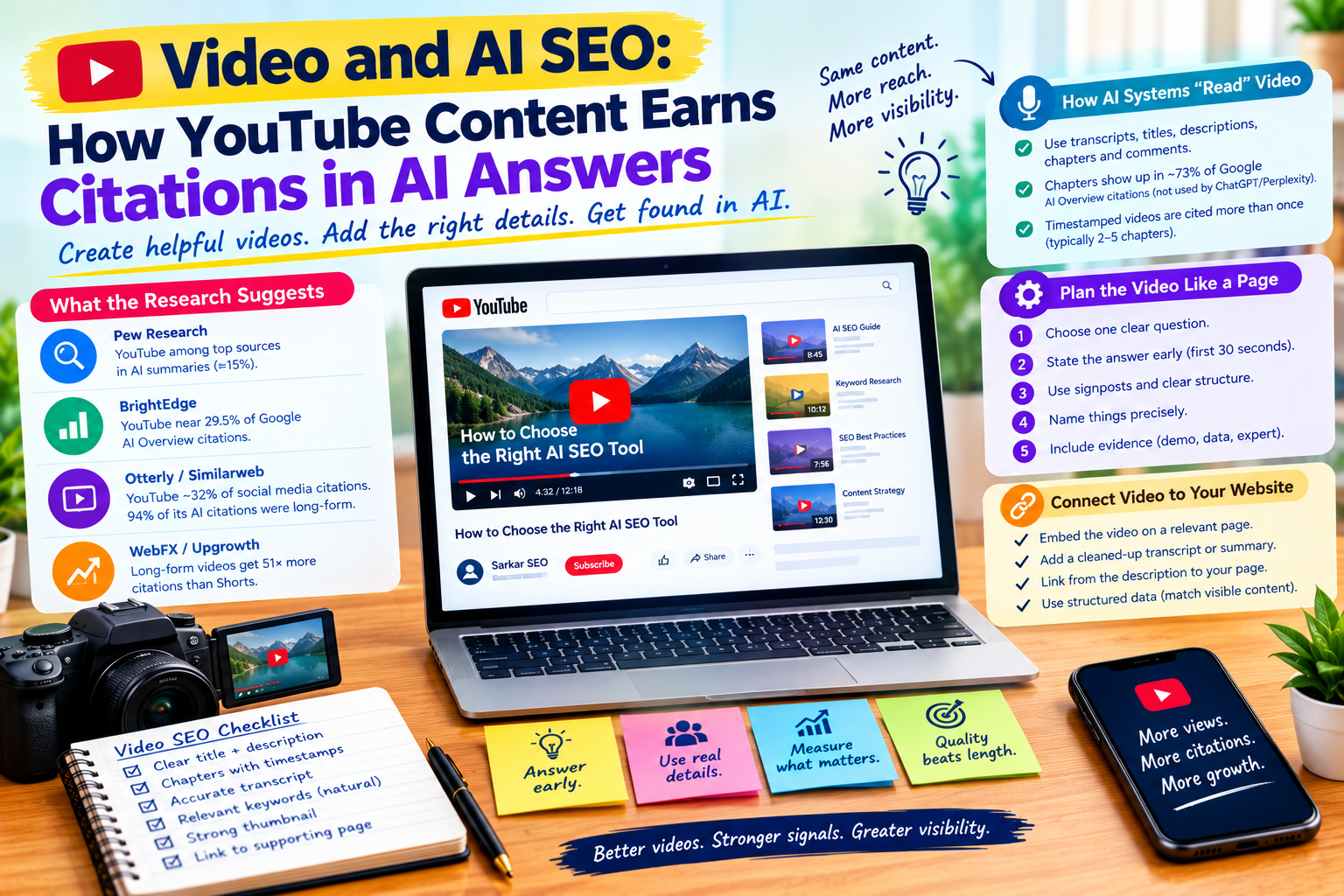
- Pew’s browsing study found Wikipedia, Reddit and YouTube among the most-cited sources in Google’s AI summaries, together appearing in about 15% of them.
- BrightEdge, as relayed by Veed and Quattr, reportedly puts YouTube near 29.5% of Google AI Overview citations in October 2025, making it the top domain in that dataset.
- Otterly’s study, summarized by Similarweb, says YouTube accounts for about 32% of social media citations across six AI platforms, and that about 94% of its AI citations went to long-form video, not Shorts. A WebFX-reported study puts the social share at 38.1%, and a separate analysis cited by Upgrowth claims 51 times more citations for long-form than for Shorts.
These figures use different samples, definitions and dates, so they can’t be directly compared. What they agree on is the direction: YouTube is a major source, and long-form, explanatory video is what gets used.
How AI Systems “Read” Video
AI tools mostly don’t analyze pixels when answering a text question. They rely on text associated with the video: the transcript, title, description, chapters and comments. Several guides, including Yotpo’s and Upgrowth’s, describe transcripts as the core layer an AI system works from. I couldn’t verify how each engine uses them internally, so treat that as a practitioner consensus.
Quattr reports that timestamped chapters show up in about 73% of Google AI Overview video citations and 27% of AI Mode citations, and that other assistants such as ChatGPT and Perplexity don’t currently use them. Similarweb, citing Otterly, adds that among timestamped videos cited by Google’s AI features, 78% were cited more than once, typically across two to five chapters. These come from vendors, so verify before relying on them, but they fit a simple logic: a chaptered video is easier to quote than a single unbroken file.
Plan the Video Like a Page
At Sarkar SEO, we treat a video script as a structured document that happens to be spoken. A useful sequence:
- Choose one question. “How does a heat pump work in winter?” is a better target than “Heat pump tips.” Specific questions match specific prompts.
- State the answer early. Give the short answer in the first 30 seconds, then explain. Yotpo warns that long preambles can make a video read as low in information.
- Use clear spoken signposts. Say what each section covers: “First, what it costs. Second, how long installation takes.” Spoken structure produces cleaner transcripts.
- Name things precisely. Say the product, concept or term out loud rather than “this” or “that thing.” If the speech is all pronouns, the transcript tells a machine little.
- Include evidence. Show a test, a calculation, a screenshot or an expert demonstration, and say what it demonstrates. That’s the original material AI systems look for.
Optimize the Metadata
- Title. Make it a plain description of what the video answers, often phrased as the question.
- Chapters. Add timestamps with descriptive names, such as “Installation costs” instead of “Part 3.” They act like headings.
- Transcript. Auto-generated captions contain errors, especially with names and technical terms. Upload or correct a transcript, and break it into readable paragraphs.
- Description. Open with a two-sentence direct answer, followed by a short summary of each chapter, links to sources and a link to a fuller written guide on your site.
- Thumbnail and title promise. These drive human clicks, which still matter for YouTube’s own recommendations.
Connect Video to Your Website
A video alone doesn’t build your site’s authority. Pair them:
- Embed the video on a page that covers the same question in written form.
- Publish a cleaned-up transcript or summary beneath it, so the page stands on its own.
- Link from the video description back to that page.
- If you add video structured data, make sure it matches the visible page, and note that Google says no special markup is required for AI features.
This gives each asset a job: the video earns attention and citations in video-friendly engines, while the page captures readers who want to scan.
Long-Form, Shorts and Effort
The research cited above points to long-form explanatory video as the main source of citations. Short clips may still help with awareness, but if your goal is being cited for a how-to or comparison, a focused 8 to 15-minute video tends to give an engine more to quote than a 30-second teaser. Quality beats length, though: Upgrowth’s guide argues a tight 10-minute video with a clean transcript can outperform a rambling 45-minute one, which is one vendor’s claim but a sensible rule.
You don’t need a studio. Clear audio, a steady script and honest demonstrations beat polish. If resources are limited, convert your best-performing written guides into videos before creating anything new, since you already know the questions people ask.
Measurement and Realism
AI video citations are hard to track. Similarweb notes that they don’t appear in YouTube Analytics or Search Console. To measure progress:
- Test your target prompts monthly across ChatGPT, Perplexity, Gemini and Google’s AI features, and record whether your videos are cited.
- Watch watch time, retention and traffic from video descriptions to your site.
- Check branded search and direct visits for lift after releases.
- Review chapter-level performance in YouTube Analytics to see which sections hold attention.
Be careful with causation. A video that’s cited may also be well produced and popular for other reasons.
Mistakes to Avoid
- Making video for the algorithm only. A boring video with perfect metadata still fails viewers.
- Ignoring accuracy. A flawed auto-transcript can spread wrong terms or numbers into AI answers.
- Keyword stuffing descriptions. Plain summaries serve people and systems better.
- Posting once and forgetting. Refresh descriptions and pinned comments when information changes.
