



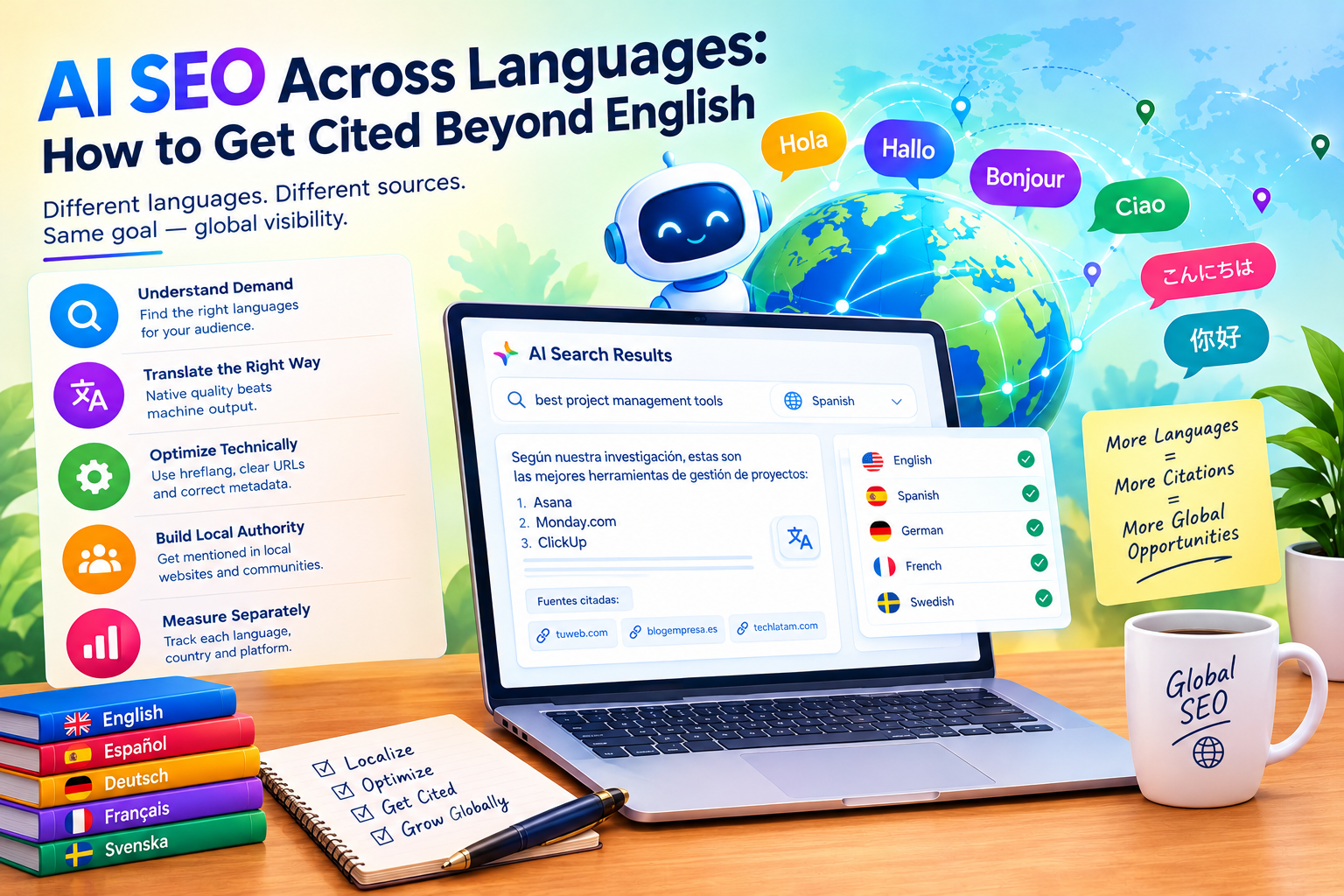
A great deal of AI SEO advice quietly assumes the customer types in English. For a business serving people worldwide, that assumption can cost visibility. When someone asks an AI assistant a question in Spanish, German or Swedish, the answer may lean on very different sources than the English version of the same question. Sarkar SEO works with the idea that international reach is now part of AI SEO, not a separate project, so here is what the evidence says and what to do about it.
Language Shapes Which Sources Get Cited
Researchers have started measuring this. One analysis of more than 7 million AI-generated citations covered 4 models, 6 non-English languages, 12 countries and 47 industries, and found that for non-English prompts, the share of cited sources that actually match the prompt’s language varies enormously by model.
Some engines lean on English more than others. In that study, 39.6% of Grok’s citations default to English on non-English prompts, while Google AI Overviews showed an English rate of just 8.7%. The same report notes that Romance languages consistently fare better. Lost in Translation +2
The practical meaning is simple. An English-only site may be cited by some engines for foreign-language questions, but the engine closest to traditional search is more likely to prefer pages in the user’s own language.
What the Translation Studies Show, and What to Doubt
The most quoted figure comes from Weglot’s analysis of 1.3 million citations across Google AI Overviews and ChatGPT. It reported that translated websites saw up to 327% more visibility in AI Overviews than untranslated ones. A related summary adds that translated sites gained on average 24% more total citations per query, including a 16% increase in citations for the original content. searchenginejournaldeepl
Treat these numbers carefully. Weglot sells website translation software, and several articles repeating the figures come from translation vendors. The studies show association, not proof that translating caused the gain, and “up to” figures describe the best case, not the typical one. They are good reasons to test a second language, not reasons to translate everything at once.
Start with Demand, Not Language Count
More languages do not automatically mean more traffic. A cheaper and smarter starting point is a short market check:
- Look at your existing data. Which countries and languages already send visitors, enquiries or sales?
- Check Search Console by country. Impressions in a country where you have no local page are a useful clue.
- Ask sales and support teams. Which languages do customers request?
- Test the questions. Put your buyers’ common questions into AI assistants in the target language. If competitors are cited and you are absent, that is a gap.
Pick one or two languages and do them well. This is a worldwide strategy built one market at a time.
Quality Beats Quantity
Raw machine translation published at volume brings risk. Google’s spam policies, as covered widely in 2026, target mass-produced pages with little original value, regardless of method. One localisation guide also argues that AI engines trained on multilingual web data favour content that reads as native, not content that was clearly machine-translated and shipped. That claim is a practitioner’s view, not a verified fact, but it matches common sense: awkward wording reduces trust with readers too.
A sound process is to translate with tools if you wish, then have a fluent speaker who understands the industry review terminology, examples, units, currency and legal references. Better still, localise the substance. A guide on pension rules for the UK cannot simply be translated for Germany.
Get the Technical Signals Right
Language versions need clear labelling. Hreflang tags tell search systems which version suits which audience, and mistakes are common. One practitioner who runs a site in 13 languages reported that hreflang and x-default correctness, llms.txt scope and schema consistency across locales were the first things to break once he looked beyond English. Notice that llms.txt remains an unofficial convention, and Google has said no special AI file is required.
A short checklist:
- Reciprocal tags. Each language version should point to the others, and each should point back.
- Distinct URLs. Use separate, crawlable URLs per language, not content that changes by browser setting alone.
- No fake translations. Do not tag an English page as the Spanish version of itself.
- Translated metadata and markup. Titles, descriptions, headings and structured data should be in the page language.
- Sitemaps. Include every language version, not only English.
Remember Engines Beyond the Big Three
Global audiences do not all use the same tools. The same practitioner points out that Yandex runs its own generative answer layer for Russian-language queries and has meaningfully more share of Russian search than Google does. Other regions have their own leading platforms. Before building for a market, check which search and AI tools people there actually use.
Build Local Authority Too
Earlier in this series we noted that other websites shape how AI describes a brand. The same applies per country. A mention in a respected English trade site does little for a Portuguese-language question. Seek local directories, industry associations, press and communities in each target language. This takes longer than translation but is often what separates a translated site from a trusted one.
Measure Each Language Separately
Combine languages in one report and you will miss what is working. Track visits, engagement and enquiries by language and country, and run a fixed set of AI prompts in each language every month. Expect noise, since answers vary between sessions. Compare trends over several weeks, and keep notes on what you changed.
A Practical First Quarter
In month one, choose one market and audit demand. In month two, localise your five most commercial pages with native review, fix hreflang and publish. In month three, start earning local mentions and compare results against your baseline. Only then consider the next language.
