



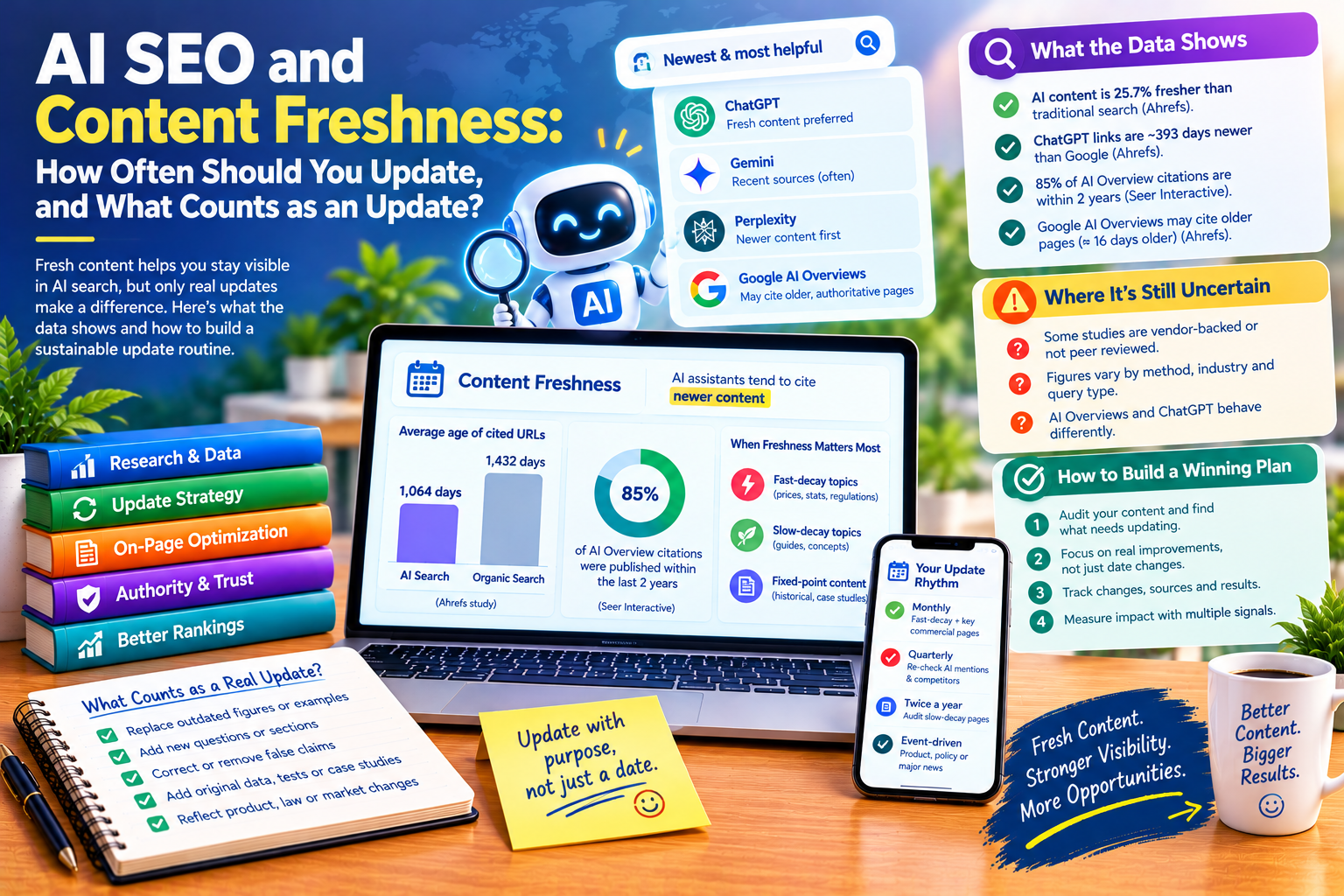
Many teams have run on one rule for years: publish evergreen content and let it compound. AI SEO search puts pressure on that rule. Several studies suggest AI assistants lean toward newer sources. But the evidence is uneven, and the lazy response, changing dates and calling it fresh, is likely to backfire.
This guide covers what the research really shows, where it is overstated, and how to build an update routine that serves readers first.
What the Largest Study Found
The most credible dataset comes from Ahrefs, which examined about 17 million citations. According to a summary of the work, AI assistants cite content that is 25.7% fresher than what ranks in traditional organic search. The average cited URL was 1,064 days old, against 1,432 days for organic Google results. marketingmarketing
Platforms differ sharply. In the Ahrefs data, ChatGPT’s reference URLs were about 393 days newer than those in organic Google search, and ChatGPT and Perplexity both tended to cite newer content first in their reference lists.
Google’s AI Overviews are the exception. The same analysis found they were among the most likely to cite older pages, about 16 days older than organic results. One explanation offered is that AI Overviews draw on the same core ranking systems as classic search, so freshness works as one input among many, not a gate.
A separate study by Seer Interactive looked at more than 5,000 citation URLs and reported that about 85% of AI Overview citations were content published within the last two years, with roughly half of Perplexity’s citations coming from 2025 alone. seerinteractive
Treat the Bold Claims With Care
You may see sweeping figures online: half of all citations come from the last 13 weeks, or a majority of ChatGPT citations come from pages updated within 30 days. These circulate through vendor blogs and are repeated without clear methodology. I could not trace them to a primary source I could verify.
The more careful commentary pushes back too. One analysis notes that although ChatGPT often favors recent pages, 29% of its citations come from 2022 or earlier on queries where authority outweighs recency, and concludes that “freshness dominates everything” overstates the case. Ahrefs itself cautions that AI assistants still prefer long-lived content, and low-quality content updated every day won’t have a magic positive effect.
So a balanced reading is: recency helps in many AI assistants, especially for fast-moving topics, but it doesn’t replace authority, accuracy or usefulness.
When Freshness Matters Most
Not every page needs attention at the same pace. Sort your content into three groups.
Fast-decay topics. Prices, comparisons, tool features, regulations, statistics, “best of” lists, anything with a year in the question. A stale page here isn’t just less attractive; it’s wrong.
Slow-decay topics. Explanations of concepts, processes and principles. A page on how a mortgage works rarely needs rewriting each quarter, but it needs a periodic accuracy check.
Fixed-point content. Historical records, case studies, announcements. These should stay as they are, perhaps with a dated note.
Sarkar SEO starts content reviews with this split, because spending the same effort on all three groups wastes time and tends to produce cosmetic edits.
What Counts as a Real Update
One article on this topic makes the point sharply: the freshness signal rewards genuine content improvement. A real update does at least one of the following:
- Replaces outdated figures, screenshots or examples
- Adds a section answering a question readers now ask
- Corrects or removes claims that are no longer true
- Adds new first-party data, a test or a case
- Reflects changes in the product, law or market
What does not count: swapping the date, adding a sentence about the current year, or reshuffling paragraphs. Misleading date changes can erode reader trust, and the underlying staleness remains. If a system reads the body text, an unchanged page is still an unchanged page.
Show readers what changed. One practitioner recommends clear update annotations such as “Updated February 2026: new data added.” A short change note helps people judge reliability and costs you little.
A Maintenance Rhythm You Can Sustain
A calendar tied to risk is more realistic than “update everything monthly.”
Monthly: Review your fast-decay pages and top commercial pages. Check numbers, prices, availability and links.
Quarterly: Re-run your target questions in several assistants. If a competitor’s newer page is being cited instead of yours, compare what theirs has that yours lacks.
Twice a year: Audit slow-decay pages for accuracy. Merge overlapping articles rather than refreshing both.
Event-driven: Update promptly after product launches, policy changes or major industry news.
Sarkar SEO suggests keeping a simple log: URL, date reviewed, what changed, and the next review date. It prevents repeat work and shows which updates actually moved results.
How to Judge Whether an Update Worked
Give it time and use more than one measure:
- Search Console impressions and queries for the page before and after
- Whether the page is cited in your sampled prompts
- Referral traffic from AI assistants, where measurable
- Conversions and engagement, not only visits
AI answers vary between runs, and caching and indexing take time, so avoid judging within a few days. Compare against similar pages you didn’t touch where possible.
Common Pitfalls
- Date gaming. It misleads readers and doesn’t fix the content.
- Over-updating weak pages. Improve or remove thin pages instead of polishing them.
- Ignoring links and facts elsewhere. If your pricing page and blog disagree, freshness on one doesn’t help.
- Chasing every platform’s bias. Google’s AI Overviews and ChatGPT behave differently, so fit effort to where your audience actually searches.
