



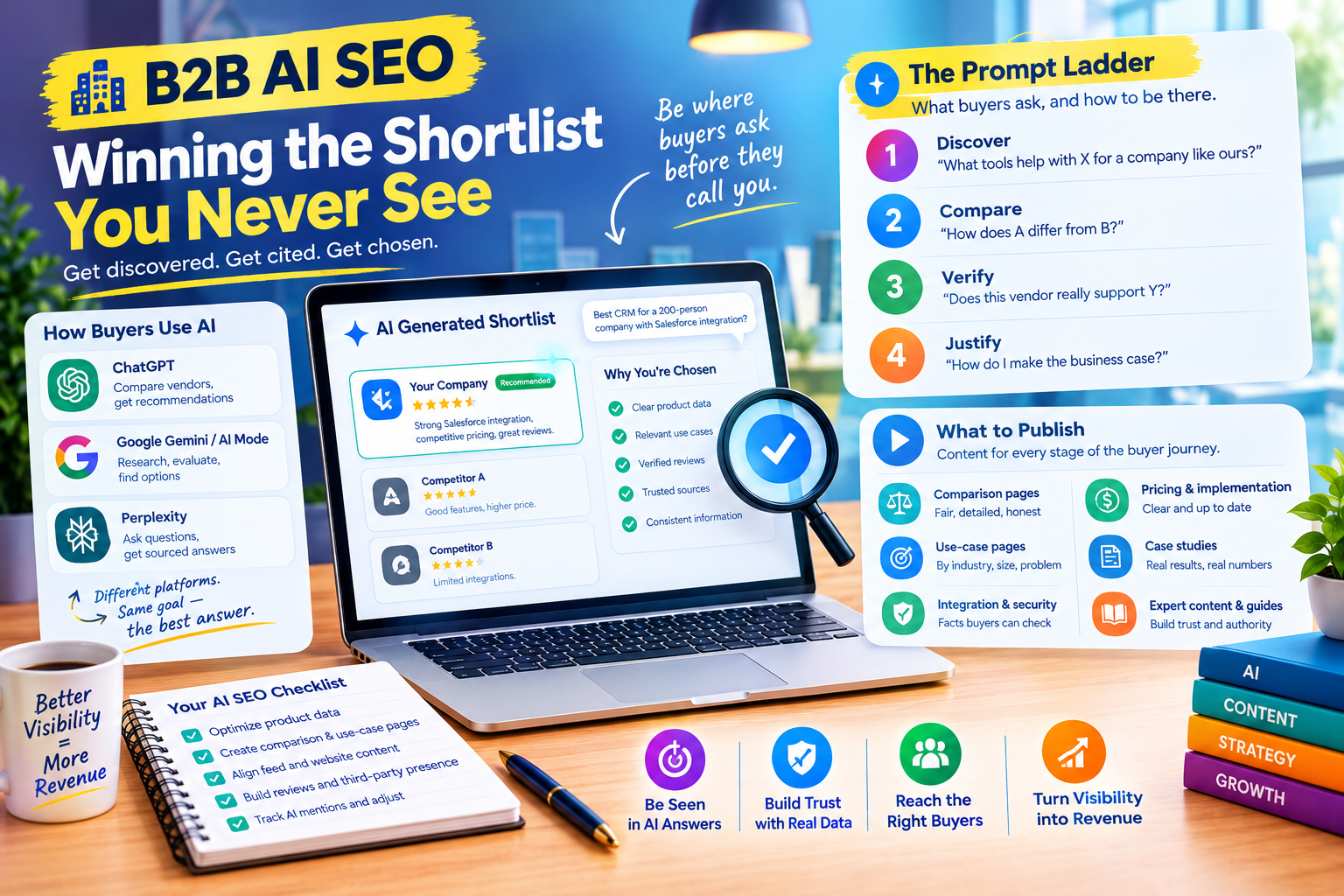
In B2B, many deals are lost before a salesperson hears about them. A buyer asks an AI assistant for options, gets a shortlist, and never visits the sites that did not make it. At Sarkar SEO, we think this makes AI SEO a revenue issue for B2B firms, not just a traffic one. This article looks at how buyers use AI and what vendors can do about it.
How Buyers Use AI Now
Survey data points in one direction, though the sources are mostly vendors with their own interests. G2 surveyed 1,076 software buyers in March 2026 and found that 51% now start research with an AI chatbot more often than Google, up from 29% eleven months earlier. The same survey reports that 54% of buyers cite AI chatbots as the single biggest influence on which vendors make the shortlist.
The picture is wider than software. A summary of Forrester’s survey of nearly 18,000 business buyers says 94% used generative AI in their latest purchase. Buyers reportedly used it to research product information (54%), compare vendors (55%) and build internal business cases before engaging any vendor (47%).
G2 sells software-review services, so check its framing against other sources. Even so, several independent surveys agree on the main point: AI is now part of how B2B buyers get oriented.
The Shortlist Is Decided Early and Quietly
One G2 finding stands out for marketers: 69% of buyers picked a different vendor than planned after AI chatbot guidance, as reported by a secondary roundup. And 85% think more highly of a vendor when an AI chatbot mentions them in a recommendation. demandgenreportdemandgenreport
Comparison is the leading use. G2 reports that comparing vendor strengths and weaknesses is the top use case, at 41%. That means an assistant is often describing your weaknesses to a buyer, using whatever it can find, while you are not in the conversation.
Buyers Still Want Proof
Before overreacting, note the counterweight. TrustRadius reports that 63% of buyers used AI during their purchase journey, but 94% fact-check AI responses at least some of the time. A Gartner finding summarised by one agency says 69% of buyers use sales reps to validate AI-generated insights. G2 adds that 80% still use Google somewhere in their buying journey. ai is where b2b software discovery starts in 2026 but buyers still close deals on demos and reviews +2
So the journey looks like this: AI builds an early shortlist, then buyers verify on your website, review profiles and in conversations. You need to be selected and then hold up under checking.
A Four-Rung Prompt Ladder
This framework is our own, not an industry standard. It helps plan content around what buyers ask at each stage.
- Discover. “What tools help with X for a company like ours?” You win here by being clearly tied to a category and an audience.
- Compare. “How does A differ from B?” You win by publishing fair comparisons that machines can quote.
- Verify. “Does this vendor really support Y?” You win by making specifics easy to confirm.
- Justify. “How do I make the business case?” You win by giving buyers material they can pass to colleagues.
One source puts the average buying committee at 10 people, so assume that every answer is read by several people with different worries.
What to Publish for Each Rung
For discovery, describe plainly what you do, who it is for and what category you belong to, using the words buyers use. Many firms bury this under slogans. An assistant cannot recommend what it cannot classify.
For comparison, create honest “versus” and “alternatives” pages. State where a competitor is the better fit. This feels risky, but it makes your page more credible and quotable, and it supplies the nuance that an assistant would otherwise guess at.
For verification, make facts easy to check. Publish pricing or a clear pricing model, integration lists, security and compliance information, implementation timelines and service limits. One commentary notes that any claim that can’t be verified quickly risks slowing the deal or getting a vendor dropped from a shortlist.
For justification, provide case studies with real numbers and context, ROI explanations that show assumptions, and short summaries a champion can forward. Only publish customer results you have permission to share and can support.
Check What Third Parties Say About You
AI answers about vendors draw on more than your site. A useful question from one analysis: which review platforms, community threads and independent write-ups are most likely to be referenced by the AI tools your buyers use, and do they reflect current capabilities and pricing? Update your profiles on the review sites in your category, correct outdated descriptions and respond to criticism professionally. Earlier in this series we covered how outside sources shape what AI says, and B2B is a clear case of it.
Align Sales with What Buyers Already Believe
Buyers now arrive with opinions formed by AI. Add a question to discovery calls: “Did you use any AI tools while researching us, and what did they say?” Record the answers. They reveal gaps and errors, such as a retired feature still described as current, and they tell your content team what to fix. Treat this as research, not a trick to catch buyers out.
What to Be Careful About
- Survey hype. Many statistics come from firms that sell tools or data, and they overlap and vary. Use them to argue for attention, not to forecast revenue.
- Overstating results. Do not make claims about your product that you cannot defend, because buyers say they check.
- Ignoring Google. Most buyers still use it as well.
- One-size content. A security lead and a finance lead ask different questions, so cover both.
A Practical First Month
In week one, run the ladder prompts for your category in several AI tools and record how you are described and who else is named. In week two, correct the biggest factual errors at their source, on your site and on review profiles. In week three, publish one fair comparison page and one verification page. In week four, add the sales-call question above and review the first answers. Repeat the prompts after a few weeks, remembering that answers vary between sessions.
