



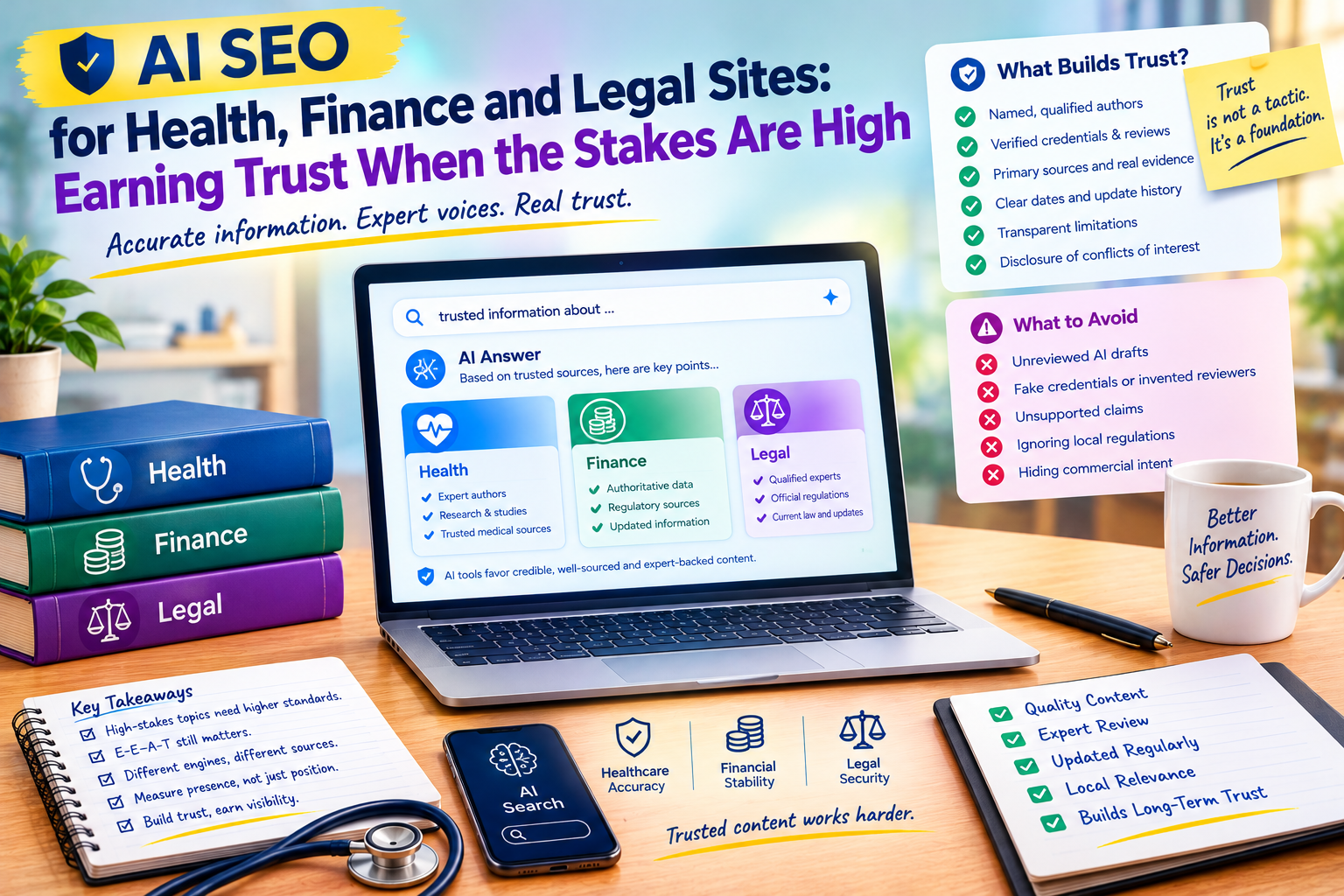
If your content can affect someone’s health, money, safety or legal rights, being wrong costs more than a bounced visit. Google’s Search Quality Rater Guidelines call this territory “Your Money or Your Life,” or YMYL, and treat it with stricter standards. It is reasonable to assume that AI SEO answers built on top of search inherit some of that caution.
That assumption is where many articles on this topic go wrong. They describe precisely how AI systems judge trust, with percentages and multipliers, while offering little evidence. This guide separates what is well supported from what is not.
What We Can Say With Confidence
YMYL is a recognized category. Texta’s overview, drawing on Google’s rater guidelines, defines it as content that could affect health, financial stability, safety or well-being. Those guidelines emphasize expertise, authoritativeness and trustworthiness, particularly for high-stakes subjects.
Google says AI features rely on normal search systems. Its published guidance states there are no extra requirements for AI Overviews and AI Mode. So the trust standards that apply to YMYL pages in search plausibly carry into AI results.
Many practitioners report the same patterns. Multiple agency guides, including those from LSEO, Pepper and Tenten, describe AI answers favoring pages with named, credentialed authors, visible sourcing and institutional backing. That is consistent with how search quality guidance reads.
What Remains Unproven
Several claims in circulation deserve skepticism:
- Specific uplift figures. One guide promises a 3 to 6 times improvement in “trust signals,” and another a 132% visibility gain from citing trusted sources. I found no methodology behind either.
- Conflicting prevalence numbers. Vendor sources put AI Overviews at 51% of health searches in one place and 63% in another. These can’t both describe the same thing, and no primary data accompanies either.
- Claims about how models decide. Healthcare Success notes that AI models don’t independently verify medical truth. So the “trust” they show is inferred from signals, not confirmed fact. No outside party can prove how any specific engine weighs those signals.
Treat advice here as informed practice, not measured science.
Trust Signals Worth Building
Even without proof of exact weighting, these signals make sense for readers, regulators and any system trying to avoid recommending weak sources. At Sarkar SEO, we treat them as baseline editorial hygiene for sensitive topics, not as tactics to win citations.
Named, qualified authorship. Anonymous or “editorial team” bylines are a weak fit for medical, legal or financial advice. Show who wrote the page, their credentials and relevant experience. Where a non-specialist writes, add a named reviewer with verifiable qualifications, such as a physician with a specialty, an attorney with bar admission details or a licensed financial planner.
Verifiable identity. Link authors and reviewers to external proof where possible, such as institutional profiles, licensing registries or professional bodies. Pepper’s guide recommends this for healthcare, and the logic extends to law and finance.
Primary sources. Cite guidelines, regulations, peer-reviewed studies and official agencies directly, and name them in the text. Summaries of summaries are a risk in fields where evidence changes.
Visible dates and review history. Show when a page was published and last reviewed, and update it when guidance changes. Stale medical or tax content is worse than missing content.
Transparent limitations. Say who the information applies to, what variables change the answer and when to consult a professional. Finance pages benefit from stating assumptions behind calculators and examples.
Disclosure of interests. Mark affiliate relationships, sponsorships and any commercial stake in a recommendation.
Write Carefully, Not Vaguely
Caution in YMYL doesn’t mean mush. Strong pages are specific about what is established and measured about what isn’t.
- Separate fact from interpretation. “Guidelines from [named body] recommend X for adults with Y” differs from “most people should do X.”
- Avoid absolutes. Words like “always,” “guaranteed” and “cure” are risky unless a source truly supports them.
- Match the reader’s situation. A page about managing a condition should say when symptoms need urgent care. A tax guide should note jurisdiction, since rules differ by country and year.
- Keep calculators honest. Document formulas, rates and assumptions, and note when results are estimates.
Governance Behind the Pages
Individual page quality isn’t enough. Build the system around it.
- Publish an editorial policy describing how content is researched, reviewed and updated.
- Set review intervals by risk. Fast-changing areas such as tax rates or drug guidance need frequent checks.
- Keep an evidence log per page: sources used, reviewer, date and what changed.
- Run an accuracy check on AI answers about you. Ask engines about your services and compare their statements with reality. Errors about eligibility, pricing, dosage or fees can mislead customers and create liability.
- Respect local regulation. Advertising and disclosure rules for medical, financial and legal content vary by country, so confirm requirements with a qualified professional in each market you serve.
Mistakes That Cost Trust
- Unreviewed AI drafts. Publishing generated medical or legal text without expert review is the fastest way to publish errors.
- Fake credentials or invented reviewers. If it’s discovered, the damage extends far beyond search.
- Borrowing authority. Quoting a famous institution without that institution’s actual guidance misleads readers.
- Treating AI citations as proof. Texta advises using AI citations as discovery signals, then verifying every claim against primary or expert-reviewed sources.
- Hiding commercial intent. Readers and systems both punish content that steers toward a sale without saying so.
