



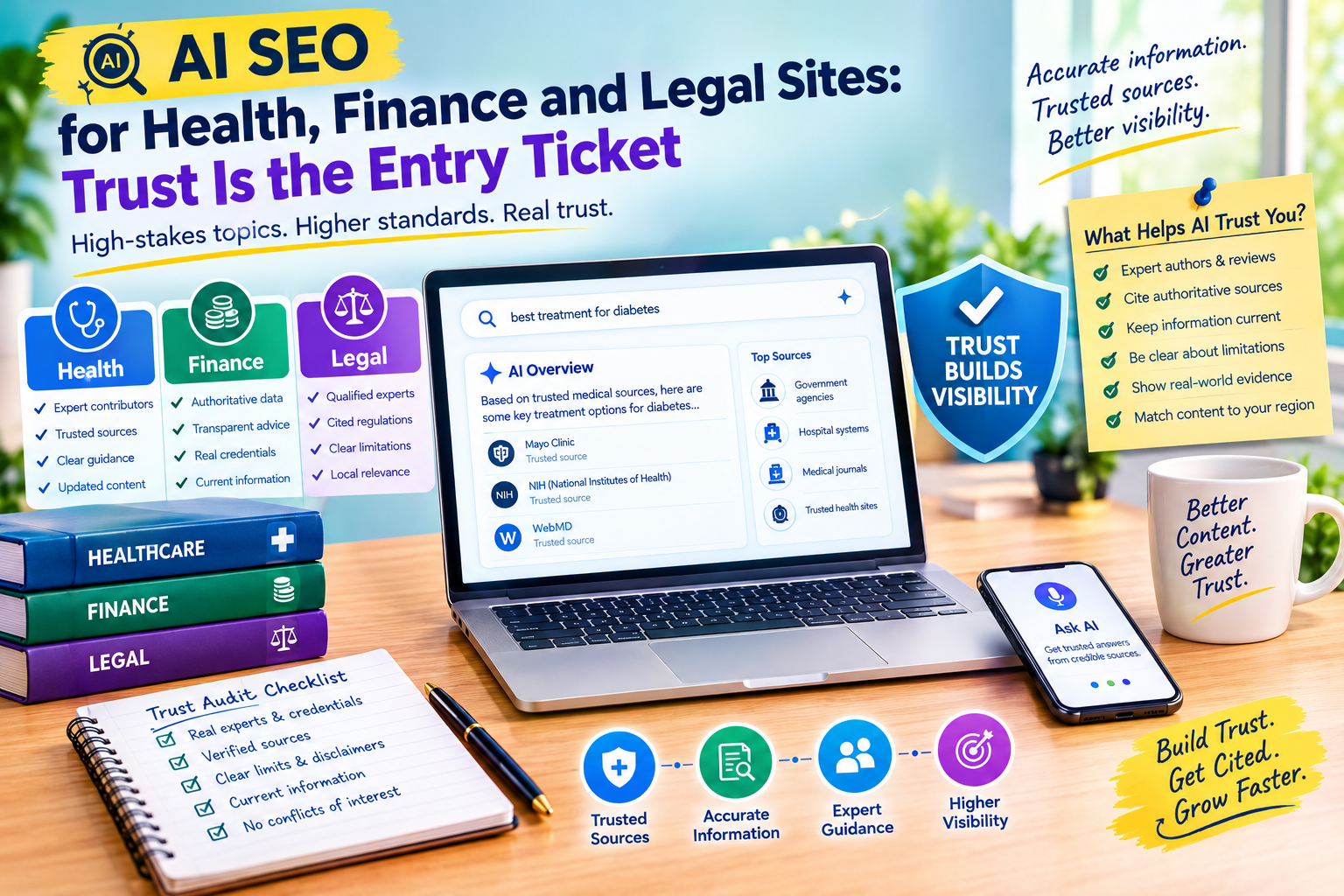
If your website covers medicine, money or law, AI SEO search treats you differently from a recipe blog. A wrong answer here can delay treatment or cost someone their savings, and the systems that assemble answers are built with that in mind. At Sarkar SEO, we advise high-stakes publishers to start with credibility, not tactics. This article explains why and what that looks like in practice.
AI Cites Different Sources When the Stakes Are High
BrightEdge’s analysis of health and finance citations for one week in August 2026 (US data) shows how selective the engines are. It reports that ChatGPT’s five most-cited healthcare sources are government agencies and hospital systems, while Google AI Overviews puts YouTube above every clinical source in the same category. In finance, ChatGPT spreads citations across five sources, one of them a specialist, while Google AI Overviews leans on one source at roughly half of prompts. brightedgebrightedge
This is one week of data from one vendor, so it is a snapshot, not a rule. It does show that large institutions dominate, and that the two engines do not behave alike. A strategy for one will not automatically work for the other.
How Often Do AI Answers Appear Here?
Sources disagree. One analysis says that in some YMYL sectors AI Overviews may not appear at all, and that Google tells users to seek expert advice or verify information when it matters. Another claims 44% of YMYL searches already trigger AI Overviews. The figures depend on the tracker, the topic list and the date, so measure your own queries instead of relying on a headline number.
There is also a relationship with ranking. The same analysis reports that nearly 80% of healthcare AI Overview sources are also ranking for the query, while in ecommerce it is just over 20%. The implication is that in health, traditional rankings and AI citations are tightly linked, so strong organic fundamentals matter even more.
What “Trust” Means in Practice
Google’s guidance has long held these topics to a higher standard. In an older comment, Google’s John Mueller said its algorithms are very picky about what they show for medical content, and suggested having a legitimate expert review content and saying so on the page. The principle has stayed consistent even though the terminology has changed. searchenginejournal
A practitioner guide lists what separates strong from weak pages. In its words, an “Editorial Team” byline is weak for YMYL unless it is supported by a review workflow and visible expert contributors. The same guide says finance pages work best when they state what problem they solve, who they are for, what variables affect the answer and which sources support the recommendation.
Trust Signals Are Not a Switch
A warning from one SEO case study: a site that improved author bios, added medical contributors and upgraded content still stayed suppressed through multiple core updates. The same author states that having an expert write things does not magically make you rank better.
That is worth remembering. Expert labels on a thin page do not create trust. Substance, reputation and a track record do, and those build slowly.
A Seven-Point Trust Audit
This checklist is our own working method, not an official standard. Run each important page through it.
- Who is accountable? Name a real person with relevant credentials and explain their role. Link to a biography that shows qualifications.
- Who reviewed it? For medical, legal or financial claims, add a qualified reviewer and the date of review.
- What is the evidence? Cite primary sources such as regulators, official guidance, peer-reviewed research and professional bodies. The practitioner guide above recommends peer-reviewed journals, major health systems, specialty societies and public health agencies for health content.
- What are the limits? State who the advice applies to, what it excludes and where rules differ by country or region.
- When should the reader seek help? For health, include warning signs and when to see a professional. For finance and law, say when personalised advice is needed.
- Is there a conflict of interest? Disclose commissions, sponsorships and product ties plainly.
- How current is it? Show update dates and refresh pages when guidance changes. Our freshness article covers what counts as a real update.
Match Your Sources to Your Region
Rules and authorities vary around the world. A page on tax, medication or tenancy law that quotes one country’s regulator is wrong, or even harmful, for readers elsewhere. Cite the local authority for each market you serve, and be explicit about which jurisdiction applies. This also makes pages more useful in the languages and countries we discussed earlier in this series.
Be Careful With AI-Generated Drafts
Language models can write fluent text containing errors. One guide advises that AI citations should be used as discovery signals, then every YMYL claim verified against primary or expert-reviewed sources before publishing. If you use AI in drafting, require a qualified human to check every statistic, dosage, rate, deadline and legal reference, and keep a record of who did it.
Check How AI Describes You
Search the questions your audience asks and see whether AI answers cite you, a competitor or an institution. Check what is said about your organisation, and whether any claim is wrong or outdated. The same guide warns that sources cited by AI do not prove how any specific AI model ranks citations, so treat the results as clues. If errors appear, correct them at their source and make the right information easier to find on your own pages.
Where Smaller Publishers Can Compete
You may not outrank a national health agency, but you can serve narrower needs. BrightEdge’s data hints that smaller sites can appear in finance, though the detail is thin, so check it. Focus on a specific audience, a local rule set or a practical problem that large institutions cover thinly, and back it with real expertise.
