



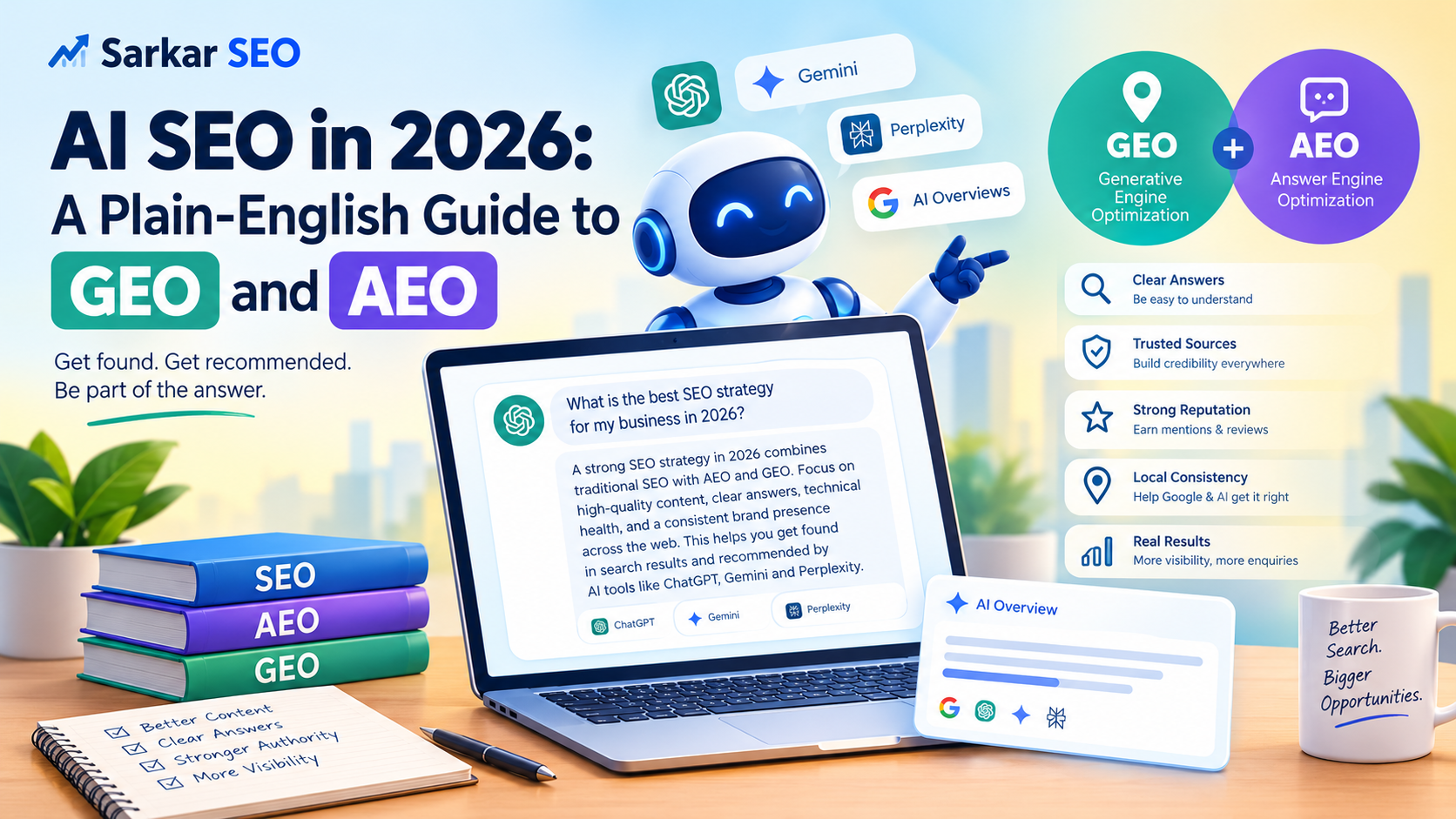
Not long ago, AI SEO meant one thing: get your page onto Google’s first page and wait for the clicks. Today, a growing number of people never reach that page. They ask ChatGPT, Gemini, Perplexity or Google’s AI Overviews a question and act on whatever answer comes back. At Sarkar SEO, business owners tell us the same thing almost every week: “My rankings look fine, so why are enquiries slowing down?” This guide answers that, one question at a time.
What is AI SEO, in simple words?
AI SEO is the work of making your brand easy for AI tools to find, understand and recommend. Traditional SEO asks, “Will Google rank this page?” AI SEO asks, “When someone puts a question to an AI, will my business be part of the answer?”
The basics have not gone anywhere: useful content, a healthy website and trustworthy sources still matter. What has changed is the finish line. You are no longer competing only for a blue link; you are competing to be named. That is how we at Sarkar SEO look at it: AI SEO is good SEO, extended.
What is AEO, and how is it different from SEO?
AEO stands for Answer Engine Optimization. It is about giving clear, direct answers to specific questions so that search features, voice assistants and AI tools can pick them up easily. Featured snippets and “People also ask” boxes are the older, familiar examples.
In practice, AEO means writing the question as a heading and answering it in the first one or two sentences, then adding detail below. Keep each answer short, factual and able to stand on its own. If a sentence only makes sense when the reader has seen the paragraph before it, an answer engine will probably skip it.
What is GEO, and why is everyone talking about it?
GEO stands for Generative Engine Optimization. Generative tools do not simply list pages. They gather information from several sources, compare it and write a fresh answer. GEO is about becoming one of the sources they trust enough to use.
The signals are fairly down to earth: clear writing, original information, facts about your brand that match across the web, and credible mentions from other sites. It is trending in 2026 because AI answers have become part of ordinary search habits, not a novelty people try once.
Is GEO the same as local SEO?
No, and the names cause confusion. GEO here means generative, not geographic. Local SEO is about showing up for “near me” searches through your Google Business Profile, reviews and consistent address details. That said, the two help each other: a business with accurate, consistent details everywhere is easier for both Google and AI tools to describe correctly.
Do I still need traditional SEO?
Yes. AI tools lean heavily on pages that are already crawlable, fast and well organised. If your site is slow, thin or confusing, no amount of clever formatting will rescue it. A simple way to picture it: SEO is the foundation, AEO is how you phrase your content, and GEO is the reputation you build around it. Skip any of the three and the whole structure gets wobbly.
How should I write content so AI tools can use it?
Most of it is common sense, applied consistently:
- Lead with the answer, then explain.
- Cover one topic per section so each part can be quoted cleanly.
- Use real names, numbers and dates instead of vague claims.
- Build FAQ sections from questions your customers genuinely ask.
- Show who wrote the page and why they are qualified to.
- Refresh older posts instead of leaving them to go stale.
The Sarkar SEO team has a simple test: read your page aloud, and if a sentence could not be quoted by itself as a useful answer, rewrite it.
Does schema markup help?
It can. Structured data such as Article, Organization, Product or LocalBusiness schema helps machines read your pages with less guesswork. Google now shows FAQ rich results far less often than it once did, but marking up genuine questions and answers still describes your content clearly. Think of schema as removing ambiguity, not as a switch that guarantees a mention.
How important are mentions on other websites?
Very. AI tools build their picture of a brand from what is said about it everywhere: reviews, forums, news articles, directories and interviews. Use the same business name, description and service details across all of them, and earn mentions through real expertise rather than spam. At Sarkar SEO we advise clients to treat each honest mention as a vote of confidence that a machine can read.
How do I measure AI SEO?
There is no single dashboard yet, so keep it practical. List fifteen to twenty questions your customers really ask. Once a month, put them to the major AI tools and note whether your brand appears, how it is described and which competitors show up instead. Alongside that, watch branded searches, direct visits, referral traffic from AI tools and the quality of the enquiries you receive. Keep in mind that AI answers vary by person and by day, so look for patterns, not single results.
How long does it take to see results?
Be wary of anyone who promises a fixed timeline or a guaranteed AI ranking. Technical and content fixes can be picked up within weeks; reputation takes months. Sarkar SEO prefers steady, measurable steps over big promises, because that is what holds up when the tools change, and they change often.
Where should I start this month?
Here is a simple 30-day plan:
- Week one: fix crawling, speed and mobile issues, and check that your key pages are indexed.
- Week two: rewrite your top five pages with direct answers and FAQ sections.
- Week three: make your business details consistent across directories, profiles and social pages.
- Week four: run your question list through the AI tools and record the baseline.
Then repeat every month and adjust.
