



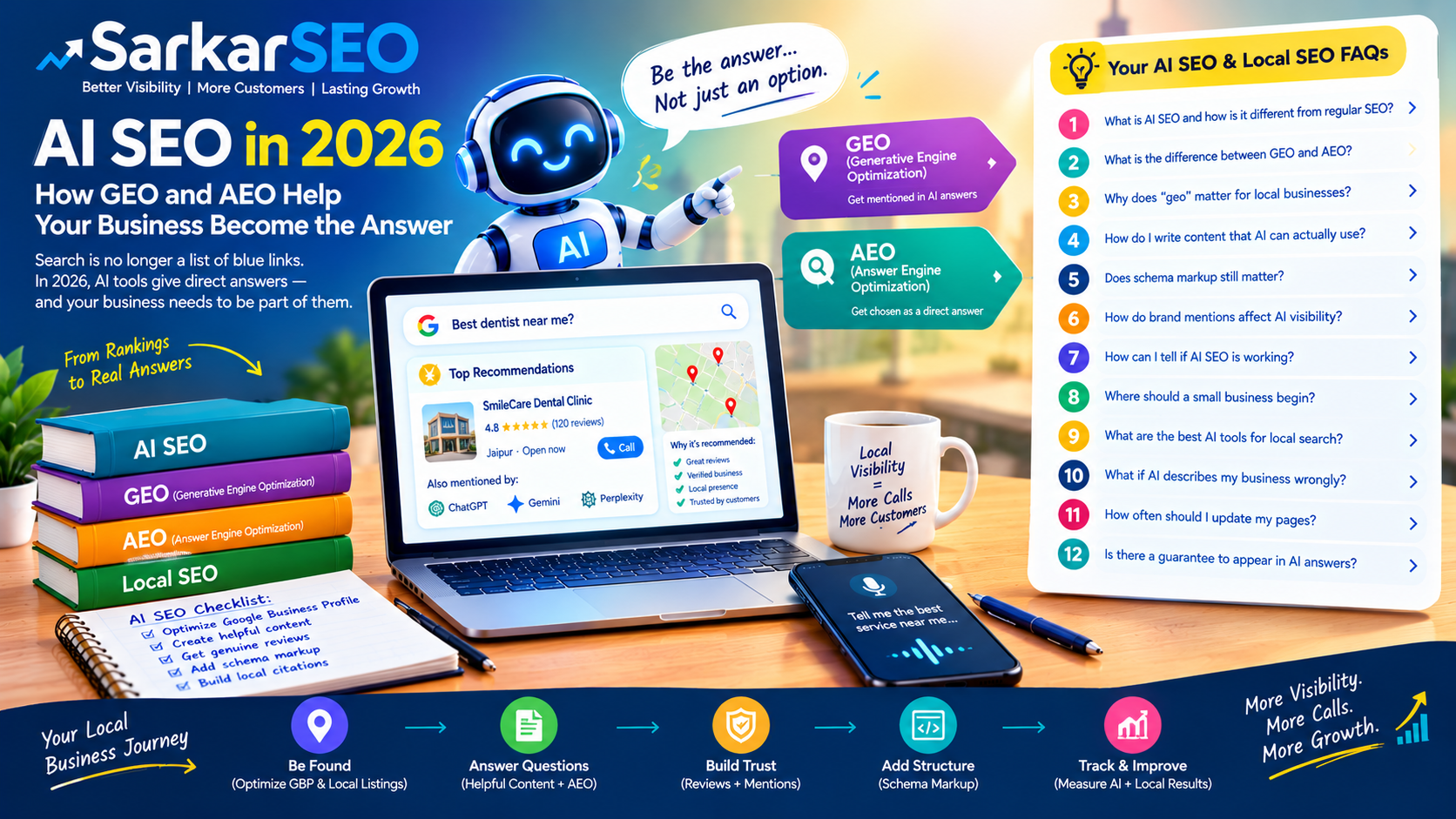
Search is no longer a list of ten blue links. When someone asks ChatGPT, Gemini or Google’s AI Overviews for “the best dentist in Jaipur” or “a reliable SEO agency for small businesses,” they get one confident answer instead of a page of options. If your business is not in that answer, you are invisible at the moment of decision.
That shift is the reason AI SEO has become the most discussed topic in digital marketing this year. At Sarkar SEO, we work on it with clients every day, and the same questions keep coming up. So here are the answers, in plain language.
What exactly is AI SEO?
AI SEO is the practice of making your brand easy for AI systems to find, understand, trust and recommend. Traditional SEO asks, “How do I rank on page one?” AI SEO asks, “How do I become the source an AI quotes?”
The two overlap, but they are not identical. Rankings still matter, because AI tools often draw from pages that already perform well. The difference is that AI also weighs how clearly you answer questions, how consistent your brand information is across the web, and how often credible sources mention you. Sarkar SEO treats AI SEO as an addition to a strong SEO foundation, never a replacement for it.
What is the difference between GEO and AEO?
People mix these up, so here is the simple version.
AEO (Answer Engine Optimization) is about structure. You write content so a search engine or voice assistant can lift a short, accurate answer from it. Think of clear questions, direct first sentences and tidy formatting.
GEO (Generative Engine Optimization) is about influence. Generative tools such as ChatGPT and Gemini build their own replies from many sources. GEO helps your brand appear inside those replies through authority, mentions and consistent entity signals.
Put simply, AEO helps you get picked as a snippet, and GEO helps you get mentioned in a conversation. Sarkar SEO builds both into one plan, because one without the other leaves gaps.
Why does “geo” matter for local businesses?
This is where many business owners are missing out. Plenty of AI queries carry local intent, such as “best coaching institute near me” or “affordable interior designer in Rajasthan.” AI tools lean heavily on location signals when answering these.
That means your local footprint needs to be strong and consistent:
- A complete, active Google Business Profile
- The same name, address and phone number everywhere you appear online
- Genuine reviews that mention your services and your city naturally
- Location pages written for real people, not stuffed with city names
Sarkar SEO often finds that a small local business with tidy, consistent information beats a bigger competitor with messy listings. AI systems prefer clarity over size.
How do I write content that AI can actually use?
Start with the question your customer is really asking, then answer it in the first one or two sentences. Add depth below that. This “answer first, explain second” habit is the heart of AEO.
A few habits that help:
- Use question-style headings that match how people speak.
- Keep paragraphs short and focused on one idea.
- Include real examples, local details and first-hand experience.
- Add an FAQ section to every important page.
- Update old posts instead of letting them go stale.
At Sarkar SEO, we also edit every piece so it reads like a person wrote it. AI tools and readers both notice generic, padded writing, and neither rewards it.
Does schema markup still matter?
Yes, more than before. Structured data such as FAQ, Organization, LocalBusiness and Article schema gives machines a clean description of who you are and what a page covers. It removes guesswork.
Schema is not a magic switch, and it will not force an AI to recommend you. What it does is reduce confusion, which makes it easier for search engines and AI tools to trust your information. Sarkar SEO includes schema review as a standard step in every AI SEO audit.
How do brand mentions affect AI visibility?
A great deal. AI systems form an impression of your brand from what the wider web says about it. Mentions in credible articles, honest reviews, community discussions and industry directories all feed that impression.
This is why chasing links alone is an outdated plan. You want your brand described accurately, in the right context, in places people and machines already trust. Sarkar SEO focuses on earning those mentions through useful content, real expertise and outreach that makes sense, because forced or spammy mentions can do more harm than good.
How can I tell if AI SEO is working?
Rankings alone no longer tell the full story. Look at a mix of signals:
- Does your brand appear when you ask AI tools your customers’ questions?
- Is the description they give accurate and favorable?
- Are branded searches and direct visits growing?
- Are you winning featured snippets and “people also ask” boxes?
- Are your leads improving, not just your traffic?
Test a set of 15 to 20 real customer questions every month and record the results. Sarkar SEO uses this kind of tracking so clients can see progress in plain terms, not vague promises. Be wary of anyone who guarantees a specific AI placement, because no honest agency can.
Where should a small business begin?
Do not try to do everything at once. A sensible order looks like this:
- Fix the basics. Check site speed, mobile experience and technical errors.
- Clean up your local data. Make your business details consistent everywhere.
- Upgrade your best pages. Add direct answers, FAQs and schema.
- Build trust signals. Collect real reviews and earn credible mentions.
- Measure and refine. Track AI answers monthly and adjust.
This is the same path Sarkar SEO follows with new clients. It is steady, honest work, and it compounds over time.
