



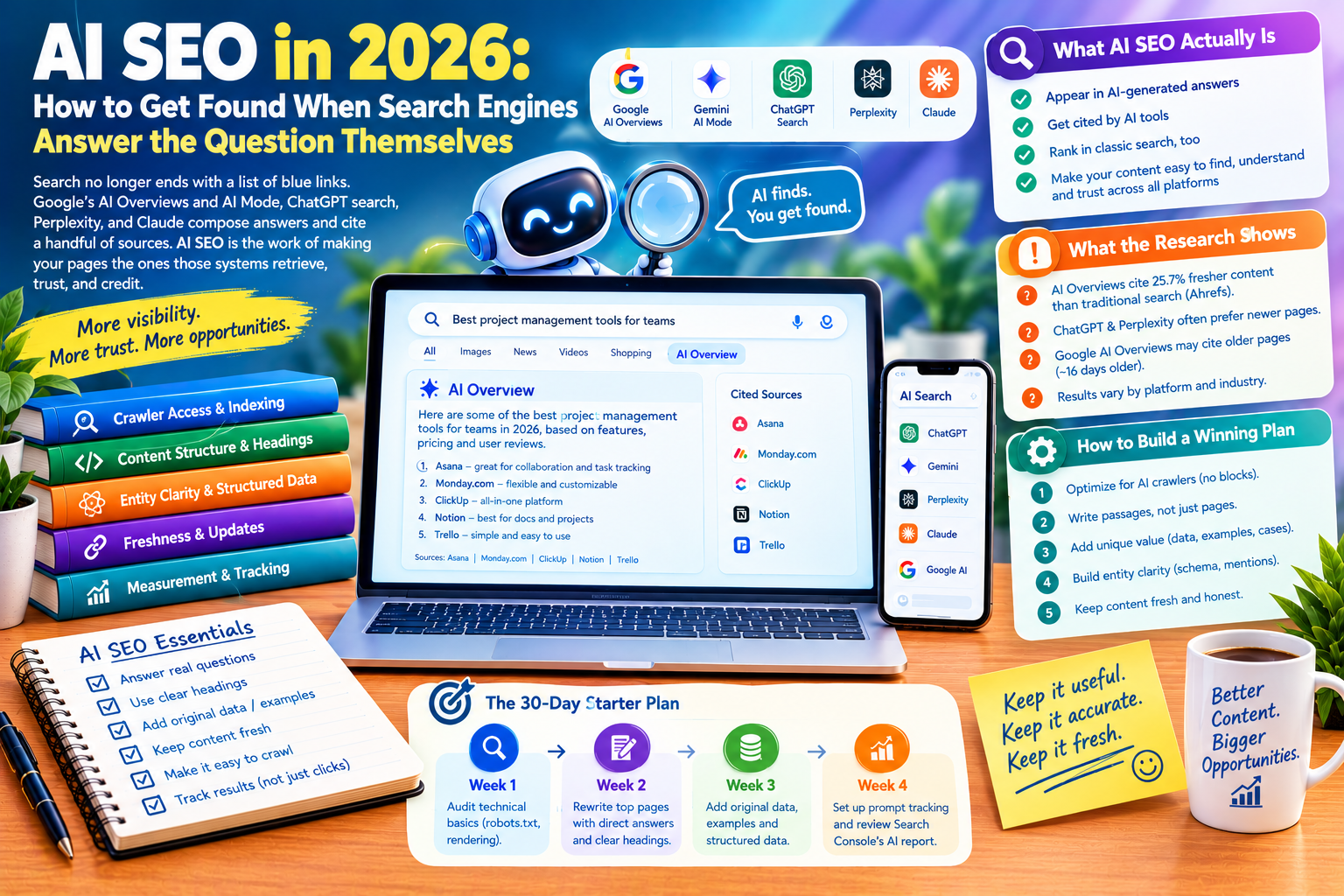
Search no longer ends with a list of blue links. Google’s AI Overviews and AI Mode, ChatGPT search, Perplexity, and Claude compose answers and cite a handful of sources. AI SEO is the work of making your pages the ones those systems retrieve, trust, and credit.
Here is what the evidence supports, and what is still marketing noise.
What AI SEO Actually Is
AI SEO means optimizing content so it can be found, understood, and cited by AI-driven search, alongside ranking in classic results. It is not a replacement for SEO. Google’s own documentation for site owners states that no additional requirements or special optimizations are needed to appear in AI Overviews or AI Mode, and that standard SEO fundamentals still apply.
That doesn’t make the shift trivial. These systems retrieve differently, and the details below change what you should prioritize.
How AI Search Chooses Sources
Google says both AI Overviews and AI Mode may use “query fan-out,” meaning they issue several related searches across subtopics and data sources before writing a response. A person may type one question, but the system researches five or six.
Practically, a page that answers only the head query is at a disadvantage. A page that covers the surrounding questions (costs, comparisons, risks, next steps) has more chances to be retrieved.
The sources also differ by product. One third-party analysis reports that only 13.7% of citations overlap between AI Overviews and AI Mode. That is a single study and worth treating cautiously, but it supports a sensible conclusion: ranking well in one surface does not guarantee presence in another. At Sarkar SEO, we advise clients to measure each surface separately.
Step One: Make Sure the Crawlers Can Reach You
Many sites lose AI visibility before content quality even matters. Several AI vendors run separate crawlers for separate jobs, and blocking one does not affect the others.
- OAI-SearchBot builds the index behind ChatGPT search. Blocking it removes your pages from ChatGPT search answers.
- GPTBot collects training data. Blocking it does not remove you from ChatGPT search.
- PerplexityBot and Claude-SearchBot index content for their respective answer features.
Allowing search crawlers while deciding on training crawlers as a separate business choice is a common approach. Check your CDN or firewall too, because bot-management rules at providers such as Cloudflare can block AI crawlers regardless of what your robots.txt says. Also confirm that important content appears in the raw HTML. Several practitioner sources report that most AI crawlers do not execute JavaScript, so content that loads client-side may be invisible to them. Test this yourself by fetching your page without a browser.
Remember that robots.txt is a request, not a lock. Unidentified scrapers can ignore it.
Step Two: Write Passages, Not Just Pages
AI systems tend to lift specific passages rather than whole articles. Write each section so it can stand alone:
- Put a direct, complete answer in the first one or two sentences under each heading.
- Use headings that mirror real questions people ask.
- Keep one idea per paragraph, with the entity (the product, concept, or place) named explicitly rather than hidden behind “it” or “this.”
- Use tables for comparisons and numbered lists for processes, since both are easy to extract.
Don’t confuse this with writing shorter content. Depth still wins when it is organized. The goal is that any 80-word slice of your page makes sense on its own.
Step Three: Add Information the Model Can’t Invent
AI answers are built from existing material, so generic summaries add nothing a model cannot already produce. What earns citations is material that exists nowhere else: original data, your own test results, named case examples, expert quotes, screenshots, and clear opinions backed by evidence.
Ask a simple question of every draft: what does this page contain that the top ten results do not? If the answer is nothing, the page is a candidate for being summarized away rather than cited.
Show real authorship too. Name the author, state their relevant experience, and keep claims verifiable. Never publish invented statistics. AI systems and human editors both punish unsourced numbers, and it is a fast way to lose trust.
Step Four: Build Entity Clarity
AI search works with entities, such as brands, people, and topics, as much as with keywords. Make yours unambiguous:
- Use consistent brand and author names across your site and profiles.
- Add structured data (Organization, Article, Person, FAQ where genuinely relevant) so machines can confirm what each page is about.
- Earn mentions on credible third-party sites. Being described accurately elsewhere reinforces your identity.
- Keep key facts, such as services, locations, and pricing models, in plain crawlable text.
Step Five: Keep Content Fresh and Honest
Several sources note that AI features lean on recently updated pages. Refresh high-value articles with new data and remove outdated claims, and update the visible date only when the content has actually changed. Cosmetic date changes are easy to spot and add nothing.
Measuring Results
Measurement has improved. According to SerpApi’s review of the SERP, Search Console introduced a generative AI performance report in June 2026, giving site owners a dedicated view of performance in AI Overviews and AI Mode. Google also notes that traffic from these features is counted within overall Search Console totals.
For other platforms, no equivalent official dashboard exists, so track manually:
- Build a list of 20–30 priority prompts your customers actually ask.
- Run them monthly in ChatGPT, Perplexity, Gemini, Claude, and Google AI Mode.
- Record whether you are cited, how you are described, and which competitors appear.
- Watch referral traffic and branded search growth in analytics.
Expect some queries to lose clicks. Reports suggest the losses concentrate on simple informational queries that AI can fully answer in a paragraph, while cited brands can still benefit. Shift effort toward queries where users need depth, trust, or a purchase decision.
Common Mistakes to Avoid
- Chasing “AI hacks.” Beyond the fundamentals, no secret formula is documented by Google.
- Blocking all bots out of caution. This can remove you from answer engines entirely.
- Publishing at scale without editing. Thin, repetitive AI-written pages give retrieval systems no reason to choose you.
- Ignoring technical health. Slow, unindexable, or JavaScript-dependent pages fail before quality is judged.
A Practical 30-Day Plan
Week 1: Audit robots.txt, CDN rules, and rendering.
Week 2: Rewrite your top ten pages with direct answers and clearer headings.
Week 3: Add original data or firsthand examples to each, plus structured data.
Week 4: Set up prompt tracking and review Search Console’s AI report.
The teams at Sarkar SEO treat this as an ongoing process rather than a one-time project, because AI search products change monthly. If you want a clear view of where your site stands today, Sarkar SEO can run an AI visibility audit and turn the findings into a prioritized roadmap.
