



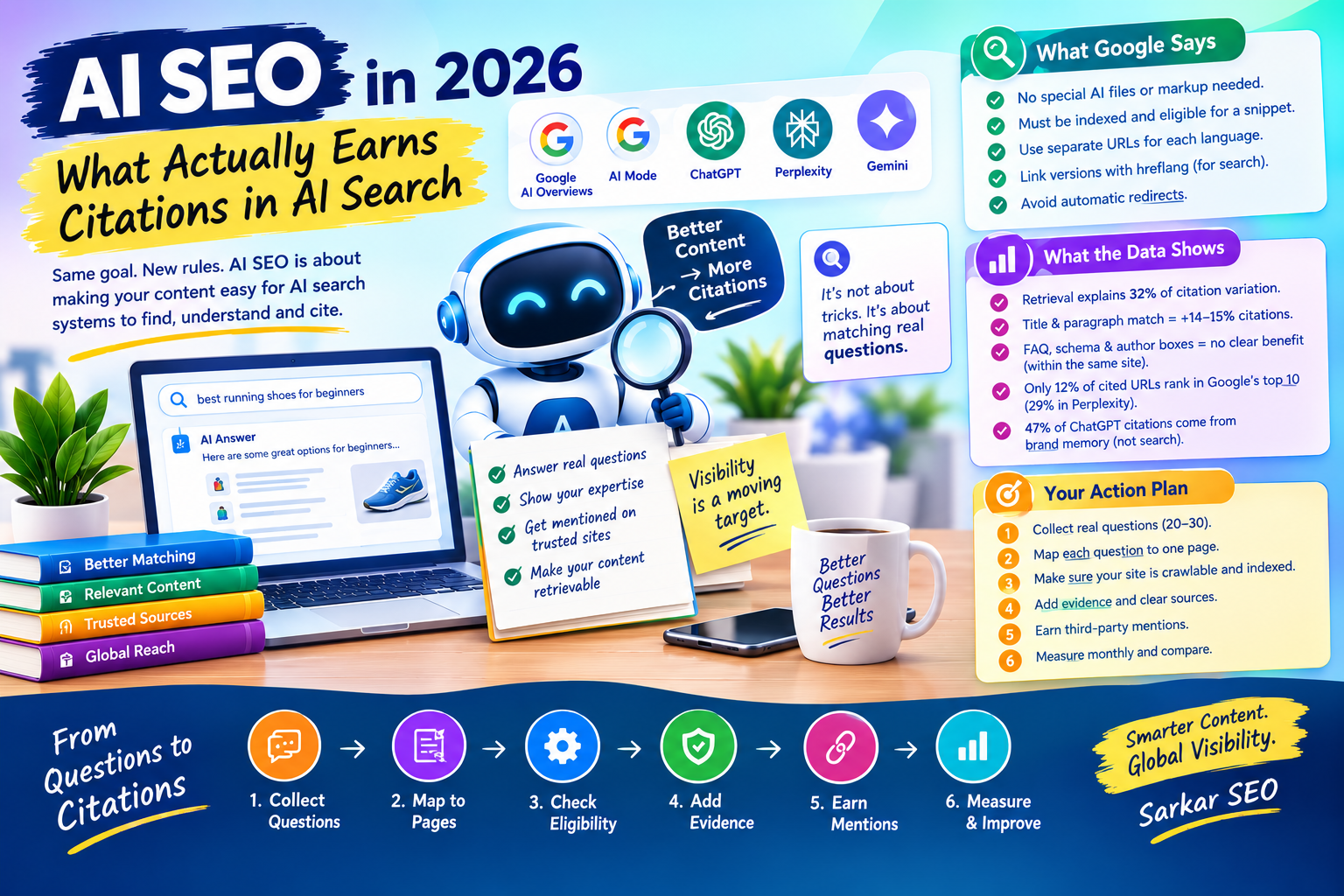
AI SEO is the practice of making your pages easy for AI SEO search systems to find, understand and cite. Those systems include Google’s AI Overviews and AI Mode, ChatGPT, Perplexity and Gemini. The short answer from current evidence: the fundamentals still apply, but the winning move is matching the exact questions people ask, not adding AI-specific tricks.
What Google Says About AI SEO
Google’s documentation states that no extra requirements exist for appearing in AI Overviews or AI Mode. A page needs to be indexed and eligible to show with a snippet. Google also says you don’t need special AI text files, new markup or dedicated schema.
One detail matters for strategy. Both features may use “query fan-out”, which means issuing several related searches across subtopics before building an answer. Your page can be pulled in for a question the user never typed.
Retrieval Comes Before Citation
A 2026 preprint from University of Toronto researchers tracked 158,099 answers and 468,037 citations from ChatGPT, Gemini and Perplexity. Its central finding: every page ChatGPT cited had first been retrieved by its own search. Retrieval explained 32% of the variation in citations between pages of the same website, while page features such as length or markup explained 2.8%.
The engine also rewrites each question into new sub-queries on every answer, so the same question can surface different pages from one run to the next. Visibility is a moving distribution, not a fixed ranking.
The Page Signals That Held Up
Only one family of signals survived the researchers’ robustness tests: how closely a page’s title and best paragraph match the question. Within the same website, a better-matching paragraph went with about 15% more citations per standard deviation, and a better-matching title with about 14%.
Commonly recommended extras did not hold up. FAQ blocks, schema markup and author boxes looked helpful when comparing different websites, because stronger sites tend to use them. Compared within one website, none showed a reliable benefit. This is an association study using engine APIs and English, US-focused commercial questions, so treat it as strong evidence rather than proof. It also doesn’t make schema pointless. Google still wants structured data to match visible text, and it serves purposes beyond AI.
Google Rankings Don’t Transfer Evenly
Ranking first on Google does not guarantee a citation elsewhere. An Ahrefs study of 15,000 prompts, as reported by Frase, found only 12% of URLs cited by assistants such as ChatGPT, Gemini and Copilot ranked in Google’s top 10. Perplexity was the outlier at roughly 29%. Google’s own AI Overviews overlap far more with the classic results, though measured overlap varies by study and by month.
The practical reading: classic SEO still matters most for Google’s AI features, and matters less for standalone assistants.
Brand Memory Shapes Who Gets Named
The Toronto study found that 47% of ChatGPT’s citations came from websites its model named without searching. In controlled tests, revealing brand names reordered product rankings even when the underlying facts were identical.
For established brands, reputation is partly baked into the model. For smaller businesses, the data points elsewhere: they were named mainly when a cited third-party page mentioned them. Earning mentions on independent sites, industry roundups and expert discussions is therefore part of AI SEO, not a separate PR project.
A Question-Matching Workflow You Can Run This Month
This approach avoids guesswork and is the framework Sarkar SEO suggests as a starting point.
- Collect real questions. Pull 20 to 30 from sales calls, support tickets, Search Console queries and People Also Ask boxes. Include comparison and “best for” phrasing.
- Map each question to one page. Put the question’s own wording in the title or a heading, then answer it in a single self-contained paragraph that still makes sense if quoted alone.
- Confirm eligibility. Check that robots.txt and your CDN allow crawling, the page is indexed, snippets are not blocked, and key content is real text rather than script-dependent.
- Add evidence. Original data, named sources and clear definitions give retrieval systems something specific to match and give readers a reason to trust you.
- Earn third-party mentions. Contribute data or commentary where your audience already reads.
- Measure repeatedly. Run your question set monthly in each engine and log which pages and brands appear. The Toronto researchers found cited sets drift: ten weeks apart, only 14% of ChatGPT’s variation was shared with the earlier window. A single snapshot misleads.
Search Console reports AI feature traffic inside the standard Web performance data, so baseline your clicks before judging changes. Sarkar SEO recommends pairing that with the manual question log, since citations without clicks won’t appear in analytics.
AI Overviews Versus AI Mode
The two features serve different needs, and your content plan should reflect that. Google positions AI Overviews as a quick summary for questions where it adds value beyond classic results, and notes that they often don’t trigger at all. AI Mode targets queries that need exploration, reasoning or comparison. Informational pages that define, explain and compare tend to suit both. Pages that only repeat a keyword suit neither, because the fan-out searches look for specific subtopics, examples and decision criteria.
What Not to Chase
Skip tactics that promise guaranteed citation. No platform publishes a universal formula, and the engines overlap less than most advice assumes. Avoid rewriting every page into bullet fragments or stuffing questions into FAQ sections. The evidence favors direct, specific answers on pages that deserve to be retrieved.
