



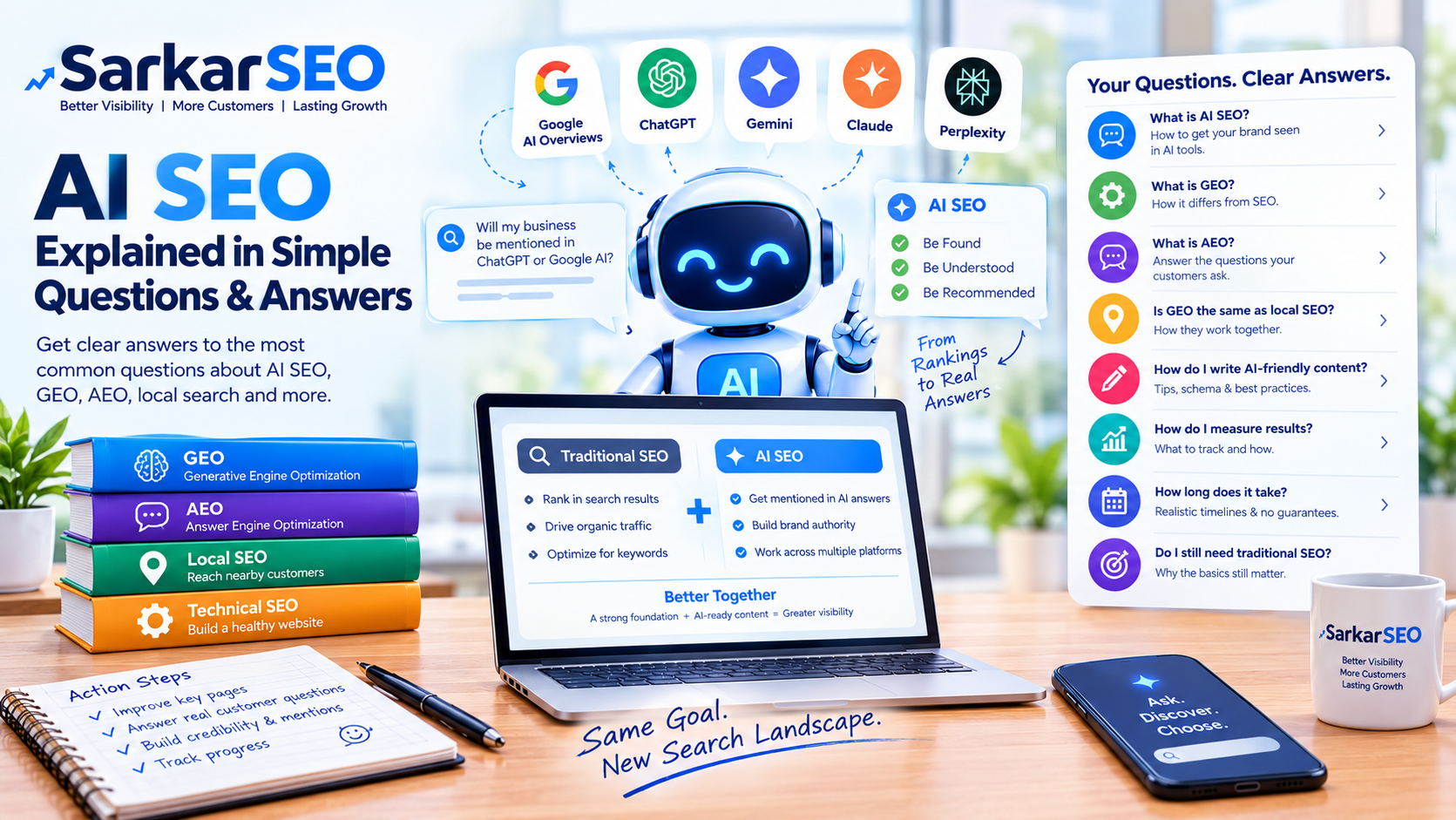
A few years ago, clients asked us, “Can you get my site to page one?” Today the question has shifted. Now they ask, “Will ChatGPT or Google’s AI mention my business?” At Sarkar SEO, we hear this almost every week, and it makes sense. People increasingly get a direct answer instead of a list of links, and whoever appears in that answer wins the attention.
This guide explains AI SEO in a simple question-and-answer format, the same way the Sarkar SEO team explains it on client calls.
What is AI SEO?
AI SEO is the work of making your brand and content easy for AI-powered tools to find, understand, and recommend. That covers Google AI Overviews, ChatGPT, Gemini, Claude, and Perplexity. Traditional SEO asks, “How do I rank?” AI SEO asks, “How do I become the answer?”
At Sarkar SEO, we treat both as partners. Good basics such as fast pages, clean structure, and trustworthy content still matter, because AI tools learn from the same open web that search engines crawl.
What is GEO, and how is it different from SEO?
GEO stands for Generative Engine Optimization. It focuses on how generative AI tools choose and describe sources when they build a response. The goal is not position number one. The goal is a mention or citation inside the answer itself.
GEO rewards clarity: who you are, what you offer, where you operate, and who vouches for you. Sarkar SEO usually begins a GEO project by asking AI tools about the client’s brand. The gaps, outdated details, and wrong claims we find show us exactly what to fix first.
What is AEO?
AEO means Answer Engine Optimization. It is about giving short, accurate answers to the questions people actually ask, whether by typing, speaking to a phone, or chatting with an assistant. Think of it as writing for the first forty words: answer first, explain after.
A simple way to remember it: GEO helps AI tools cite you, and AEO helps your content become the line they quote. Sarkar SEO builds pages that serve both.
Is GEO the same as local SEO?
No, but they overlap, and the confusion is common. GEO is about generative AI. Local SEO is about being found in a specific place. Still, when someone asks an AI assistant for a dependable service provider in their city, location signals matter. A complete Google Business Profile, consistent name, address and phone details, and genuine reviews all feed those answers. Sarkar SEO connects the two so a local business shows up in both map results and AI replies.
How do I write content that AI tools can use?
Keep it practical and human. Here is what works for the Sarkar SEO team:
- Use real customer questions as your headings.
- Answer each one in two or three clear sentences before adding detail.
- Add specifics such as examples, numbers from your own work, and names of tools or places.
- Add FAQ sections with FAQPage schema, plus Organization or LocalBusiness schema where it fits.
- Show who wrote the page and why they are qualified.
- Refresh important pages when facts change.
Thin, repeated, copy-paste content does the opposite. AI tools have plenty of that already.
Which pages should I fix first?
Start with the pages that earn money: your homepage, main service pages, and “about” page. Then add a strong FAQ page covering pricing, process, and comparisons, the questions buyers ask before they call. Sarkar SEO usually tackles pages in that order, because a few well-built pages move the needle faster than fifty rushed blog posts.
Do mentions outside my website matter?
Yes, a lot. AI tools form their picture of a brand from many places: reviews, forums, news sites, directories, and social platforms. If those places describe you differently, the picture gets blurry. Sarkar SEO helps clients keep their name, description, and key services consistent everywhere, and earn genuine mentions instead of chasing sheer volume. One credible mention beats ten empty ones.
How do I measure AI SEO results?
There is no single dashboard yet, so keep it simple. Each month, run the same list of fifteen to twenty customer-style questions through the major AI tools. Note whether your brand appears, how it is described, and which competitors show up. Then check your analytics for referral visits from AI platforms, growth in branded searches, and the quality of leads. Sarkar SEO keeps this kind of prompt log for clients, so progress is visible and not just a feeling.
How long does AI SEO take, and can anyone guarantee a mention?
Be careful here. AI answers change by user, location, and day, so nobody can honestly promise a fixed placement. With steady work, many brands see early movement within a few months, but results depend on your industry, competition, and starting point. Sarkar SEO prefers realistic targets and regular reporting over big promises. If an agency guarantees a spot inside ChatGPT, ask how they plan to prove it.
Do I still need traditional SEO?
Absolutely. Rankings, technical health, and backlinks still drive traffic and still shape what AI tools trust. Treat AI SEO as the next layer on top of a solid foundation, not a replacement. Skipping the basics is like decorating a house that has no walls.
