



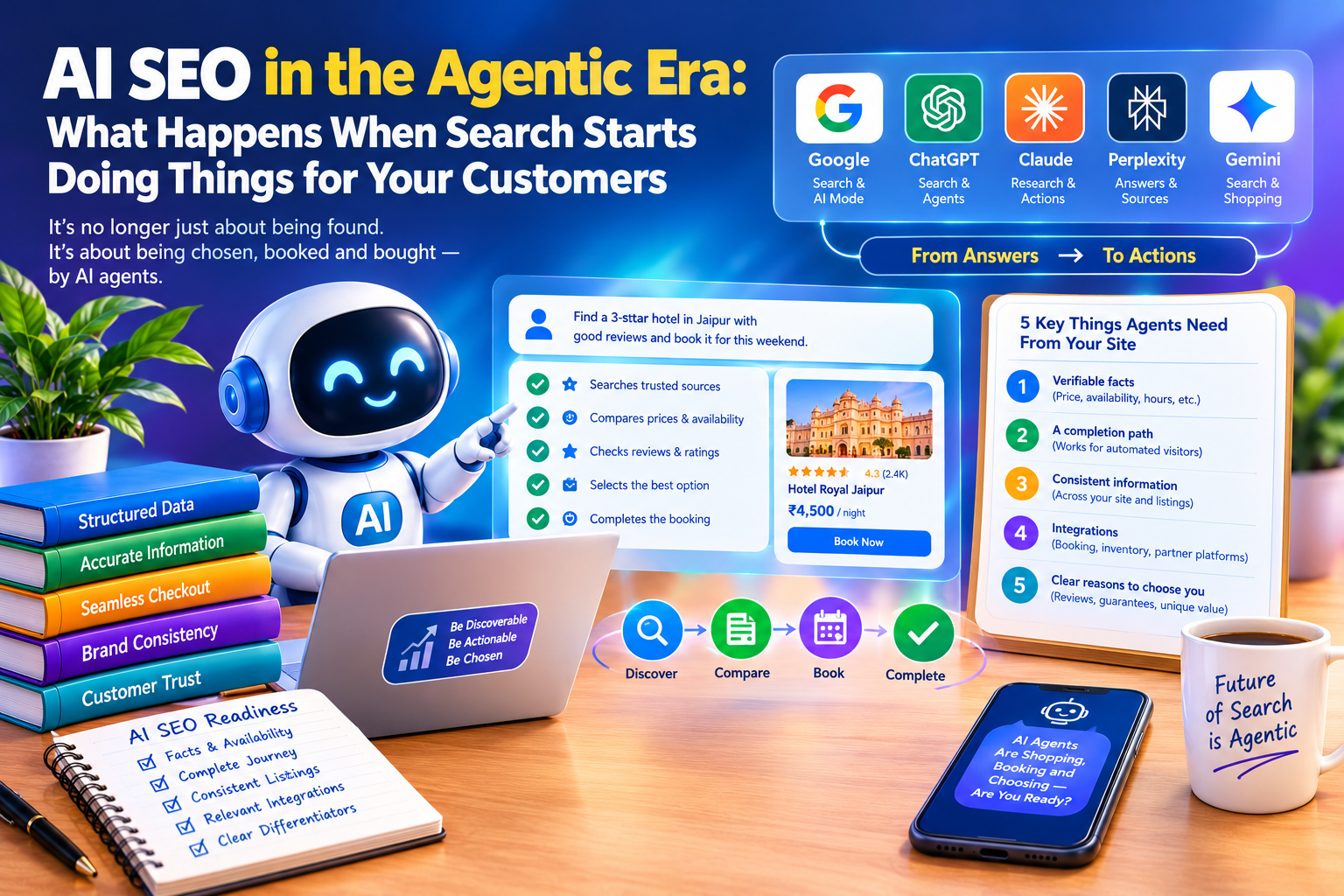
For two decades, search worked like a library catalog. A person typed a query, scanned results and chose a site. AI SEO has so far focused on getting cited inside AI answers. But a bigger shift is now arriving: AI that doesn’t just answer, but acts. It books the table, compares the prices and completes the checkout.
If that sounds distant, recent announcements suggest otherwise. This guide explains what is changing, what remains uncertain, and how to make your site usable by software acting on a customer’s behalf.
What “Agentic” Search Means
An AI agent is software that carries out a multi-step task for a user, rather than returning a list of links. Google’s I/O 2026 conference put several such features on the table. One recap describes information agents that run in the background of a user’s Google account around the clock, without the user having to search for anything, plus agentic booking, which applies the same idea to transactions. brainlabsdigitalbrainlabsdigital
Another summary of the event lists an AI-powered Search box, information agents, expanded agentic booking, personalized search experiences and generative interfaces. Agentic booking is described as letting users ask Search to find services, compare availability and provide direct links to complete bookings. seosherpaseosherpa
Commerce is moving in the same direction. Google launched its Universal Commerce Protocol in January 2026. According to one agency overview, it aims to allow AI agents to discover products and complete checkouts directly on websites. The same source says agent-led restaurant bookings arrived in AI Mode in the UK in April.
A caution on interpretation: most coverage of these launches comes from marketing agencies, not Google itself. Features also roll out unevenly by country and category. Treat the direction as credible and the details as subject to change.
Why This Matters for AI SEO
When a person chooses, your page competes on persuasion. When an agent chooses, your page competes on clarity and completeness. One commentator frames the shift this way: AI agents make decisions before options are presented to your audience. If your site is skipped at that stage, the customer never sees you.
There is also a visibility risk worth stating plainly. One recap of the I/O announcements notes that with these features, the user waits, and may never visit your site at all. That makes measuring only clicks even less reliable than before.
Five Things Agents Need From Your Site
Nobody outside the platforms knows exactly how each agent scores sites. But the pattern across industry guidance points to five areas worth fixing now.
- Facts an agent can verify instantly
One strategy guide advises that agents rely on structured endpoints to verify price, stock and shipping speed instantly. Whatever your category, the equivalent is knowing which facts a decision depends on: prices, opening hours, availability, service areas, delivery times, cancellation terms. Put each in plain, consistent text on the page, not only in images or PDFs.
- A completion path that software can follow
Many brands assume a human will fill the form. One recap poses the question directly: can an agent actually complete a booking on your site? Check your own journey. Do you require an account before showing prices? Does a pop-up block the form? Does a verification step fail for automated visitors? Each friction point is a place an agent, or a patient human, may give up. Sarkar SEO treats this “can it be completed?” test as a standard part of an AI SEO audit, because it is quick to run and often reveals the most costly gap.
- Consistent information across the web
Agents don’t rely on your site alone. One local-search guide recommends keeping key details accurate on both your website and your Google Business Profile. The same guide says Google may weigh availability, cuisine, location, reviews, booking integrations and business information when recommending a restaurant. If your hours differ across listings, an agent has reason to distrust all of them.
- Integrations where your market uses them
The restaurant example shows that agents often pull availability from partner booking systems. If your sector relies on such systems, being absent from them may matter more than any on-page change. Ask which platforms your customers’ agents are likely to query, then check whether you’re connected.
- Reasons to be chosen, not just found
An agent must decide between options, so differentiators need stating plainly: guarantees, certifications, response times, real customer evidence. Vague claims give an agent nothing to compare. Reviews also carry weight, as the restaurant guidance above indicates, so your review practices are now part of AI SEO.
What Not to Do
Don’t rebuild everything for hypothetical protocols. Standards like UCP are new and may change. Most businesses gain more by fixing basic accuracy and checkout friction than by chasing the latest specification.
Don’t abandon content. Agents still need information to choose you. Helpful, original content remains the reason a system trusts a brand enough to recommend it.
Don’t assume it applies equally to every business. A bakery, a B2B software firm and a clinic face very different agent exposure. Start with where your revenue is closest to a transaction.
A Simple Readiness Check
Score your top conversion page against these questions:
- Could someone with no prior knowledge of you find price or availability in under 30 seconds?
- Can a guest complete the key action without creating an account?
- Do your website, business listings and booking platforms all show identical details?
- Is every key fact written in text, not locked in an image?
- Do you give a clear reason to choose you over the next option?
Each “no” is a fix, ranked by how close the page sits to revenue.
