



Open any marketing feed and you will find confident advice about AI SEO: add this file, rewrite your pages like this, buy that kind of mention. In May 2026, Google published its own guidance, titled “Optimizing your website for generative AI features on Google Search,” and it settles several of those debates.
At Sarkar SEO, we read it closely. This FAQ turns it into plain language, one myth at a time.
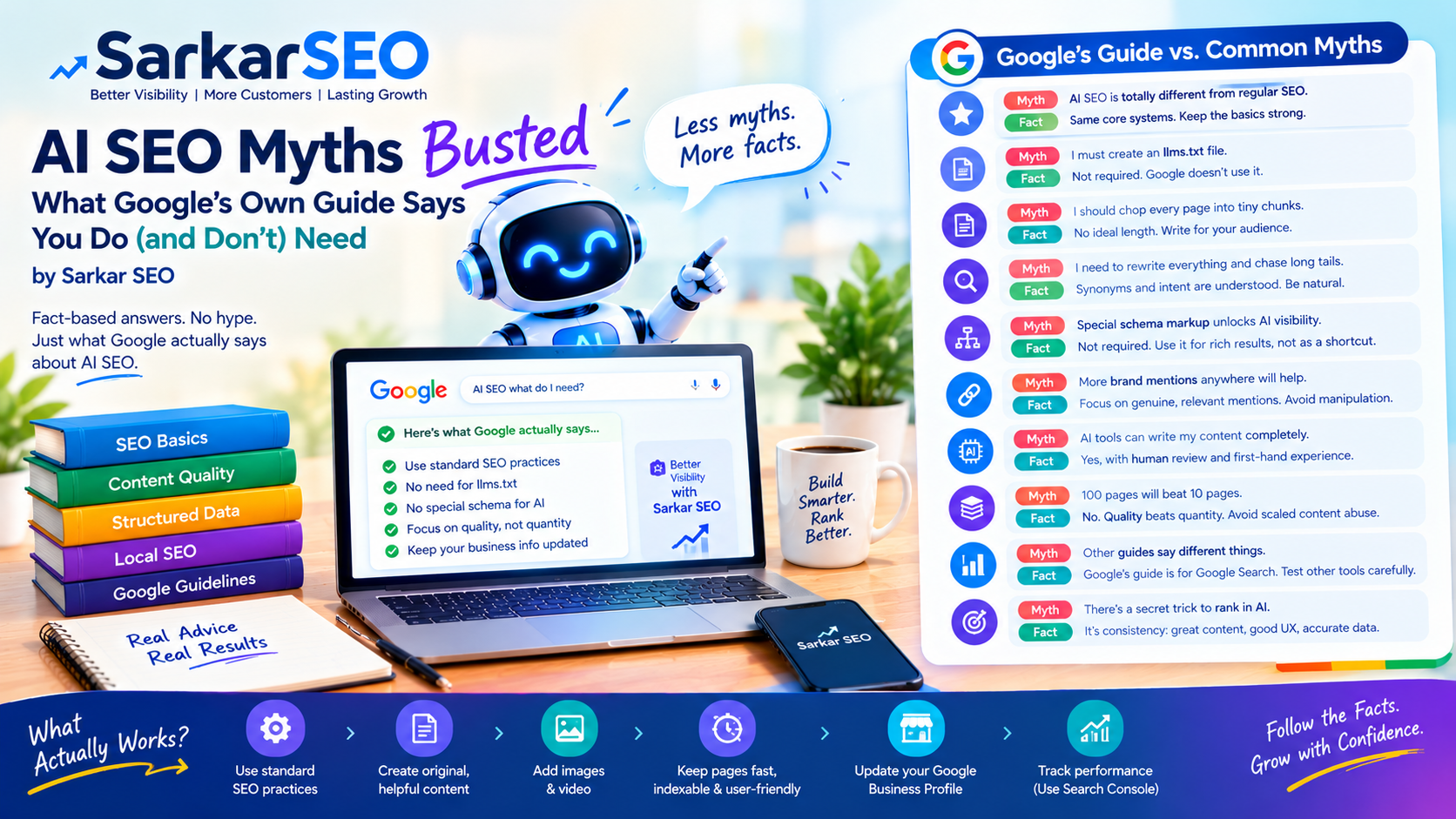
Is AI SEO really different from regular SEO?
Less than the hype suggests. Google’s guide explains that its AI features rely on the same core ranking and quality systems as the rest of Search, so foundational SEO practices still apply. Terms like GEO and AEO are industry labels. They are handy for planning, but they are not a separate rulebook. Sarkar SEO uses them as shorthand for where to focus, not as a reason to abandon the basics.
Myth: “I must create an llms.txt file”
Google says its Search does not use llms.txt files, AI text files, or special markup, so you do not need them to appear in Search or its AI features. You can still create one for other services if you like. It simply will not help or hurt your Google visibility. Sarkar SEO would rather spend your budget on pages people actually read.
Myth: “I should chop every page into tiny chunks”
Not required. Google says its systems can handle pages that cover several topics, and it states that there is no ideal page length. Write clearly for your audience, use sensible headings, and stop worrying about slicing content for machines. Sarkar SEO still keeps paragraphs short, but that is for human readers.
Myth: “I need to rewrite everything for AI and chase every long-tail phrase”
Google notes that its systems understand synonyms and intent, so content worded differently can still match a query. You do not need a special AI writing style or a page for every phrase variation. Write naturally, answer the question properly, and let the language model do its job.
Myth: “Special schema markup unlocks AI visibility”
Structured data is not required for generative AI search, and Google says there is no special schema for it. It is still worth using, because it makes pages eligible for rich results and states facts clearly. Just do not sell it, or buy it, as an AI shortcut. Sarkar SEO adds markup for accuracy, not for magic.
Myth: “More brand mentions anywhere will make AI recommend me”
Google says chasing inauthentic mentions across the web is not useful. Its core ranking systems favour quality content, and its spam systems filter out manipulation. The honest version is slower: be worth mentioning. Genuine reviews, real press, helpful community answers, and happy customers who talk about you are what build a lasting footprint. Sarkar SEO focuses on relevant, genuine mentions for exactly this reason.
Can I use AI tools to write my content?
Yes, with conditions. Google says generative AI can help create content, but the result must still meet its Search Essentials and spam policies. In practice, that means a human adds first-hand experience, checks every fact, and removes filler. At Sarkar SEO, AI can speed up drafting, but a person owns the final page.
Will publishing 100 pages beat publishing 10?
No, and it can backfire. Google says that creating large numbers of pages mainly to manipulate rankings or AI responses violates its scaled content abuse policy. It also points out that more pages do not make a site higher quality or more relevant. Ten excellent pages beat a hundred near-duplicates.
Why do so many guides still say otherwise?
Partly because the field is new and advice moves faster than evidence. Partly because some tactics are sold with confidence long before anyone proves them. One honest caveat: Google’s guide covers Google Search. Other AI tools may behave differently, and their rules are not always published. Our approach at Sarkar SEO is to build on what Google confirms, test other platforms carefully with real prompts, and share the results openly instead of repeating folklore.
So what actually works?
The guide’s answer is refreshingly familiar:
- Keep applying foundational SEO.
- Publish original, non-commodity content with a real point of view, first-hand experience, and clear organisation.
- Add helpful images and video.
- Make sure pages are indexed, snippet-eligible, fast, and easy to use.
- Keep your Google Business Profile and Merchant Center details current.
Nothing here needs a secret trick. It needs consistency, and Sarkar SEO builds its monthly work around exactly these steps.
How should I measure AI performance?
Google points site owners to the Generative AI performance report in Search Console, and suggests checking third-party tools against its official guidance. That is good advice. Many tracking tools are useful for spotting trends, but Search Console is the source for what Google itself is showing. Sarkar SEO combines both, then ties the data to leads and sales.
What about AI agents that act for shoppers?
Google suggests exploring agentic experiences as they become relevant to your business. You do not need to rebuild anything today. Keep your prices, availability, hours, and contact details accurate, because an agent can only act on information it can trust. Sarkar SEO treats clean, current data as the base for whatever comes next.
