



If your organic traffic has softened while your rankings look steady, you are not imagining things. AI-generated summaries now answer many questions on the results page itself, and several large studies have tried to measure the damage.
This article skips the “how to get cited” playbook and looks at a harder question: how should you judge AI SEO when clicks are no longer the whole story?
What the Research Found
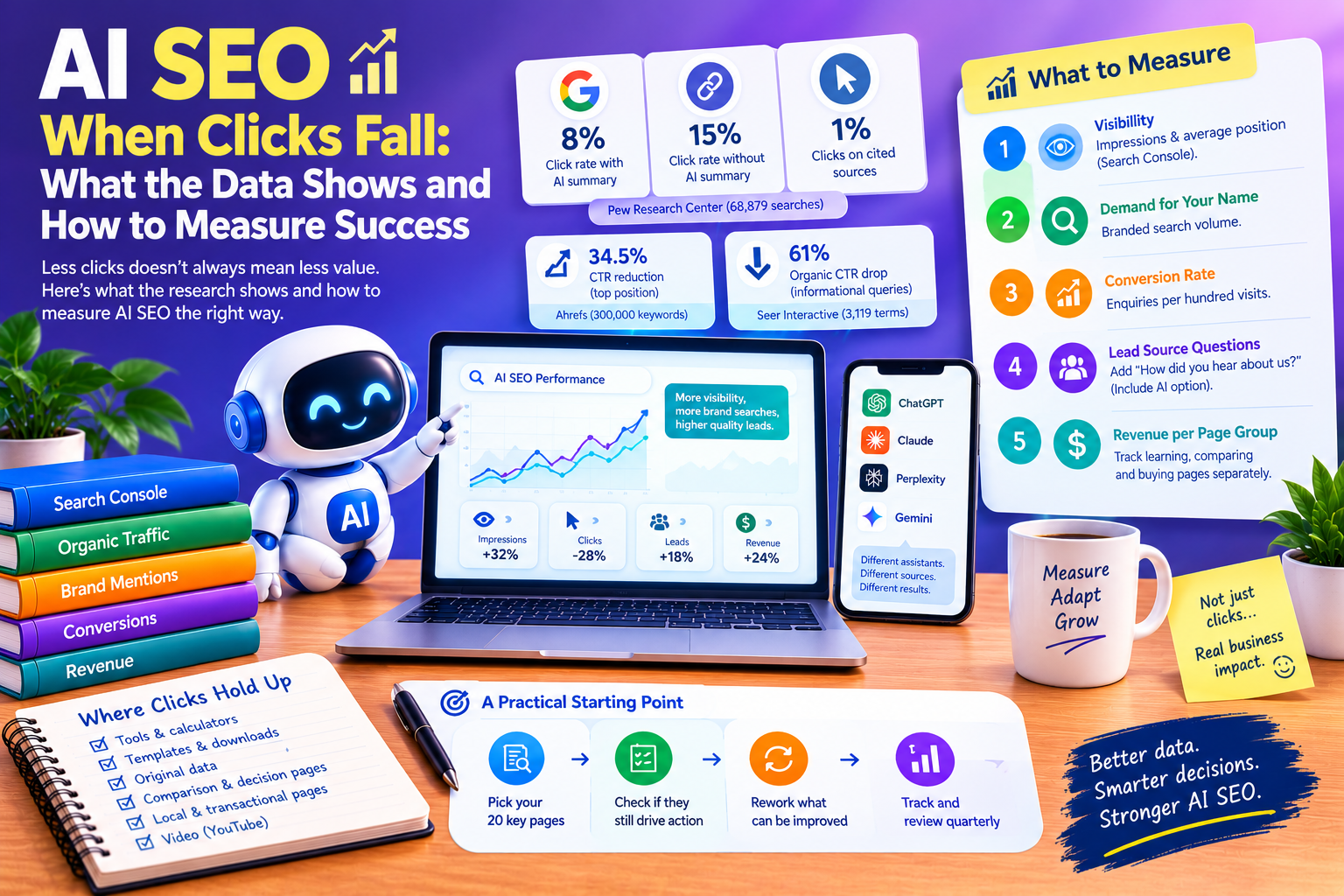
The strongest public evidence comes from Pew Research Center, which, according to one review, is the only large study with no commercial interest in the answer, and published it in full. It analyzed 68,879 Google searches. A summary of its findings reports that users clicked links 8% of the time when an AI summary appeared, against 15% when it did not, and only 1% clicked the sources cited inside the summary. itwholewhale
Industry studies point the same way. Ahrefs compared 300,000 informational keywords, half with an AI Overview and half without, and estimated that the overview reduced click-through rate for the top position by about 34.5%. Seer Interactive’s analysis of 3,119 search terms across 42 organizations found that organic click-through rates for informational queries with AI Overviews fell 61% since mid-2024.
Treat these numbers as direction rather than destiny. One independent review points out that every click-through-rate study in this field works by comparison, and none measures AI Overview clicks directly. Query mix, device, and industry all change the result. it
Why Your Own Dashboard May Mislead You
Impressions can mislead too. The same review notes that in Seer’s later data across 5.47 million queries and 53 brands, impressions rose from 15.8 million to 33.1 million in one month while clicks stayed almost flat, which halves the rate arithmetically. A falling click-through rate does not always mean fewer people care about you. Sometimes your pages simply appear in more places.
That is why a single metric cannot carry AI SEO reporting anymore.
Does Being Cited Pay Off?
Seer found that brands cited in AI Overviews earned 35% more organic clicks and 91% more paid clicks than those not cited, though the researchers acknowledged they cannot prove citation causes the higher rates. That caveat matters. Strong brands may be both cited more often and clicked more often for the same underlying reason.
A reasonable reading: citation is worth pursuing, but it will not restore the old traffic curve by itself.
A Better Scorecard
Replace “sessions” as your headline number with a short set of measures that connect to revenue.
- Visibility. Track impressions and average position in Search Console for your priority topics. Google states that AI feature traffic is reported within the Web search type of the Performance report, so you will not find it as a separate line, but the trend is still visible.
- Demand for your name. Branded search volume is a useful proxy for awareness. If people increasingly search for your company after seeing it in AI answers, you will see it here before you see it anywhere else.
- Conversion rate, not just volume. Fewer clicks can still mean more leads if the remaining visitors are further along in their decision. Compare enquiries per hundred visits, month by month.
- Lead source questions. Add “How did you hear about us?” to forms, with options such as “AI assistant.” Self-reported data is imperfect but often catches influence analytics miss.
- Revenue per page group. Group pages by purpose, such as learning, comparing, and buying, and report each group separately. A drop in learning traffic is a different problem from a drop in buying traffic.
At Sarkar SEO, reporting follows this layered approach, because a client who sees only one graph tends to make poor decisions when that graph moves.
Where Clicks Hold Up
Not every query behaves the same. AI summaries do their best work on simple, factual questions. Visitors still need a page when the task goes beyond reading a paragraph. Consider shifting effort toward content that cannot be fully answered in a summary:
- Tools and calculators that produce a personal result.
- Templates and downloads a reader can use immediately.
- Original data that others must cite back to you.
- Comparison and decision pages where the buyer needs detail and nuance.
- Local and transactional pages where the next step is a visit, call, or purchase.
Video is worth a mention. In an analysis of AI Overview citations, Ahrefs found that YouTube accounted for roughly 5.6% of all cited URLs, and Pew found that Wikipedia, YouTube, and Reddit together made up 15% of the sources in the summaries it examined. If your audience watches how-to content, a channel may be an underused route into AI answers. busyseedbusyseed
What to Stop Doing
Stop publishing pages whose only job is to answer a simple question that a summary will answer better. If the page has no tool, data, or point of view to add, a click has no reason to happen. Fewer, stronger pages usually outperform a long tail of thin ones.
Also stop judging AI SEO on a single month. Seer’s own guidance suggested planning for click-through rates on high-funnel queries to be 20 to 30% lower than current levels, which is a planning assumption, not a certainty. Set targets against that kind of range and review quarterly.
A Practical Starting Point
Pick your twenty most valuable pages. For each, write down the action you want a reader to take, whether that is a call, signup, or purchase. Then check whether the page still earns that action, and whether a summary could replace its content. Strengthen the pages that pass and rework the ones that fail. Sarkar SEO uses this same exercise as the first step in client audits, since it separates pages that make money from pages that merely collect traffic.
