



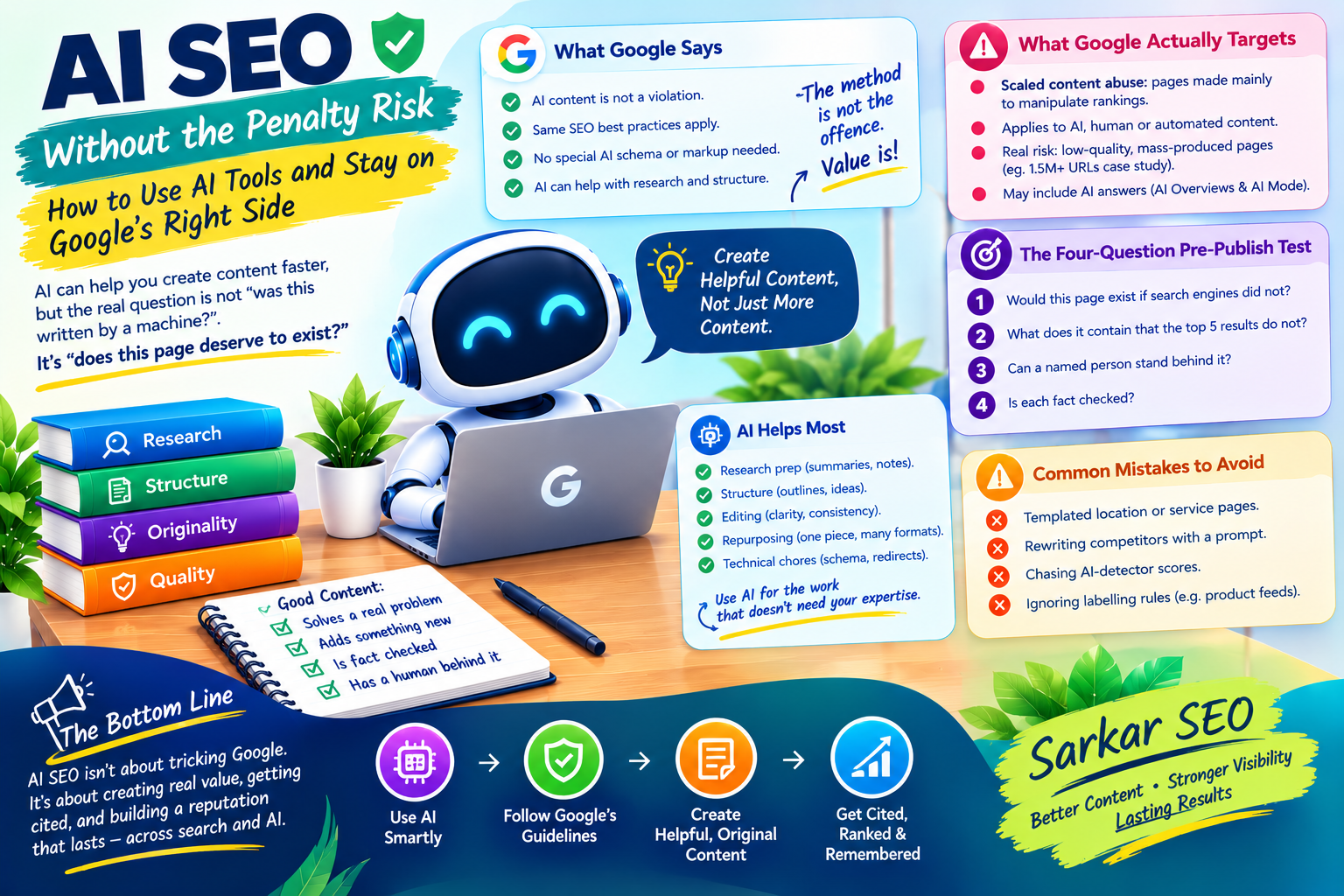
Using AI SEO to speed up content is now routine. The real question is where efficiency ends and spam begins. Google’s policies draw that line more clearly than most of the commentary around them, and the line is not where many people think it is. Sarkar SEO sees teams worry about the wrong risk: they fret over whether a page “sounds like AI” while ignoring what the policy actually targets.
Google Does Not Ban AI Content
The method of production is not the offence. One analysis of Google’s policies puts it bluntly: AI-generated content is a production method, not a violation. Google has also said it would be as absurd to ban all AI content as to ban all human content, since some humans produce spam. Its current guidance even recognises that AI can help with research and article structure. scaled content abuse +2
So the useful question is not “was this written by a machine?” It is “does this page deserve to exist?”
What Google Actually Targets
The relevant rule is called scaled content abuse. Google describes it as generating many pages chiefly to manipulate rankings rather than to help the people who land on them. The policy was introduced in March 2024 and, according to Google’s spokesperson at the time, aimed to address low-quality AI-generated content designed to attract clicks without adding much original value.
It is method-neutral. The policy covers content created by humans, generative AI or other automated means, and one commentator notes you can break it with a room full of human writers producing weak pages from the same template. TechCrunchreturnonnow
The risk is real. A recent set of case studies on Google’s August 2026 spam update describes a site with over 1.5 million URLs indexed that the author judged to fall under scaled content abuse. Google itself has never stated that the update targeted AI-generated pages, so treat any claim that it did as interpretation.
A Newer Wrinkle: AI Answers Are Covered Too
On May 15, 2026, Google updated its spam policy documentation to clarify that all existing spam policies apply to generative AI responses in Search, including AI Overviews and AI Mode. Reports on the change stress that it did not invent new violations. What it does is close a gap: tactics aimed at getting into AI answers, such as mass-producing near-duplicate pages around query variations, get the same treatment as old ranking tricks.
The same coverage notes that Google is not saying that understanding how AI Overviews work and structuring content accordingly is spam. Good structure is fine. Manufactured entry points are not.
The Four-Question Pre-Publish Test
This is a working checklist we propose, not a Google rule. Run any AI-assisted page through it before it goes live.
- Would this page exist if search engines did not?
If the only reason for a page is to catch one more query variation, it is a doorway in practice. A page should answer a genuine need that a real person has. - What does it contain that the top five results do not?
This might be your own data, a worked example, a tested process, a correction of a common mistake, or a specialist’s judgement. If the honest answer is “nothing,” the page adds volume, not value. - Can a named person stand behind it?
Someone with relevant knowledge should review, correct and take responsibility for the content. This matters most in health, money and legal topics. One review of the August 2026 update cases flags pages in an ultra-YMYL niche that combined programmatic content with 100% AI-generated text as a particular concern. - Is each fact checked?
Language models can state invented details with confidence. Every statistic, date, name and quote needs verifying against a source you have opened. Unverified figures damage trust faster than awkward phrasing ever will.
Where AI Helps Most
Used well, AI saves time on work that does not need your expertise, leaving more hours for the work that does.
- Research prep: summarising your own interview notes, call transcripts or support tickets to spot recurring questions.
- Structure: proposing outlines you then reshape around what you actually know.
- Editing: tightening drafts, flagging repetition and checking consistency of terms.
- Repurposing: turning one verified report into a summary, a checklist and a short talk outline.
- Technical chores: drafting schema, redirect maps or title variations that you then review.
Notice what is missing from the list: publishing raw output. One practitioner guide describes safe AI content as assembled in several stages and finished by hand, not generated in one click. That is a fair summary. seoquick
Common Mistakes to Avoid
- Templated location or service pages. A thousand near-identical pages that differ only by a city name are the textbook example. One source describes a thousand templated “service + city” pages generated in one evening as abuse.
- Rewriting competitors with a prompt. If your page is a paraphrase of the top result, it adds nothing new.
- Chasing AI-detector scores. Google’s own guidance is about value, not detection. One policy guide stresses that Google’s approach is not an AI detector policy. Passing a detector does not make a thin page useful.
- Ignoring labelling rules where they apply. Some surfaces have their own requirements. For product feeds, one guide says AI-generated images need IPTC DigitalSourceType metadata and AI-written product text needs separate labelling. Check the rules for any platform you publish to.
A Sensible Publishing Rhythm
Smaller, better pages beat large batches. Publish fewer articles, but make each one the best available answer to a single question. Revisit older pages and update them when facts change. Prune or merge thin pages that nobody reads, because they weaken the whole site.
