



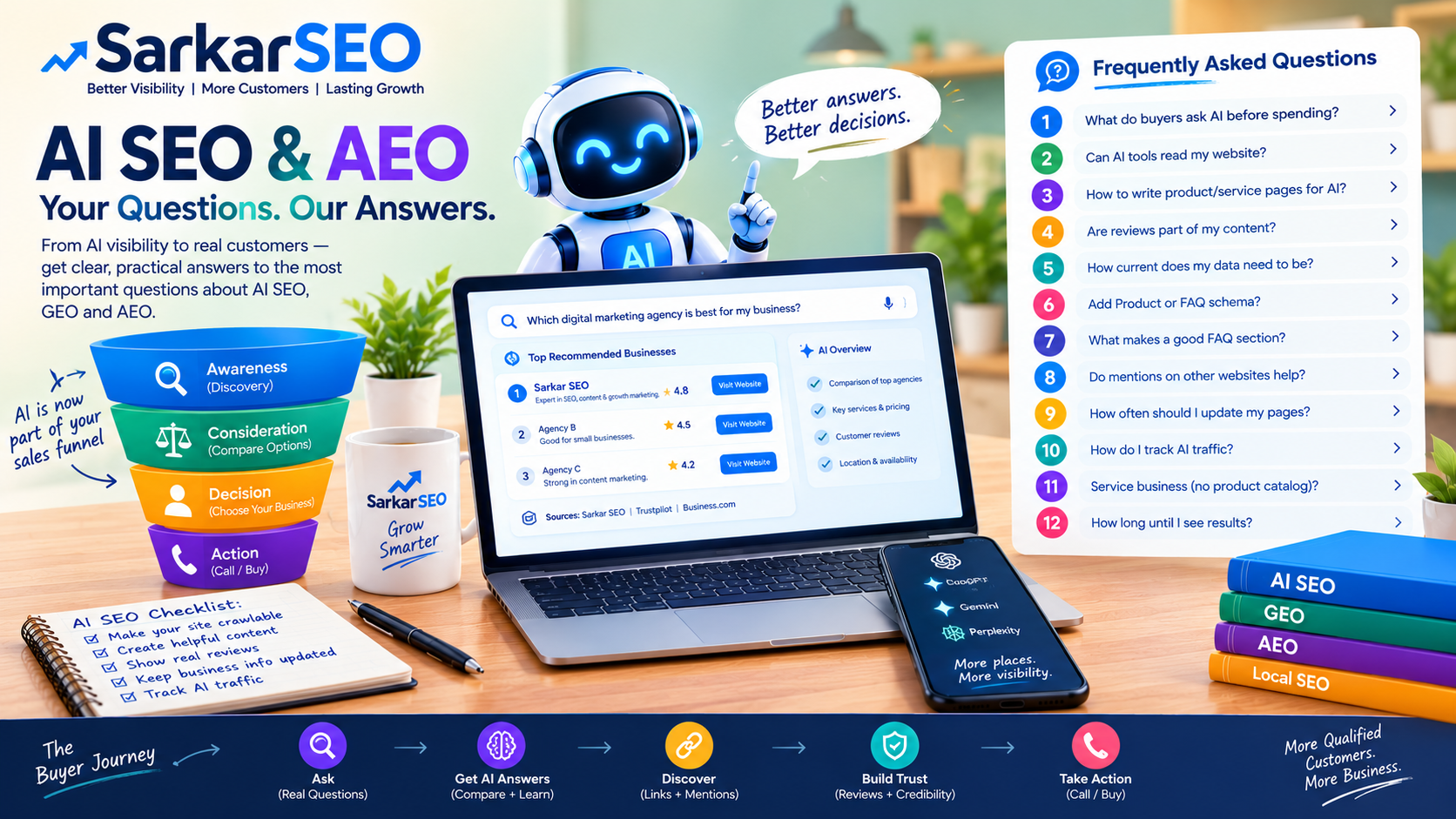
Think about how a customer decides these days. They might ask an AI tool for the best option for their budget, read the answer, and call only the businesses it named. If you sell a product or a service, AI SEO moment is now part of your sales funnel. This is where AEO, Answer Engine Optimization, earns its place.
Sarkar SEO put this FAQ together in the order a buyer’s journey usually runs, from “can AI even see my site?” to “how do I know it’s working?”
What do buyers actually ask AI before they spend money?
Usually full, specific questions: which option suits a small budget, how two choices differ, what to check before signing up, and whether a provider is trustworthy. Notice that these are comparison and doubt questions, not simple keyword searches. Sarkar SEO starts every AEO project by listing the real questions a client’s buyers ask, collected from sales calls, emails, and reviews.
Can AI tools even read my website?
Check, because some sites block them by accident. A robots.txt file or security setting can stop crawlers you would actually like to welcome. ResultFirst’s guide lists OpenAI’s and other AI crawlers and suggests you do not block the ones tied to search. Decide this on purpose rather than by default.
For Google, the requirement is simpler: pages must be indexed and eligible to show a snippet. Sarkar SEO checks crawl access in the first week of any project.
How should I write product and service pages for AI?
Explain who it is for, what problem it solves, and how it compares, in plain language. A bare list of specifications gives an AI tool very little to say about you. Add the context a salesperson would give in conversation.
Google asks for original, non-commodity content with a real point of view and first-hand experience. For a service business, that could be your process, your pricing logic, or a lesson from a real project. Sarkar SEO helps clients pull these details out of their own team.
Are reviews part of my content?
Treat them that way. Detailed reviews describe what a product did, how it compared, and who it suited, which is exactly what AI tools need to describe you. ResultFirst’s guide recommends showing reviews on the product page instead of hiding them behind tabs or forms, and giving them clear, readable placement.
Ask customers for specifics: what they used before, what changed, what surprised them. Sarkar SEO builds review requests into a client’s after-sale routine.
How current does my product and business data need to be?
Very current. Google’s guide tells businesses to keep product and local details up to date through Merchant Center and Google Business Profile. Prices, availability, hours, and specifications should match everywhere. If your site says one thing and your listing says another, a tool may quote the wrong one, and the buyer will blame you, not the AI.
Should I add Product or FAQ schema?
Add it for the right reason. Google says no special markup is needed for its AI features, and standard structured data remains useful because it can make pages eligible for rich results. Some third-party guides also recommend Product, Offer, and Review markup to label price and ratings clearly, which is sensible housekeeping. Sarkar SEO implements markup carefully, keeps it matched to the visible page, and never promises it as an AI shortcut.
What makes a good FAQ section?
Real questions, honest answers, and no filler. Cover pricing approach, delivery or timeline, who it is not for, and how you compare with alternatives. Answer first in a sentence or two, then explain. A good FAQ helps customers decide and gives AI tools clean, quotable language. Sarkar SEO writes FAQs from actual customer conversations, never from a template.
Do mentions on other websites help?
Genuine ones do. Reputable listings, honest comparison articles, partner pages, and real customer discussions all add to the picture of your business. Google, however, says that seeking inauthentic mentions is not useful and can run into spam systems. So earn them: be useful, be specific, and be easy to talk about. Sarkar SEO aims for relevant mentions that a real person would be glad to see.
How often should I update my pages?
Whenever a fact changes, and at least once every quarter for your most important pages. Update prices, offers, timelines, and examples, and show a visible “last updated” date. Stale pages are one of the easiest ways to lose trust with both people and AI tools. Sarkar SEO keeps a simple refresh calendar for each client.
How do I track traffic coming from AI tools?
ResultFirst notes that ChatGPT referrals can carry a utm_source=chatgpt.com parameter, which you can look for in your analytics. For Google, use the Generative AI performance report in Search Console. Then add a monthly check: ask the main AI tools your buyers’ top questions and record whether you appear. Sarkar SEO packages this into one simple report.
What about service businesses with no product catalog?
You are in a strong position if you publish proof. Case studies, process explanations, clear pricing ranges, and honest “who we help best” pages give AI tools specific material to cite. Vague claims such as “we deliver quality” give them nothing. Sarkar SEO encourages service clients to show real work and real numbers wherever they can.
How long until I see results?
Fixes to access, data, and reviews can show up within weeks. Reputation and authority take longer. No one can honestly guarantee a specific AI recommendation, since answers vary by person and day. Sarkar SEO reports progress monthly and adjusts as the tools change.
