



Most AI SEO discussions focus on what machines do: how they retrieve, rank and cite. This article starts with the person typing. Their behavior is changing in ways that matter more than any technical tweak, because it decides which content gets read at all.
The Best Primary Evidence on Clicks
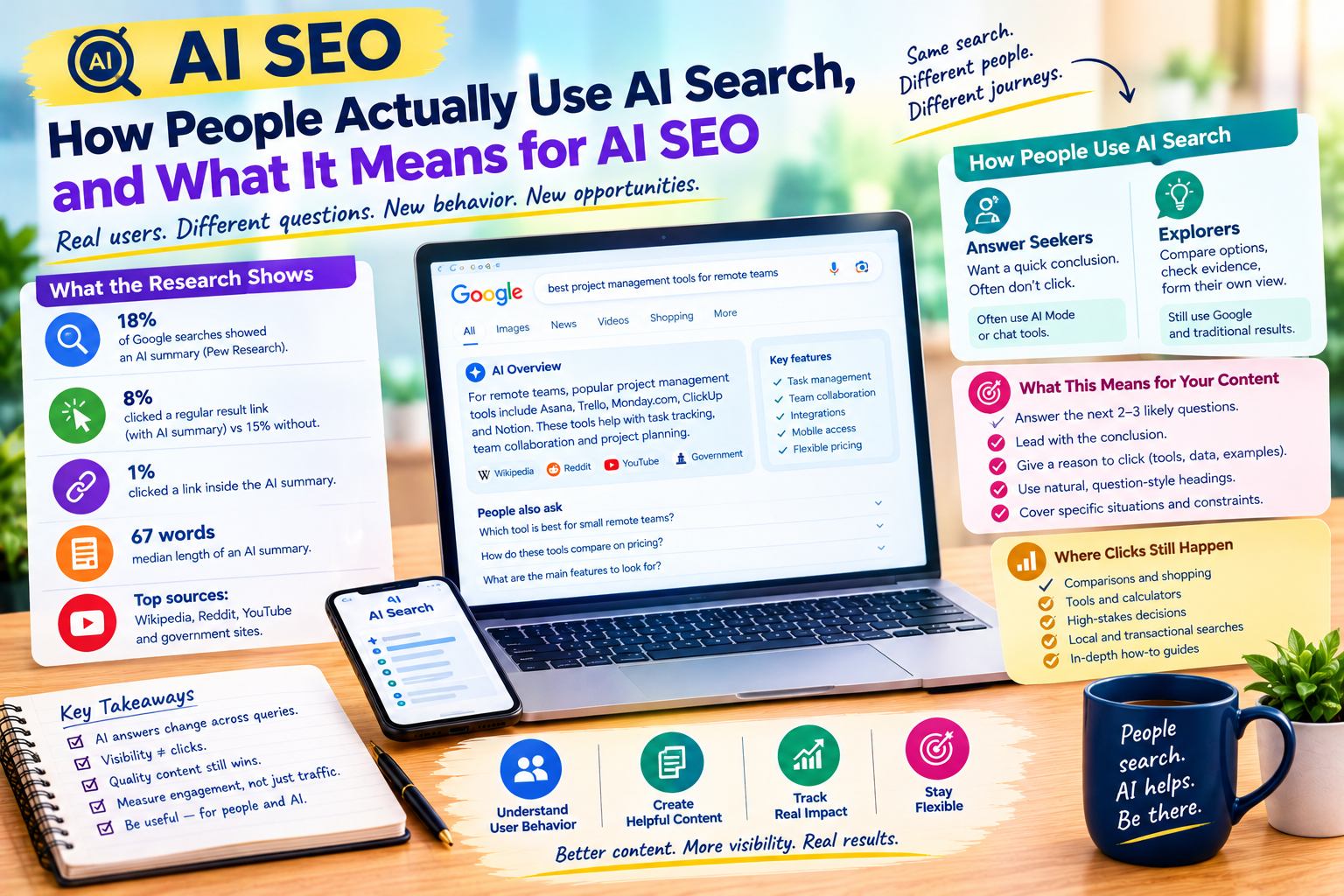
The most credible public dataset comes from Pew Research Center, which tracked the browsing of 900 US adults and analyzed 68,879 Google searches collected in April 2025. Its findings:
- About 18% of searches produced an AI summary.
- Users clicked a regular result link in 8% of visits to pages with an AI summary, compared with 15% on pages without one.
- Clicks on links inside the AI summary itself were rare, about 1% of visits.
- The median AI summary ran 67 words.
- Wikipedia, Reddit and YouTube were the most-cited sources. Government sites made up 6% of sources in AI summaries and 2% in standard results.
Two limits matter. The data is American and from spring 2025, so current numbers may differ. And it measures one Google feature, not ChatGPT or Perplexity. Still, it is one of the few studies built on actual browsing behavior, not on a vendor’s prompt sample.
Who Gets an AI Summary
Pew also found that the type of query matters. Searches beginning with a question word such as “who,” “what,” “when” or “why” produced an AI summary 60% of the time, and searches containing a full noun-and-verb sentence did so 36% of the time. Short keyword queries triggered them far less.
So AI exposure concentrates on conversational, explanatory questions, exactly the kind that informational blogs have always targeted. Transactional and navigational searches are affected less.
Two Kinds of Searchers
Google’s own comments add a useful distinction. In a Search Engine Journal write-up of an interview with Google’s Liz Reid, she described people who go straight to AI Mode as asking more complex, longer questions where they expect to follow up. Someone with a “browsy” query, who wants to see choices and compare sources, may prefer the full results page. She also said many people use several tools together.
A TechCrunch interview with Google’s Robby Stein, relayed by Young Urban Project, reports AI queries running about twice the length of traditional searches, with follow-up questions roughly a quarter of the time. I couldn’t verify the original, so treat those numbers as indicative.
This divides your audience into at least two behaviors:
- Answer seekers want a conclusion fast and may never visit a website.
- Explorers want to compare options, check evidence and form their own view.
Your content serves both, but in different places.
What Changes for Content
At Sarkar SEO, we plan pages around the conversation a buyer has, not the single query that starts it. Query fan-out describes what the engine does behind the scenes. This is the human side of the same shift: the person keeps asking.
Write for the second and third question. A reader who asks “What is a retainer-based SEO contract?” will likely follow with “What does it typically include?” and “How do I know it’s working?” A page that answers only the first leaves them to find the rest elsewhere. Map the likely follow-ups, and answer them in sequence.
Lead with the conclusion. If an AI summary will paraphrase your answer, the first sentences should be the ones worth paraphrasing. Put the direct answer first and the reasoning second.
Give readers a reason to click. A summary can state a fact, but it can’t replace a tool, a dataset, a template, a worked example or an expert’s reasoning. Pew’s low click rates suggest the click now has to be earned by something the summary can’t contain.
Use natural phrasing. Since longer, sentence-style queries are more common, headings that mirror real questions (“How long does a site migration take?”) tend to fit better than keyword fragments. Stay readable, though. Don’t stuff question-shaped headings everywhere.
Provide the details of a situation. People increasingly describe their circumstances in a single prompt: their budget, location, constraints and goal. Pages that address specifics, such as “for a ten-person agency” or “for a first-time homebuyer,” match that detail better than generic overviews.
Where Clicks Still Happen
Not every query loses traffic. Consider where people still want a full page:
- Comparisons and shopping, where they want to see options and prices.
- Tools and calculators, which an answer can’t replicate.
- High-stakes decisions, where readers verify claims against primary sources.
- Local and transactional intent, where the next step is an action.
- Deep how-to guides, where a person needs the whole procedure and visuals.
If most of your traffic comes from simple definitions and quick facts, you are the most exposed. If your pages help someone do something, you are better protected.
Rethink What a Visit Is Worth
When fewer people click, each visit matters more. Several practical shifts follow:
- Measure engagement and outcomes, not only sessions. Look at conversions, enquiries and return visits per page.
- Check what you lose and keep. Compare impressions and clicks in Search Console for question-style queries over time. A falling click-through rate with stable impressions suggests you’re being shown but not clicked.
- Capture demand off-site. If answers happen elsewhere, brand recognition travels further than the click. Consistent naming, a clear category and memorable positioning help people look you up later.
- Build a direct relationship. Email lists, communities and product experiences don’t depend on a summary sending traffic your way.
Mistakes to Avoid
- Assuming one pattern fits all queries. Informational, commercial and navigational searches behave differently.
- Cutting content that people do read. A page with fewer clicks may still influence decisions through citations.
- Over-trusting one study. Pew’s data is a snapshot, and vendors report other figures with unclear methods.
- Writing for machines only. The person at the end of the answer is still the one who buys.
