



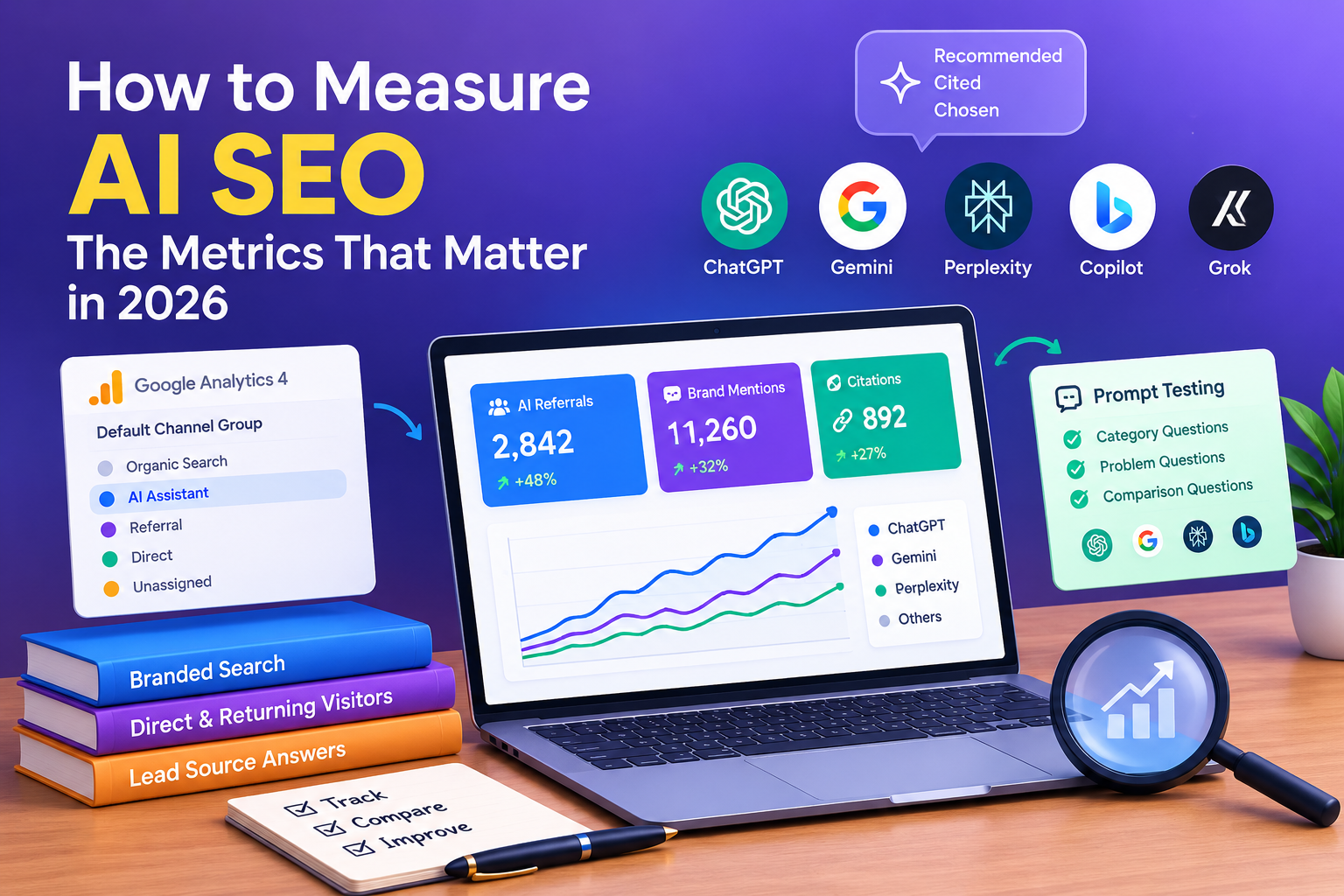
Most businesses can tell you where they rank. Far fewer can tell you whether ChatGPT recommends them, whether Google’s AI answers cite them or whether any of it brings in customers. That gap is the real obstacle in AI SEO. You can’t improve what you can’t see, and AI search hides a lot.
The fix is to stop looking for one number. A reliable picture comes from three layers, each answering a different question.
Layer One: What Your Analytics Can See
Google Analytics 4 added a native “AI Assistant” channel to its Default Channel Group on May 13, 2026, according to coverage of Google’s Analytics Help documentation. It labels visits from recognized assistants, including ChatGPT, Gemini, Copilot, Grok and DeepSeek, with the medium “ai-assistant.” That is a useful starting point, but the channel has limits you should understand before trusting it:
- No backfill. Reporting on the channel starts from its launch date. Earlier AI visits stay where they were, so a fast “increase” can simply reflect the new label.
- Google’s own AI features are elsewhere. Google’s documentation files AI Overviews and AI Mode under Organic Search, not AI Assistant.
- Unrecognized referrers fall through. A session without a referrer Google recognizes lands in Direct or Unassigned, according to Madx Digital. Search Engine Journal also reports that ChatGPT traffic can be split across several channels, which causes undercounting if you read only one row.
The practical response is to keep the native channel and build a custom channel group in GA4 that matches AI referrer hostnames, placed above Referral. Then compare the two. Where they disagree, you have found traffic worth investigating.
Expect the totals to look small. One industry report, relayed by SoftwareSeni, says the large majority of AI referral traffic arrives with no usable attribution signal. Treat any GA4 figure as a floor, not a ceiling.
Layer Two: What the Engines Actually Say About You
Analytics only records people who clicked. Many users read the AI answer, note a brand name and search for it later. To measure that exposure, you have to ask the engines directly.
Build a fixed prompt set of 20 to 30 questions that real buyers ask, split roughly into three groups:
- Category questions, such as “best tools for X.”
- Problem questions, such as “how do I fix Y.”
- Comparison questions, such as “A versus B.”
Run the same set monthly in ChatGPT, Perplexity, Gemini and Google’s AI features. For each answer, record four things: whether your brand is mentioned, whether your site is cited, which competitors appear and whether the description of you is accurate.
Then calculate share of voice. Several sources define it the same way: your mentions or citations divided by all mentions or citations for the prompt set, multiplied by 100.
Two traps deserve attention. First, a mention and a citation are different events. An engine can recommend your brand without linking to you, or link to your page without naming you. Count them separately. Second, Clique Studios warns that counting every appearance can overstate visibility, and recommends distinguishing raw placements from unique cited URLs. In its own June 2026 audit, 139 raw placements reduced to 100 unique citations.
Responses also vary between runs, so one test proves little. Repeat each prompt a few times and look at the pattern, not the single answer. At Sarkar SEO, we record the date, engine and prompt for every test, so month-to-month changes can be trusted.
Layer Three: The Indirect Signals
Some of the best evidence of AI influence appears elsewhere. Watch for these changes alongside your visibility tests:
- Branded search. Rising searches for your name in Search Console, at the same time your AI mentions grow, suggest people are hearing about you in answers and then looking you up.
- Direct and returning visitors. Growth here can reflect AI-driven discovery, though many other things also cause it.
- Lead source answers. Add an open “How did you hear about us?” field to forms. Customers increasingly write “ChatGPT” without any tracking code involved.
Be careful with causation. These signals are correlated evidence, not proof. Brainlabs makes the same point: you can’t credit AI visibility for a branded-search increase unless you also tracked whether mentions rose in the same period.
Mistakes That Distort the Numbers
- Changing the prompt set every month. You can’t compare results if the questions keep moving.
- Testing branded prompts only. Of course the engine knows your name when you type it. The informative tests are the unbranded ones.
- Reporting tool scores as facts. Visibility platforms estimate by sampling prompts. They are useful, but they are not census data.
- Ignoring conversion quality. A small stream of AI visitors who book calls can outweigh a large stream of casual readers.
- Expecting overnight movement. Citation patterns shift slowly and unevenly, so judge by quarters, not days.
Setting Honest Expectations
No tool today captures all of AI search. GA4 sees clicks, prompt tests see sampled answers, and brand signals suggest influence without proving it. Used together, they give a defensible view that any single source can’t.
A sensible starting plan fits in one afternoon: set up the custom GA4 channel, write your prompt set, run a baseline test and save the results. Everything after that is comparison.
AI SEO rewards the teams that measure honestly. Sarkar SEO’s view is that a modest, consistent scorecard beats an impressive dashboard nobody trusts, because the point is to decide what to improve next, not to produce a number that looks good.
