



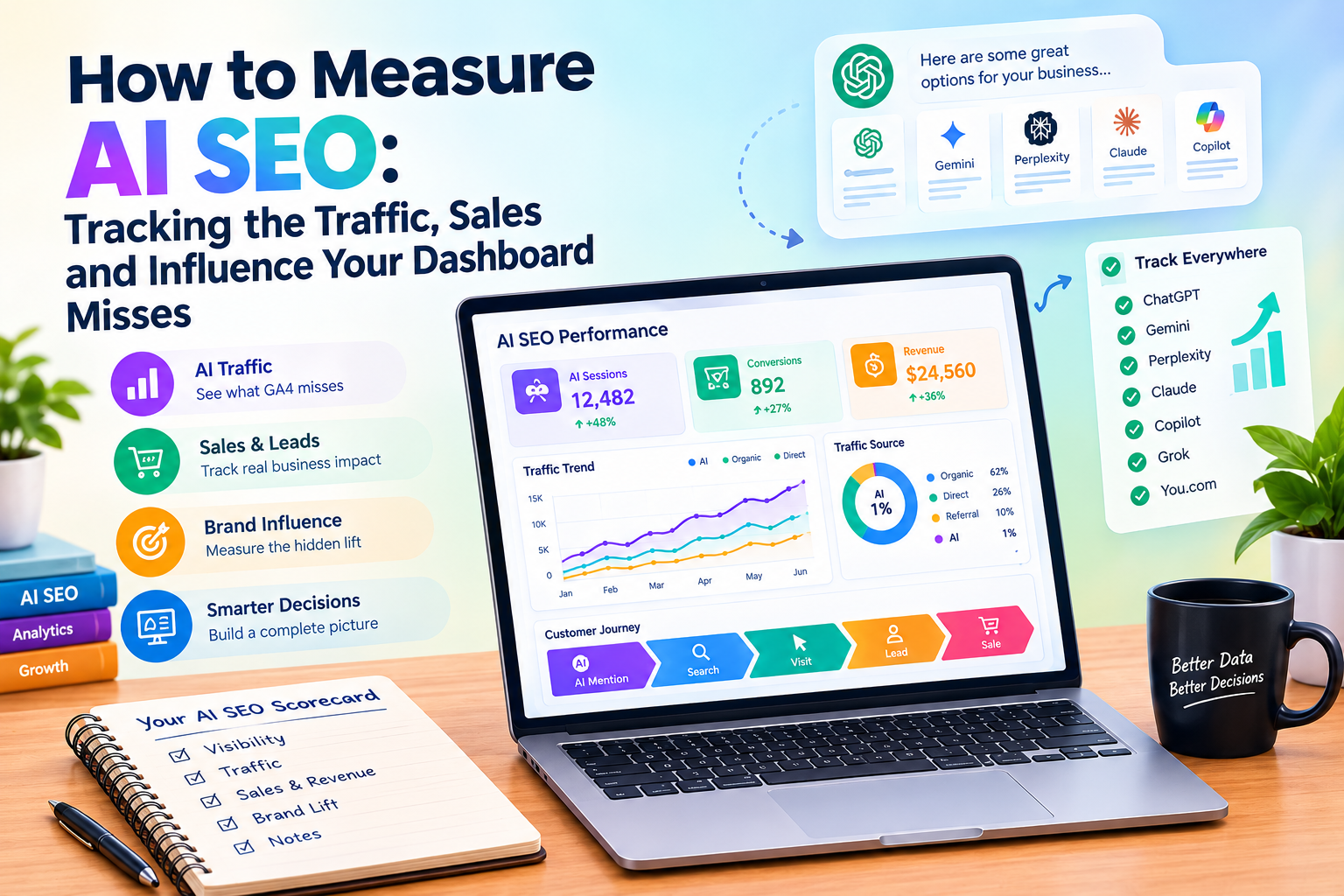
Most advice on AI SEO is about earning visibility. Far fewer people explain how to prove it worked. That gap matters, because a strategy you cannot measure is a strategy that gets cut at the next budget review. Sarkar SEO treats measurement as part of the work, not an afterthought, and this article shows how to build a realistic picture of AI-driven results.
Why Your Analytics Probably Understate It
Out of the box, Google Analytics 4 was not designed to separate AI traffic. One guide explains that when someone clicks a citation in a ChatGPT answer, GA4 sees a referral from chatgpt.com and files it under generic Referral, next to partner blogs and directories. Other visits vanish further. Another source notes that a lot of consumer ChatGPT traffic does not pass referrer data consistently, so it also folds into Direct. abmaticanglera
There is also a reported change to check. One search report says that around May 2026, Google reportedly rolled out a native AI Assistant channel to GA4 properties. The word “reportedly” is deliberate, so open your own property and see what appears before assuming anything.
Step One: Create an AI Segment
The practical fix is a custom channel group that catches known AI sources. One guide suggests a pattern matching chatgpt.com, chat.openai.com, perplexity.ai, claude.ai, copilot.microsoft.com, gemini.google.com and you.com. Order matters. As one walkthrough warns, if the AI channel sits below Referral, the referral rule catches chatgpt.com first and your AI channel stays empty. freelanceseofreelanceseo
Platforms change domains and tracking behaviour, so review the list every quarter.
Step Two: Compare Quality, Not Just Volume
Once you have a segment, look at what those visitors do. Useful measures include engaged sessions, average engagement time, key event rate, lead submissions, purchases and revenue per AI-referred session. If you run a CRM, connect lead and pipeline data so you can see what happened after the form was submitted.
Vendors claim striking results. One roundup states that Opollo’s study of 312 B2B firms found a 14.2% conversion rate for AI referrals versus 2.8% for Google organic. In retail, Adobe reported in April 2026 that AI-referred shoppers converted 42% better than non-AI traffic in March 2026.
These are encouraging but should not be treated as promises. The studies come from different industries, many are published by companies that sell AI visibility tools, and your own numbers may look very different. A reasonable hypothesis is that people arriving from an AI answer have already done some of their research, but only your data can confirm that for your site.
Step Three: Keep the Volume in Perspective
Here the picture is more sobering. One analysis of enterprise sites puts AI referral traffic at roughly 1% of total sessions in 2026, a real increase on a year earlier but small beside organic search. Growth rates sound dramatic because the starting point was tiny.
That context protects you from two mistakes: ignoring the channel because it is small, and betting the whole budget on it because the percentage growth looks impressive. Report it as one line in a wider discovery view, not as a replacement for everything else.
Step Four: Look for Influence You Cannot See
The most important lesson is that AI SEO affects behaviour that never shows as an AI visit. Someone sees your brand in an answer, does not click, then searches your name a week later. Analytics records that as branded organic or Direct. As one guide puts it, GA4 numbers for this channel are a floor, not a ceiling.
Three checks help you estimate the hidden part:
- Branded search trend. Watch impressions and clicks for queries containing your company name in Search Console. A steady rise after a visibility push is a useful signal, though other campaigns can cause it too.
- Conversion paths. Look for journeys where an AI referral appears early, but the sale is credited to Direct or branded organic. One measurement guide recommends an assisted-conversion view that credits the discovery channel that actually did the work.
- Ask customers. Add “How did you hear about us?” to forms and sales calls, with an option for AI assistants. It is crude, but it catches what no tool can.
Use Search Console, Carefully
One source reports that Google’s Search Generative AI performance report launched inside Search Console in June 2026, showing how often pages surface in AI Overviews and AI Mode. I could only confirm this through secondary reporting, so check your own Search Console account for the report and for any definitions Google provides before building decisions on it.
A Simple Monthly Scorecard
Here is a compact structure we suggest, built from the steps above. It is a working template, not an industry standard.
- Visibility: the share of your tracked customer questions where AI answers name or cite you.
- Traffic: AI-referred sessions and engaged sessions, month on month.
- Outcomes: leads, sales or revenue per AI-referred session, next to organic.
- Halo: the branded search trend and the number of customers who mention AI.
- Notes: any site changes, campaigns or platform updates that could explain movement.
Keep the same questions and the same method each month. Consistency matters more than precision, because AI answers vary between sessions.
Mistakes to Avoid
- Judging success by a single week of data.
- Comparing your numbers to a vendor’s headline conversion rate.
- Counting only clicks and ignoring brand lift.
- Changing your tracking method mid-year, which makes trends meaningless.
- Reporting AI traffic without showing what it did after arrival.
