



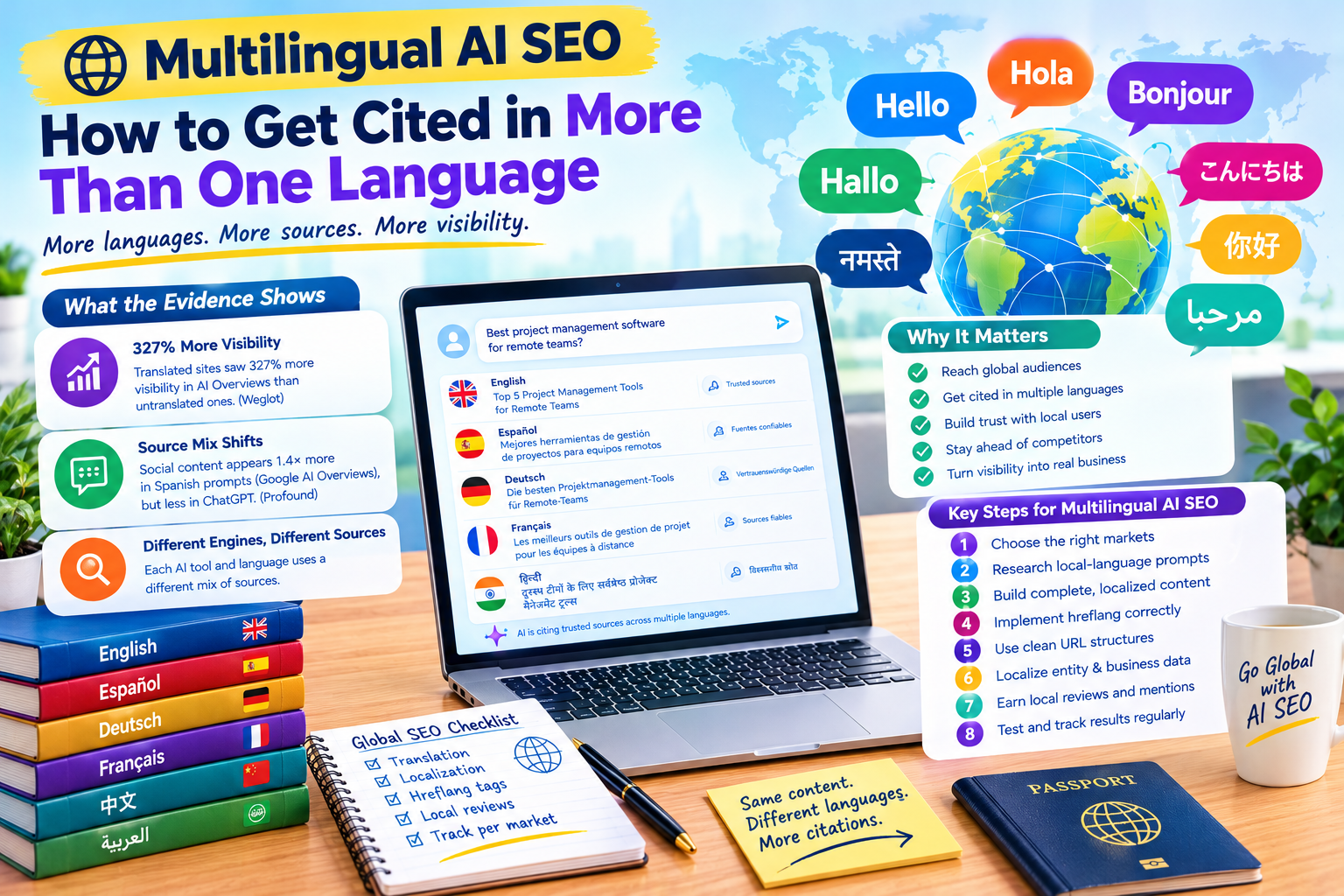
Most AI SEO advice is written, tested and measured in English. But a large share of the world asks questions in Spanish, Hindi, Arabic, Portuguese, German, Japanese and dozens of other languages, and the answers they receive can come from very different sources. If your site speaks one language, you may be invisible to everyone else.
The Evidence on Translation
The most-cited study comes from Weglot, a website translation vendor, which analyzed 1.3 million citations across Google AI Overviews and ChatGPT. Search Engine Journal reported its headline: translated sites saw 327% more visibility in AI Overviews than untranslated ones. In one sample, 98 untranslated Spanish sites received 17,094 citations for Spanish queries but only 2,810 for the equivalent English queries.
Two cautions apply. Weglot sells translation, so it benefits from this conclusion. And the finding is correlational: businesses that translate may also invest more in marketing generally. Still, the underlying logic is hard to dispute. When someone asks in Spanish, an engine is more likely to cite pages written in Spanish than to translate an English source on the fly.
AI Answers Change With the Language
Profound’s March 2026 study adds a deeper layer. It evaluated 3.25 billion citations across seven AI models in 14 countries, using English-speaking markets as a baseline. Among its findings:
- Source mix shifts by language. Spanish prompts surfaced social content at roughly 1.4 times the English rate in Google AI Overviews, but about half the English rate in ChatGPT.
- ChatGPT’s social citations drop outside English. Profound reports a fall from around 10% to 3–5% in every non-English market it studied, and attributes this to ChatGPT’s social pipeline being largely a Reddit pipeline, with Reddit being English-first.
The practical meaning is that a strategy proven in English can’t be copied across. The engines weigh sources differently in each language, so the same brand may have strong visibility in one market and almost none in another.
Where Multilingual Sites Go Wrong
Literal translation. Machine-translated text can read stiffly, misstate technical terms or lose the way local buyers actually phrase a need. A page that’s correct word for word may still fail to answer the question as asked in that market.
Wrong-language URLs. In practitioner testing published by Glenn Gabe, ChatGPT sometimes returned the US English version of a page even when translated versions existed. That is one person’s tests, not a rule, but it shows why you should verify what each engine actually cites.
Broken signals. Hreflang tags tell search engines which language or regional version to show. MultiLipi’s guide warns that canonical errors can make translated pages look like duplicates of the source language. This vendor-sourced claim matches long-standing international SEO practice, but check your own setup.
Thin localized sites. Translating only the homepage and a few product pages leaves the rest of your expertise stranded in one language.
Localize, Don’t Just Translate
At Sarkar SEO, we separate three levels of international work, and each adds more than the last.
Level 1: Translation. Convert the text accurately, using professional review for pages that matter commercially. Keep terminology consistent with how local audiences actually speak.
Level 2: Localization. Adapt examples, currency, units, regulations, payment methods, holidays, case studies and cultural references. A tax guide for Germany shouldn’t read like a US guide with German words.
Level 3: Market-native authority. Build presence in each market’s own ecosystem: local directories, review platforms, trade press, communities and, where relevant, regional search or messaging channels. Given Profound’s finding that engines draw on different source types by language, English-language reputation alone won’t carry you.
A Practical International Checklist
- Choose markets deliberately. Start with languages where you already have customers, sales support and delivery capability. A translated page you can’t fulfill creates a bad experience, not growth.
- Research prompts in the local language. Ask native speakers or local teammates how buyers phrase questions, because direct translations of English keywords often miss. Then test those prompts in ChatGPT, Gemini, Perplexity and Google’s AI features.
- Build complete sections, not fragments. Cover the questions a local buyer would ask end to end, including pricing, delivery, returns, legal terms and support.
- Implement hreflang carefully. Use reciprocal tags, consistent language and region codes, and self-referencing canonicals on each version. Audit regularly, since this is where silent errors appear.
- Use clean URL structures. Subfolders, subdomains or country domains all work if applied consistently. Don’t mix patterns.
- Localize your entity data. Keep business name, address, contact details and structured data accurate per market, with local-language descriptions where appropriate.
- Earn local proof. Collect reviews, testimonials and press mentions in the language of each market.
- Test per market, monthly. Record whether your brand is mentioned or cited, which language the cited page is in and whether the engine surfaces the right regional version.
Non-Latin Scripts and Right-to-Left Languages
Languages such as Arabic, Hebrew, Chinese, Japanese, Hindi and Russian bring extra technical care. Confirm that pages use proper character encoding, render correctly on mobile, set the right text direction and avoid embedding key text only in images. Competitive gaps are often larger in these languages because less quality content exists, which one practitioner guide on DEV Community suggests creates first-mover opportunities. Treat that as a hypothesis worth testing, not a guarantee.
Setting Expectations
Multilingual AI visibility takes longer than most teams expect. Translation can be done in weeks, but local reputation, reviews and press take months. Measure progress per market rather than in a single global number, because a gain in one language can hide a loss in another.
