



Few topics in search cause as much anxiety as click loss. Rankings look stable, yet traffic drops. Executives ask why, and the honest answer is that Google’s AI summaries now answer many questions before anyone reaches a website.
This article sets out what the research shows, where the studies disagree, and how to adjust your AI SEO plan so you’re not simply chasing a metric that has changed meaning.
What the Major Studies Found
Several independent teams have measured the effect, using different data and methods. The direction is consistent. The size is not.
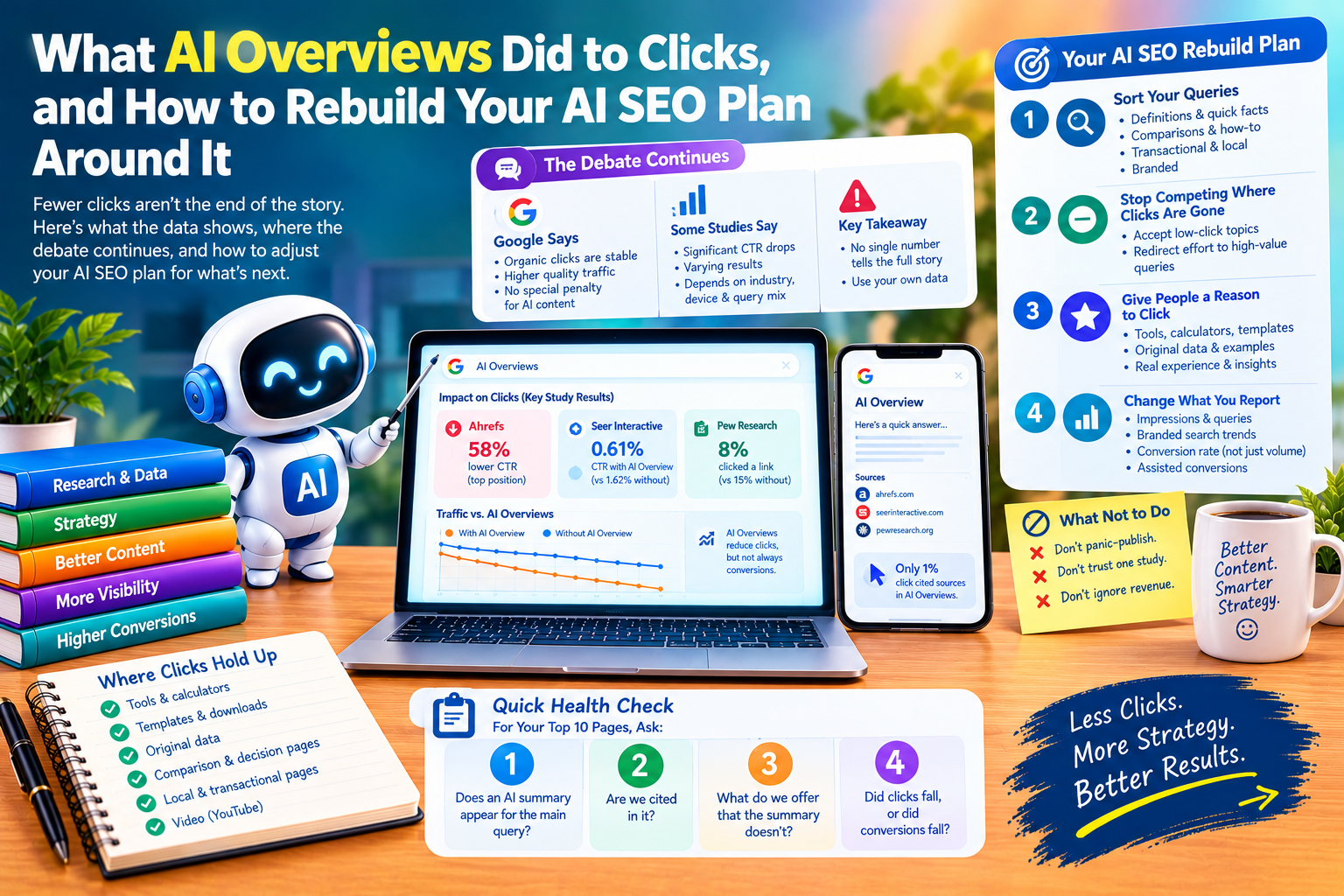
Ahrefs analyzed 300,000 keywords using Search Console data. Its February 2026 update found that AI Overviews correlate with a 58% lower click-through rate for the top-ranking page, up from a 34.5% reduction in its April 2025 version. The effect reaches beyond position one: roughly 50.8% lower at position 2, down to 19.4% at position 10.
Seer Interactive studied 53 brands over 5.47 million queries. One summary of its work reports that organic CTR on queries with an AI Overview sat at 0.61%, compared with 1.62% on queries without one. relevantaudience
Pew Research Center observed real browsing. According to one report, its panel of 900 US adults and 68,879 searches showed that only 8% of users clicked a link when an AI summary appeared, against 15% when it did not. The same study found people were more likely to end their browsing session after seeing a summary.
Where the Evidence Is Contested
It would be dishonest to present this as settled. Three caveats matter.
Google disagrees with the framing. It has said that, despite third-party reports, organic click volume from search to websites has remained consistent year over year, and that clicks are of higher quality. Google has access to data outsiders lack, but it has not published detail that would let others test the claim.
Not every analysis finds a large effect. One roundup notes an outlier meta-analysis arguing that AI Overviews have minimal impact on organic CTR. outerboxdesign
Numbers move. A 2026 analysis of the Seer data notes that the steep decline seen through much of 2025 did not continue in a straight line into early 2026, with CTR on affected queries recovering from 1.3% to 2.4% between December and February. Be wary of any single headline percentage.
A fair reading: informational queries have been hit hardest, effects vary by industry, and your own data matters more than any study average.
The Finding That Changes Strategy
The most useful result for practitioners concerns who gets the clicks that remain. Seer’s research reports that having your brand cited in AI Overviews leads to 35% higher organic click-through rates and 91% higher ad engagement. A later summary of Seer’s work puts another figure on it: cited pages earned 120% more organic clicks per impression than uncited pages. The two figures come from different studies and time periods, so treat them as directional.
Either way, the lesson holds. Visibility inside the summary and clicks outside it are linked. AI SEO is therefore partly a click-recovery strategy, not only a branding exercise.
A Four-Step Rebuild
Step 1: Sort your queries by exposure
Export your top queries from Search Console and group them:
- Definitions and quick facts: highest risk. The answer fits in a paragraph, so few people need to click.
- Comparisons and how-to questions: mixed. Summaries help, but readers often want detail.
- Transactional and local queries: typically lower exposure, though agent features may change this.
- Branded queries: protect these first.
Sarkar SEO begins most AI SEO audits with this triage, because it shows whether traffic is falling from search demand dropping or from answers appearing above you.
Step 2: Stop competing where clicks are gone
If a page exists only to define a term, accept that clicks will be scarce. Either make it the cited source, or redirect effort to queries where users need more than a paragraph. Don’t delete pages automatically, since they may support topical depth, but stop expecting them to carry traffic goals.
Step 3: Give people a reason to click after the summary
A summary can state a fact. It can’t easily give you a calculator, a downloadable template, original data, a tested comparison, a real photo or a worked example. Build the part of the answer that a paragraph can’t replace. This is the most reliable defense against click loss, and it overlaps with what makes content citation-worthy.
Step 4: Change what you report
If success means sessions alone, the story will look bleak. Add:
- Impressions and queries for affected pages
- Branded search trends
- Conversion rate, not just volume (fewer visits that convert better can beat more that don’t)
- Assisted conversions, where search is an early touchpoint
Seer’s own team says it shifted its KPIs toward share of voice, branded search, and other off-site interactions that influence conversions. Few teams need to go that far at once, but the principle is sound.
What Not to Do
Don’t panic-publish. More pages won’t reverse a structural change in behavior, and low-value volume carries its own risks.
Don’t trust one study. Pick the data closest to your market and test it against your own reports.
Don’t ignore revenue. A clean traffic chart that loses leads is worse than a falling chart that gains them.
A Quick Health Check
Answer these for your top ten pages:
- Does an AI summary appear for the main query?
- Are we cited in it?
- What does a reader get on our page that the summary doesn’t give?
- Did clicks fall, or did conversions fall?
The answers show where to invest. Sarkar SEO treats question four as the most important, because it separates a visibility problem from a business problem.
