



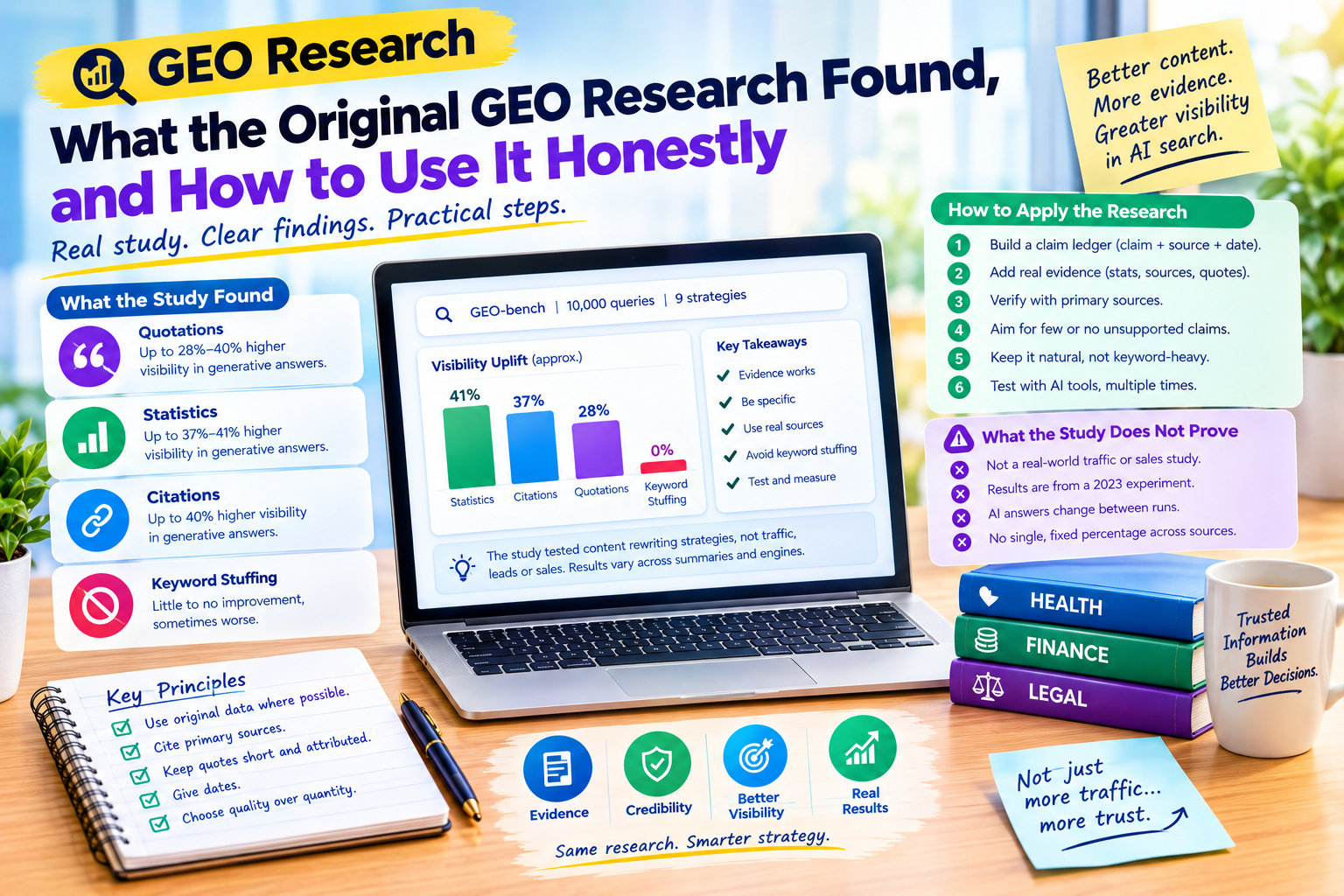
Any article about AI SEO eventually points to one study. Researchers from Princeton and other institutions published “GEO: Generative Engine Optimization” at KDD 2024, and almost every guide since quotes its “up to 40%” headline. Few explain what was actually tested or what the number does and does not mean. At Sarkar SEO, we think the study is worth understanding properly, because its practical lesson is simple and often ignored.
What the Researchers Did
The team built a benchmark and tested rewriting strategies on content. According to summaries, it was GEO-bench, comprising roughly 10,000 queries spanning multiple domains. They compared nine strategies against unoptimised content and measured how visible a source became inside a generated answer.
The headline result, as one review puts it, is that adding quotations, statistics or citations boosted visibility by up to 40% in generative engine responses. The same review notes that traditional keyword stuffing showed little to no improvement and sometimes performed worse than no optimization.
The Numbers Vary by Summary
Read the figures carefully, because secondary sources disagree. One account lists cite sources at +40%, statistics addition at +37% and quotation addition at +22%, while another gives statistics at +41% and quotations at +28%. A third describes the three leading methods as boosting visibility by 30-40% on one metric and 15-30% on subjective impression. The metrics differ, and the summaries are retellings. Rather than quote one number, say that these three methods performed best and that keyword stuffing did not. arxivliner
Why These Three Methods Work
The common thread is evidence. Statistics give an engine something specific to quote. Citations show where a claim comes from. Quotations from named experts add a voice that is not the page’s own. One commentary frames the lesson as information density, not keyword density.
That fits how generative engines work: they retrieve passages, combine them and attribute them. A passage with a checkable fact is easier to use than one full of general statements.
A Finding That Matters for Smaller Sites
One of the more interesting results concerned lower-ranked pages. A lecture summary of the paper says that for the cite-sources strategy, fifth-ranked sites saw a 115% visibility increase. Several guides repeat this, and the paper’s authors suggested the approach could democratise visibility. It is a promising idea for smaller publishers, though it comes from a controlled benchmark, not from your market, so test it yourself.
What the Study Does Not Prove
Treat the research as a strong hint, not a guarantee.
- It is an experiment. Results came from a benchmark and, according to one summary, from tests on Perplexity, where visibility improvements of up to 37% were measured. Real-world engines change often.
- It measures visibility inside an answer, not traffic, leads or sales.
- It dates from 2023 research, published in 2024. Engines and retrieval methods have changed since.
- Results are unstable. One review of the research warns that the same prompt asked twice returns different sources. tryhoverify
None of this makes the advice wrong. It makes the correct response a measured test, not a promise to a client.
Turning the Research into Practice
The following method is our own, built on the study’s direction. We call it a claim ledger.
For each important page, list every factual claim. Next to each, record the evidence, the source, its date and who verified it. Then work through three questions:
- Which claims have no support? Either add a source or soften or remove the claim.
- Where would a number help? Replace “many customers” with a figure you can defend, and state where it came from.
- Where would an expert voice help? Add a short quotation from a named person with their permission, or a clearly attributed view from a relevant authority.
As a rough working target, aim for few or no unsupported claims in any 500-word stretch of an important page. That threshold is our own rule of thumb, not a finding from the study.
Rules for Doing This Properly
Never invent evidence. A fabricated statistic or quote is worse than none. If you cannot verify it, leave it out.
Use original data where you can. Your own customer survey, product data or benchmark gives you something no one else can cite.
Cite primary sources. Link or name the regulator, study or dataset, not a blog repeating it. Check each figure against the original, because secondary summaries often garble numbers, as the table of variations above shows.
Keep quotations short and attributed. Quote a brief phrase and paraphrase the rest. Respect copyright and ask permission when quoting people directly.
Give dates. A statistic with a year is more useful and more honest.
Do not stack evidence for its own sake. A page packed with weak citations reads as padded. Choose the claims that matter.
Where Keyword Stuffing Fits Now
The study’s clearest negative result is also its most practical one. Repeating a phrase gains nothing in generative answers and may hurt. Use your main term where it reads naturally, then spend the saved effort on evidence and clarity.
A Simple Test
Pick six similar pages. Run the claim ledger on three and leave three alone. Ask the same buyer-worded questions in the AI tools your customers use, many times each, and compare how often each group is cited over several weeks. Our earlier article on reading AI visibility data explains why repeat runs matter. If both groups look alike, you have learned something useful and cheaply.
