



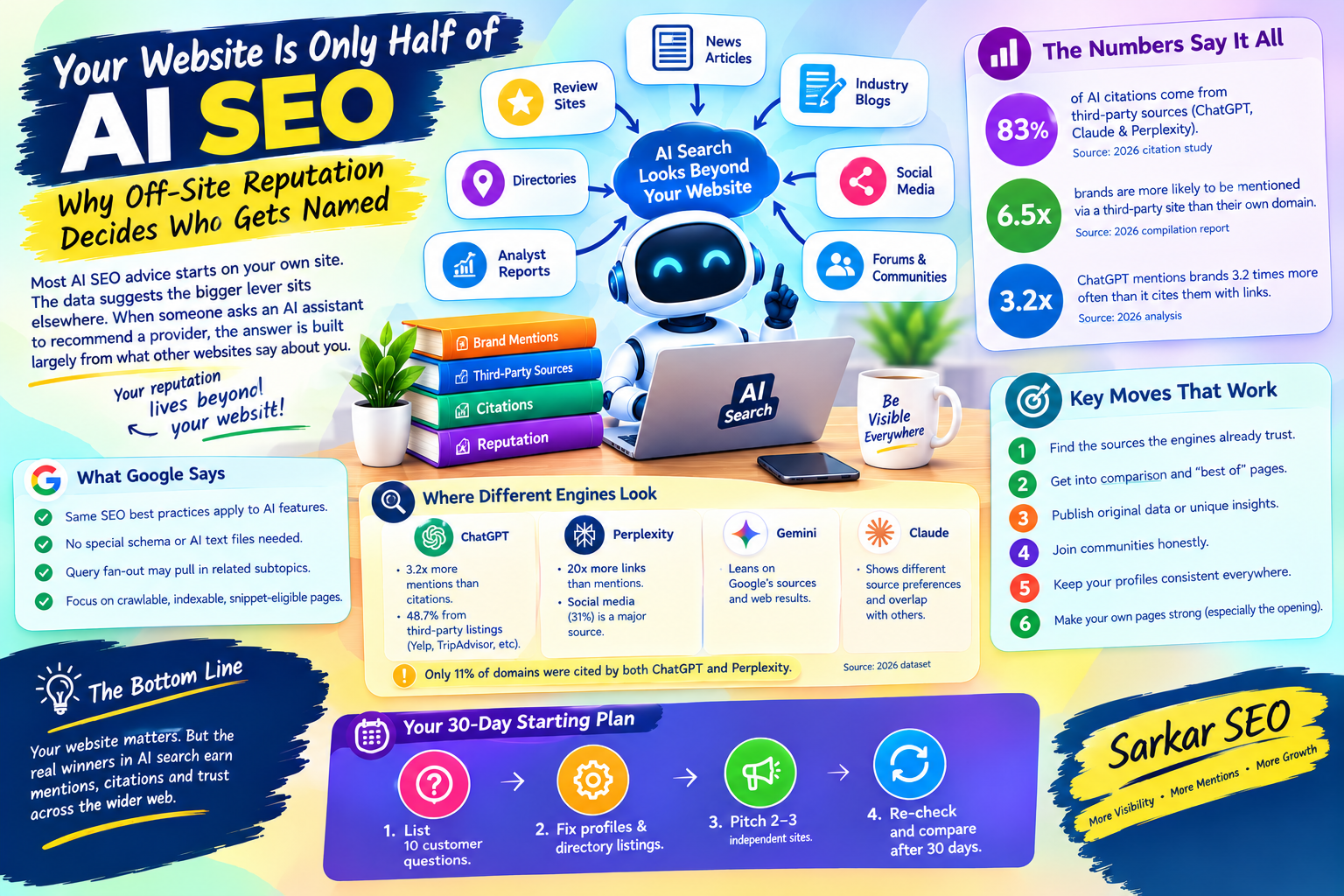
Most AI SEO advice starts on your own site. The data suggests the bigger lever sits elsewhere. When someone asks an AI assistant to recommend a provider, the answer is built largely from what other websites say about you. At Sarkar SEO, we think this is the most overlooked piece of AI SEO, so this article focuses on it.
The Pattern Across Citation Studies
Several analysts have counted where AI answers get their sources. One analysis of about 83,670 citations across ChatGPT, Claude and Perplexity found that roughly 83% of citations come from third-party sources such as review sites, news articles, analyst reports and industry blogs. Another compilation reports that brands are 6.5 times more likely to be mentioned through a third-party site than through their own domain. tryanalyzesearchengineland
The exact percentages differ between studies, and most come from vendors who sell tracking tools. Still, the direction is consistent: your own pages are a minority of the evidence AI systems use to describe you.
Mentions and Citations Are Different Things
A mention names your brand. A citation links to your page. They behave differently across platforms.
One tracker found that ChatGPT mentions brands about 3.2 times more often than it cites them with links. That means a customer may hear your name without ever seeing a URL. For that reader, your reputation has to carry the sale, because there may be no click to persuade them.
Perplexity leans the other way. The same comparison says it generates roughly 20 times more website links than brand-name mentions, so being a linkable source matters more there.
Each Engine Has Its Own Favourite Sources
Visibility on one platform does not transfer automatically. One dataset of 680 million citations found that only 11% of domains were cited by both ChatGPT and Perplexity.
The source mix also varies. Yext’s study of 6.8 million citations reportedly found that 48.7% of ChatGPT citations come from third-party listings such as Yelp, TripAdvisor and industry directories. For Perplexity, social platforms play a large part, with one data set putting 31% of its citations on social media, Reddit dominant. quickseoeverything-pr
So “do AI SEO” is too vague an instruction. A local service business and a B2B software firm will need to appear in very different places.
What to Do About It
- Find out which sources the engines already trust in your category.
Ask the questions your customers ask, such as “best accounting software for freelancers” or “top SEO agency for ecommerce,” and note which pages are cited. One practitioner guide recommends earning mentions on the pages ChatGPT already cites. That list becomes your outreach target list, and it is more useful than a generic link-building spreadsheet. - Get into the comparison articles, not just your own.
Comparison and “best of” pages written by independent sites carry weight. One analysis noted that in 81% of cases, the cited listicles were third-party rather than self-promoting. Your own “why we’re best” page is unlikely to compete. A fair mention in an independent roundup might. - Publish something worth quoting.
Original research gives other sites a reason to reference you. One source suggests that a single original data study can earn mentions across ten or twenty independent publications. A survey of your own customers, an anonymised analysis of your project data, or a benchmark nobody else has run all qualify. Only publish figures you can stand behind and explain how you collected them. - Take part in communities honestly.
Because forums and social platforms feed some engines heavily, genuine participation matters. Answer questions with real expertise, disclose your affiliation, and avoid scripted promotion. Communities spot astroturfing quickly, and a damaged reputation there is hard to repair. - Describe yourself consistently everywhere.
If your LinkedIn page, directory listings, press bio and website each say something different about what you do, systems have a muddier picture to summarise. Pick one clear sentence covering what you do, who for and where, then reuse it. Perplexity appears to favour company pages on LinkedIn: 59% of its LinkedIn citations come from Company Pages rather than individual posts. A complete company profile is cheap and worth doing. - Keep your own pages strong, especially the opening.
First-party content still matters. One analysis of 17 million citations found that most AI citations come from the first third of a cited page. Put your clearest, most useful material early, so the page earns its place when it is retrieved.
Read the Evidence Carefully
A few caveats keep this advice honest.
- Most of these studies measure correlation. One practitioner who ran their own tests admits that nobody has published a clean causal study yet. Strong brands may simply be mentioned more because they are already strong.
- Platform behaviour changes often. A source mix measured in early 2026 may look different by next quarter.
- Tools that track AI answers sample a small set of prompts, and answers vary between sessions. Treat single data points as hints, not verdicts.
- Large brands benefit from sheer volume. A smaller company should aim for a narrow area where it can become the obvious name, not for broad coverage.
A Simple 30-Day Plan
Week one, list ten questions your buyers ask and record which sources appear in AI answers. Week two, fix your profiles and directory listings so they say the same thing. Weeks three and four, pitch two or three of the independent sites you found, offering a useful contribution such as data, a quote or a correction, not a request for a plug. Then repeat the original questions a month later and compare.
