



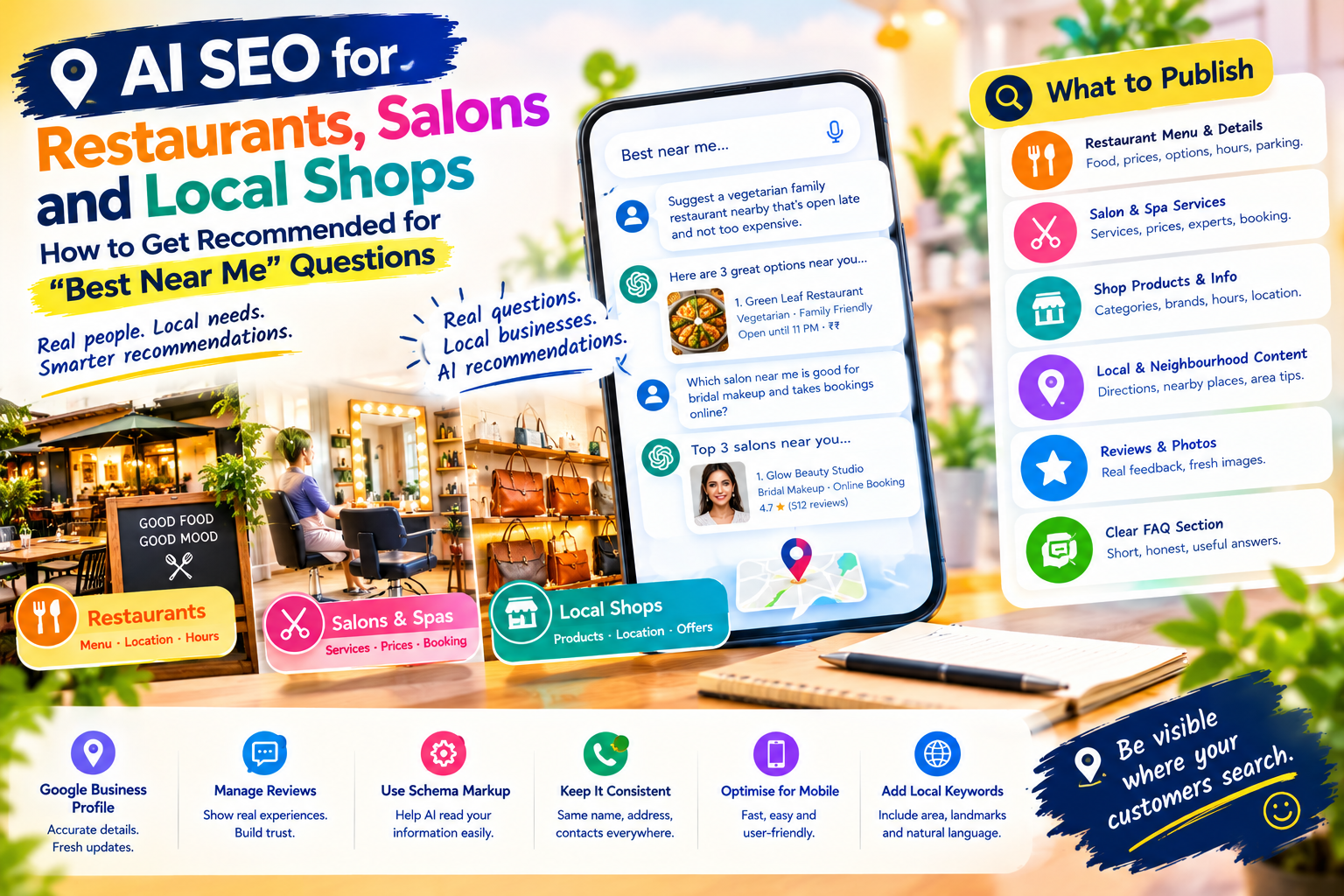
It’s 7 PM and someone types into an AI assistant: “Suggest a vegetarian family restaurant nearby that’s open late and not too expensive.” Another person asks, “Which salon near me is good for bridal makeup and takes bookings online?” A third wants “a shop that sells handmade leather bags in the city centre.”
These are quick, high-intent decisions, and the business named first often gets the visit. Here are the questions we hear most about AI SEO for restaurants, salons and local retail.
Why does AI SEO matter for everyday local businesses?
Because the decision window is short. Someone hungry or in a hurry doesn’t compare ten websites. They accept the first reasonable suggestion. AI assistants make that moment even faster by giving a short, confident list.
You don’t need a large budget to be on that list. You need accurate, specific information that an AI can read and trust.
What information should a restaurant publish online?
Think about what a hungry customer wants to know before leaving home:
- Full menu with dish names, descriptions and prices.
- Cuisine type, vegetarian, vegan or halal options and allergy information.
- Opening hours, including holidays and festival timings.
- Seating, family suitability, parking and accessibility.
- Booking, takeaway and delivery options.
- Signature dishes and what the place is known for.
Put this in plain text on your website, not only in a photo of a printed menu. An AI can’t reliably read a blurry image, but it can easily repeat a clear text line like “Pure vegetarian North Indian thali, open until 11 PM.” Sarkar SEO often finds that a text-based menu page is the quickest win for a restaurant.
What should a salon or spa publish?
Clients want to know exactly what you do and whether you suit them:
- Service list with a short description and starting price or price range.
- Specialities, such as bridal makeup, hair colouring, skin treatments or men’s grooming.
- Stylist or therapist profiles with experience and expertise.
- Booking method, cancellation rules and typical appointment duration.
- Hygiene practices and the brands or products you use.
Be specific. “Keratin treatment for long, frizzy hair, takes about three hours” gives an AI far more to work with than “premium hair services.”
How about local retail shops?
Retail customers often ask AI where to find something specific. Make that easy:
- List your main product categories and notable brands.
- Describe what makes you different, such as handmade items, wide size ranges or local sourcing.
- Share store hours, location landmarks and parking details.
- Mention services like gift wrapping, repairs, alterations or home delivery.
- Update stock highlights and seasonal ranges regularly.
If you sell online too, keep product details consistent between your shop, your website and any marketplace listings.
How important is Google Business Profile?
It’s probably your most valuable local asset. Many local recommendations connect back to it, so treat it carefully:
- Choose accurate main and secondary categories.
- Keep hours, phone number and address exactly the same as your website.
- Add the full menu or service list where the platform allows.
- Upload fresh, real photos of your space, food, work and team.
- Post updates about offers, events and new arrivals.
- Answer questions and respond to every review.
An active profile signals that the business is real, open and cared for. Sarkar SEO treats this profile as step one in any local AI visibility plan.
Do reviews and photos really influence recommendations?
Yes, strongly. AI tools learn from what customers say. A review that mentions “friendly staff, quick service and great paneer tikka” gives an AI useful details to repeat. A bare five-star rating gives it almost nothing.
Encourage customers to write specific reviews by asking simple questions: “What did you order?” or “What service did you enjoy most?” Reply politely to every review, including critical ones. Never buy or fake reviews, as it breaks platform rules and can damage your reputation.
Photos matter too. Real, recent images build trust with people and show that your business is active.
How do I answer “open now” and “near me” questions?
These questions depend on accurate, current details. Update your hours whenever they change, especially for festivals, holidays and special events. Add your area, nearby landmarks and directions on your website, for example, “Opposite the main market gate, with parking behind the building.”
Include natural Hindi or Hinglish wording in your FAQs where it suits your customers. Many people ask by voice or in mixed language, such as “Paas mein achha salon kaun sa hai jahan booking mil jaye?”
What does a good FAQ section look like for a local business?
Short, practical and honest. For a restaurant, it might cover: “Do you take reservations?”, “Is there a vegetarian menu?”, “Do you offer home delivery?” and “Is parking available?” For a salon: “Do I need an appointment?”, “How long does a haircut take?” and “Do you offer bridal packages?”
Start each answer with a direct reply, then add detail. Add FAQ schema so search and AI systems can read your answers cleanly.
How can I check whether AI recommends my business?
Try this simple monthly routine:
- Write 15 to 20 questions a nearby customer might ask, covering cuisine or service, budget, timing and occasion.
- Run them in ChatGPT, Gemini and Perplexity.
- Note which businesses appear and how they’re described.
- Fix the weakest areas first, then test again next month.
Answers change between runs, so repeat each question and look for patterns rather than single results.
What mistakes should local businesses avoid?
- Menus or price lists only in images.
- Outdated hours and closed-down branches still listed.
- Inconsistent names and addresses across platforms.
- Ignoring reviews.
- Copying generic descriptions that match every competitor.
Where should I start this week?
Do four things: replace image menus or price lists with clear text, check that your name, address and phone match everywhere, ask five happy customers for detailed reviews and write answers to your ten most common questions. If you’d like help turning this into a full plan, Sarkar SEO can audit your local AI visibility and show you what to fix first.
