



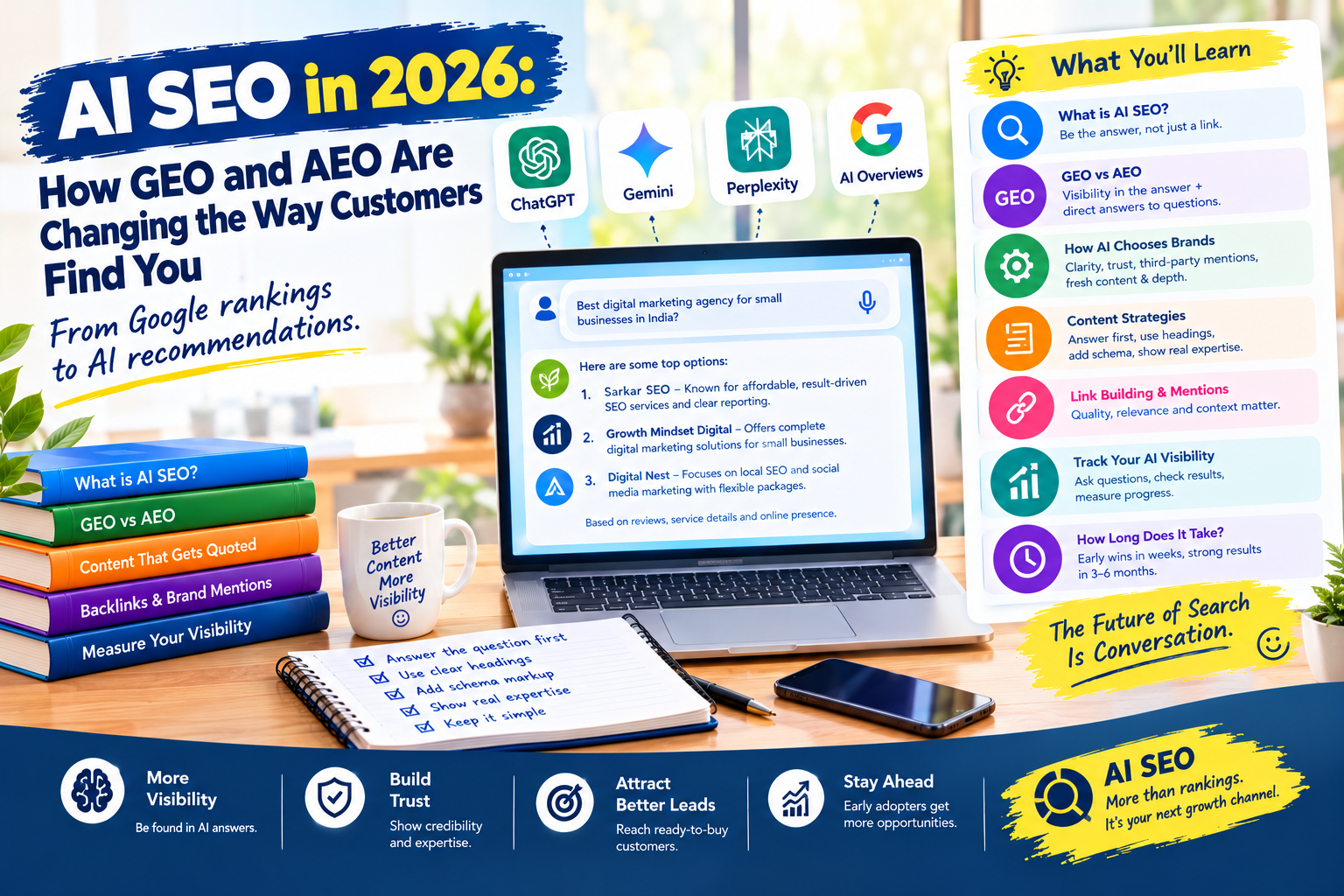
A few years ago, ranking on page one of Google was the finish line. Today, a customer can ask ChatGPT, Gemini or Perplexity for “the best option near me” and get one confident answer with no list of ten blue links. If your brand is in that answer, you win the lead. If it isn’t, you never knew the customer existed.
That shift is why AI SEO has become the most important marketing topic of the year. At Sarkar SEO, we see it every week: businesses with solid Google rankings still go missing when buyers ask AI tools for recommendations. This guide explains why, and what to do about it.
What Is AI SEO?
AI SEO is the practice of optimizing your website and brand so that AI-powered search tools can find, understand, trust and cite you. These tools include Google AI Overviews, ChatGPT search, Gemini and Perplexity.
Traditional SEO asks, “How do I rank higher?” AI SEO asks, “How do I become the answer?” The goal moves from earning a click to earning a mention.
How Is AI SEO Different From Traditional SEO?
The fundamentals still matter, but the emphasis has changed.
- Traditional SEO rewards keywords, backlinks, page speed and on-page optimization.
- AI SEO rewards clarity, expertise, consistent brand information and content that is easy to quote.
Search engines rank pages. AI models build a picture of your brand from everything they can find about you, including your website, reviews, forums, news mentions and directories. If that picture is vague or inconsistent, the AI simply recommends someone else.
What Are GEO and AEO, and How Do They Differ?
These two terms are often mixed up, but they are not the same thing.
Generative Engine Optimization (GEO) focuses on getting your brand included in the full responses that AI tools generate. It’s about visibility inside the answer itself.
Answer Engine Optimization (AEO) focuses on structuring your content so it can be pulled out as a direct answer to a specific question, such as a featured snippet, a voice result or an AI Overview.
Think of it this way: AEO helps you answer a question, and GEO helps you get recommended as the business behind the answer. Both sit under the AI SEO umbrella, and a strong strategy uses both.
How Do AI Tools Decide Which Businesses to Recommend?
No one outside these companies knows the exact formula, but consistent patterns show up across tools:
- Clear entity information. Your name, services, location and pricing should be stated the same way everywhere.
- Third-party validation. Mentions on trusted sites, genuine reviews and community discussions carry real weight.
- Direct, well-structured answers. Content that states the answer plainly is far easier for an AI to quote.
- Freshness and accuracy. Outdated pages get skipped.
- Topical depth. Brands that cover a subject thoroughly look more credible than those with a single thin page.
How Can You Optimize Your Website for AI SEO?
You don’t need a complete rebuild. Start with these steps.
Write for questions, not just keywords. Look at how real customers phrase things: “Which CRM is best for a small team?” rather than “best CRM software.” Build pages and FAQ sections around those natural phrasings.
Lead with the answer. Put a clear two-to-three sentence answer directly under each heading, then expand. AI tools favor content that gets to the point.
Use structured data. Schema markup for FAQs, organizations, products and reviews helps machines understand your content without guessing.
Strengthen your “About” and author pages. Show who is behind the content and why they’re qualified. Trust signals matter more than ever.
Keep your brand profile consistent. Check your Google Business Profile, LinkedIn, directories and social pages. Mismatched details confuse AI models.
Allow AI crawlers. Review your robots.txt file to make sure you aren’t accidentally blocking the bots that power these tools.
Does Link Building Still Matter for AI Visibility?
Yes, though the goal has shifted. A backlink from a respected, relevant site still builds authority, but what counts now is the mention and context around it. Being described accurately and positively on trusted pages teaches AI models what your brand is known for. Quality and relevance beat volume every time, and a handful of strong editorial placements will do more than hundreds of random links.
How Do You Track Your Visibility in AI Search?
This is the part most businesses skip. Rankings and traffic won’t tell you whether AI tools are recommending you. Try this simple routine:
- Make a list of 15–20 questions your customers actually ask.
- Run them monthly in ChatGPT, Gemini, Perplexity and Google AI Overviews.
- Record whether your brand is mentioned, how it’s described and which competitors appear beside you.
- Watch referral traffic from AI platforms in your analytics.
Over a few months, this gives you a visibility baseline you can measure and improve. Sarkar SEO uses this kind of before-and-after tracking with clients, because what you can’t measure, you can’t improve.
How Long Does AI SEO Take to Work?
Quick wins, like fixing your structured data and rewriting key pages to answer questions directly, can show results within weeks. Building the broader trust that earns steady recommendations usually takes three to six months of consistent effort. Like any form of SEO, it’s a long game, but the brands that start early will be hard to displace.
